Tuesday, 8 January 2013

Constantine the Great

NAME Constantine the Great

WHAT FAMOUS FOR Constantine the Great, also known as Constantine I or Saint Constantine, is celebrated as the first Roman emperor to convert to Christianity. His rule marked the rise of Christianity as a dominant faith within the Roman Empire, and he is credited with establishing Constantinople as a new capital and advancing religious tolerance with the Edict of Milan.

BIRTH Constantine was born on February 27, 272 AD in Naissus, in the Roman province of Moesia (modern-day Niš, Serbia).

FAMILY BACKGROUND He was the son of Flavius Valerius Constantius, a Roman army officer, who became Caesar, the deputy emperor in the West in 293 AD. His mother, Helena, who later became Saint Helena, was a Christian and is traditionally credited with discovering the True Cross in Jerusalem.

CHILDHOOD Constantine likely spent his early childhood in his birthplace, Naissus6. During this time, he would have been exposed to both his father's military career and his mother's influence. Helena, who later became a saint, is traditionally credited with introducing Constantine to Christianity

EDUCATION Constantine's education was multifaceted, combining formal studies with practical experience. He received a typical Roman education, including Latin literature, Greek language and literature, philosophy, and rhetoric. Given his father's position, he also received military training from an early age. As a youth, he was sent to the court of Emperor Diocletian in Nicomedia, where he gained exposure to imperial administration, interacted with pagan and Christian intellectuals, and observed political maneuvering.

Despite his education, Constantine was more comfortable with Latin than Greek. He later composed speeches in Latin and had them translated into Greek for delivery. During his time at Diocletian's court, he was exposed to both pagan and Christian influences, potentially attending lectures by the Christian scholar Lactantius. However, his full conversion to Christianity occurred later in life.

CAREER RECORD Rising through military ranks, Constantine served as a military tribune in the East under emperors Diocletian and Galerius. 

July 25, 306 Constantine's career as a ruler begins when he is proclaimed Augustus by his troops in York (Eboracum) following his father's death. However, Galerius only recognizes him as Caesar.

November 11, 308 AD At the Council of Carnuntum, Constantine is officially demoted to Caesar, though he continues to style himself as Augustus.

October 28, 312 AD Constantine defeats Maxentius at the Battle of Milvian Bridge. He entered Rome in triumph the next day. becoming the sole ruler of the Western Roman Empire.

February 313 AD Constantine and Licinius issue the Edict of Milan, granting religious tolerance to Christians.

314 AD: First civil war against Licinius, resulting in Constantine gaining control over the Balkans.

September 18 324 AD Constantine defeats Licinius at the Battle of Chrysopolis, becoming the sole emperor of the entire Roman Empire.

APPEARANCE Constantine was described as a tall and imposing figure with large, deeply set eyes that dominated his face. Unlike many previous emperors who wore beards, he preferred a clean-shaven look. His face was smooth with minimal creases, carved in simple planes. His hair was styled in a bowl cut, reminiscent of Emperor Trajan's hairstyle.

Head of a bronze colossus of Constantine by Wilfredor

FASHION As a Roman Emperor, Constantine followed the fashion trends of his time. This would have included wearing togas, tunics, and military attire.

In official depictions, Constantine was often shown wearing: A gold embellished crown adorned with pearls and emeralds, golden imperial robes, golden leather shoes and an oak-leaf crown, signifying his imperial status

As emperor, Constantine popularized luxurious attire among the clergy, presenting fine vestments to Christian bishops that rivaled pagan high priests' attire.

CHARACTER Constantine displayed a complex personality, at times ruthless, as evidenced by the execution of his eldest son Crispus and his wife Fausta under suspicious circumstances. He was also deeply religious, regularly engaging with bishops and showing a marked piety in later life.

Constantine was a skilled politician and a shrewd diplomat. 

Historical accounts suggest Constantine was an emotional person, prone to rage attacks but also easy to calm down.

SENSE OF HUMOUR Accounts of Constantine’s sense of humor are sparse, but his charisma and tact in dealings suggest he could be personable and engaging when needed.

RELATIONSHIPS Constantine married Fausta in 307 AD in Treverius (modern-day Trier, Germany). Fausta was about 17 or 18 years old at the time, while Constantine was about 15 years older. This was a political marriage that sealed an alliance between Constantine and Fausta's father, Emperor Maximian.

Initially, the marriage seems to have been successful. Constantine gradually came to appreciate Fausta and fell in love with her. They had a prolific marriage, producing five known children: three sons, Constantine II, Constantius II, and Constans, who would succeed him,and two daughters, Constantina and Helen.

There are indications that Constantine valued Fausta. In 324 AD, he awarded her the highly honorary title of Augusta and honored her by issuing coins in her name with the same title.

Despite the seemingly good start, the marriage ended tragically. In 326 AD, Constantine ordered the execution of his eldest son Crispus, followed shortly after by the execution of Fausta. The reasons for these executions remain a subject of historical debate.

Fausta, as Salus, holding her two sons, Constantine II and Constantius II by Saperaud Wikipedia 

MONEY AND FAME As the Roman Emperor, Constantine had immense wealth and power. He used his resources to fund public works projects, support the Church, and enhance his own image.

Constantine introduced a new gold coin, the solidus, which stabilized the economy and became a standard currency across Europe and the Byzantine Empire for centuries.

FOOD AND DRINK As Emperor, Constantine's meals would have been prepared by professional cooks and likely included exotic ingredients and elaborate dishes to showcase his wealth and status.

MUSIC AND ARTS Constantine promoted arts and architecture, famously constructing Constantinople, which became a cultural hub adorned with classical Greek sculptures and Christian art.

LITERATURE Constantine was interested in religious literature, particularly the Bible. He also supported the development of Christian theology and philosophy.

Though he was not a writer himself, Constantine valued religious discourse and hosted discussions with bishops. In his later years, he preached sermons in his palace, symbolizing his embrace of Christian teachings.

Constantine features heavily in historical accounts and Christian writings, often portrayed as a divine instrument for the faith. Eusebius of Caesarea’s Life of Constantine remains a key primary source, depicting him as a near-saintly figure chosen by God to lead Rome to Christianity. In Dante’s Divine Comedy, he appears in Paradiso as a ruler who changed the course of religious history.

NATURE Constantine’s foundation of Constantinople emphasized natural beauty, as the city’s location offered strategic views and lush surroundings along the Bosporus.

PETS As a Roman Emperor, Constantine would have had access to various animals, potentially including exotic ones, but these would likely have been for entertainment, hunting, or symbolic purposes rather than personal pets in the modern sense

HOBBIES AND SPORTS  Constantine was known for his interest in military strategy and likely trained regularly in martial skills. He also likely enjoyed traditional Roman pastimes such as hunting, horse racing, and chariot racing.

In 325AD Constantine tried to ban gladiatorial games. "Bloody spectacles displease Us," his decree begins. "We wholly forbid the existence of gladiators." this seems to have taken immediate effect in the east, but it was decades before blood sports were stamped out in Rome and the west. (1)

SCIENCE AND MATHS Constantine supported the use of solar dating for the Christian Sabbath and indirectly influenced the early Church’s study of astronomical cycles.

REIGN Constantine started his career under some pretty tough bosses, Diocletian and Galerius, fighting Persians and whatnot. But it was after his father died in 306 that things really got interesting.

The Council of Carnuntum, held in 308 AD, was a pivotal meeting in the history of the Tetrarchy, the Roman Empire’s system of shared rule, designed by Emperor Diocletian to prevent civil war and stabilize succession. The primary issues were rival claims to power in the West, particularly tensions between Constantine, who controlled Gaul and Britain, and Maxentius, who held Rome and Italy.

Convened by Emperor Galerius, the conference aimed to address the instability within the Roman Empire. At this gathering, Constantine was demoted from the rank of Augustus (senior emperor) to Caesar (junior emperor) a lower title, while Licinius, a trusted ally of Galerius (then the senior Augustus in the East), was appointed Augustus of the West. This demotion was a significant setback, as it stripped him of much of his authority and influence.  However, Constantine was not one to accept defeat easily. Despite the official demotion, he continued to style himself as Augustus, asserting his claim to the imperial title.

Constantine fought a bunch of civil wars and emerged victorious, becoming the sole ruler of the Roman Empire. Once in charge, he was a bit of a reformer. He restructured the government, introduced a new gold coin, and reorganized the army. He even went on successful campaigns against the Franks, the Alemanni, and the Goths.

Now, here’s where things get really fascinating. Constantine was a bit of a religious chameleon. He started as a pagan, then became a Christian, and even dabbled in Arianism before settling on a more orthodox form of Christianity. He issued the Edict of Milan, which legalized Christianity, and convened the First Council of Nicaea to define Christian doctrine. He even built the Church of the Holy Sepulchre in Jerusalem.

But what really cemented his legacy was his move of the capital from Rome to Byzantium, which he renamed Constantinople. This city would go on to be the heart of the Byzantine Empire for over a thousand years.

Constantine was a complex figure, a man of both action and faith. He shaped the course of Roman history and left an enduring mark on the world. So next time you think about the Roman Empire, remember Constantine the Great, the man who made Christianity cool, moved the capital, and basically changed the game.

PHILOSOPHY & THEOLOGY A complex spiritual journey led him from paganism to a Christian conversion, partly due to his vision before the Battle of Milvian Bridge in 312 AD. 

Constantine's journey to Christianity wasn't a sudden conversion but a gradual evolution. In his early years as emperor, his religious beliefs were a bit of a mixed bag. He was drawn to the idea of a single, supreme deity, and he even promoted Sol Invictus, the Unconquered Sun, as a symbol that could appeal to both pagans and Christians.

After his father's death in 306, found himself locked in a power struggle with Maxentius for control of the Western Roman Empire. Determined to settle the matter by force, Constantine prepared for the decisive Battle of Milvian Bridge in 312.

On the eve of the battle, as he crossed the Alps, Constantine experienced a divine vision. A luminous cross appeared in the sky, accompanied by the words "In this sign, you shall conquer." Interpreting this as a message from the Christian God, Constantine ordered his soldiers to paint the sign of the cross on their shields and standards. The ensuing battle was a resounding victory for Constantine. 

After the vision, Constantine began incorporating Christian symbols like the Chi-Rho into imperial imagery, including on the shields of his soldiers and on coinage.

In February 313, Constantine and Licinius issued the Edict of Milan. The two emperors met in Mediolanum (modern-day Milan) and agreed to end the persecution of Christians and grant religious tolerance throughout the Empire. It was formally promulgated in the Eastern Empire by Licinius on June 13, 313, through letters sent to provincial governors

Constantine decreed Sunday as the day of rest in the Roman Empire on March 7, 321 AD. This law mandated that courts, city dwellers, and trades should rest on "the venerable day of the Sun," while allowing agricultural work to continue if necessary.

As time went on, Constantine became increasingly aligned with Christian orthodoxy. He convened the Council of Nicaea on May 20, 325 AD, which helped to define the core beliefs of Christianity. After this point, he stopped promoting Sol Invictus and embraced a more traditional Christian perspective.

Constantine was baptized by Eusebius of Nicomedia, an Arian bishop, in 337 near Nicomedia He had put off baptism until he fell gravely ill in the spring of 337. Constantine initially wished to be baptized in the River Jordan, but as his condition deteriorated, he tried to return to Constantinople and was baptized on the journey. He received baptism, "putting off the imperial purple for the white robes of a neophyte," and died shortly after .

The delay in baptism was not uncommon for the time. Some historians suggest Constantine waited until the end of his life to be baptized so he could have all his sins forgiven at once, especially given the violent acts he had committed as emperor.

The Baptism of Constantine, as imagined by students of Raphael

Ultimately, Constantine believed that the Christian God had granted him victory in battle and favored his rule. While he increased tolerance for Christianity, he also placed limits on traditional Roman polytheism. His complex religious journey and political maneuvering shaped the course of the Roman Empire and the future of Christianity.

In 326 AD, Constantine's mother, Helena, embarked on a pilgrimage to the Holy Land. Her mission was to uncover the sacred relics associated with Jesus Christ. On September 14th of that year, a significant discovery was made: the True Cross, believed to be the actual cross upon which Jesus was crucified. This sacred relic was unearthed in Jerusalem.

Helena brought fragments of the True Cross, along with other holy relics, back to Rome. These precious artifacts were housed in a private chapel within her palace, where they remain to this day, a testament to her pilgrimage and a revered relic for generations of believers.

POLITICS Despite his support for Christianity, Constantine was a conservative leader who aimed to preserve the Roman Empire's traditions. His laws reflected Christian values but also maintained Roman legal principles.

Constantine's religious policies were often driven by political considerations. He saw religion as a tool to unite the empire and maintain stability. He balanced Christian and non-Christian officials in his government, showing a pragmatic approach.

Constantine shifted the empire’s power center eastward by founding Constantinople and was instrumental in endorsing Christianity as the empire’s primary religion.

SCANDAL The suspicious deaths of Constantine’s son, Crispus, and wife, Fausta, marked a significant scandal. Fausta was executed by suffocation after Crispus was put to death, both under allegations of conspiracy.

MILITARY RECORD Constantine, a skilled military commander, engaged in numerous campaigns throughout his reign. He began his career assisting his father in Britain and later defended Gaul from Frankish invaders. He also led successful raids and campaigns against the Bructeri, Franks, and other tribes along the Rhine.

The most significant campaigns of his reign were the civil wars against Maxentius and Licinius. Constantine's decisive victory at the Battle of Milvian Bridge in 312 marked a turning point in his career and the history of the Roman Empire. He later defeated Licinius in 314 and 316, ultimately becoming the sole ruler of the Roman Empire after triumphing at the Battle of Chrysopolis (modern Üsküdar, Turkey) in 324.

In addition to his civil wars, Constantine conducted successful campaigns against various tribes on the Roman frontiers, including the Franks, Alemanni, Goths, and Sarmatians. He reorganized the Roman army to improve its effectiveness, creating mobile units for offensive operations and frontier garrison troops for defense.

At the time of his death in 337, Constantine was preparing for a campaign against the Persians. His military prowess and strategic acumen were instrumental in maintaining the stability and security of the Roman Empire.

The Battle of the Milvian Bridge (1520–24) by Giulio Romano

HEALTH AND PHYSICAL FITNESS Constantine maintained his strength and military fitness, although his later years were marked by a serious illness that eventually claimed his life.

HOMES Constantine, during his reign, established various centers of power throughout the Roman Empire. Initially, he ruled from Trier in Gaul, a former Tetrarchic capital. However, he was a man of movement, setting up courts in cities such as Arles, Milan, Ticinum, Sirmium, and Serdica.

Rome, the traditional heart of the Empire, remained an important city for Constantine. He invested heavily in the city, constructing numerous monuments, including his iconic Arch and the churches of Saint Peter and Saint Paul. He even celebrated his twenty-year jubilee there.

In 324 AD, a pivotal moment arrived. Constantine consecrated Byzantium, renaming it Constantinople, and designating it as the new capital of the Roman Empire. The official dedication took place on May 11, 330 AD. He constructed a magnificent new imperial palace, solidifying Constantinople's status as the imperial center. The grand complex symbolized his legacy and devotion to the Christian faith.

The consecration of Constantinople. Image by Gemini

TRAVEL Constantine was a frequent traveler, crisscrossing the Roman Empire throughout his reign. He made his presence felt in major cities like Trier, Rome, Milan, Sirmium, and Constantinople. His journeys weren't just for pleasure; they were often tied to military campaigns and administrative duties.

He led expeditions against the Franks, Maxentius, Licinius, and various frontier tribes. Additionally, he undertook extensive administrative tours to oversee governance, attend councils, and implement reforms.

While specific details about his travel methods are scarce, we can make educated guesses based on Roman practices. He likely relied on the vast network of Roman roads, often traveling by horseback or in horse-drawn carriages. For longer sea journeys, ships were the mode of transport. The imperial post system, cursus publicus, would have facilitated rapid communication and travel across the empire.

During his travels, Constantine would have stayed in imperial palaces, military camps, or possibly private estates of wealthy supporters. He was always accompanied by a significant entourage, including personal guards, administrative staff, servants, and sometimes even family members.

Constantine’s reign was marked by travel across the empire, notably to Rome, Constantinople, Nicomedia, and the Holy Land, where his mother journeyed to retrieve Christian relics.

DEATH Constantine fell ill in 337 and sought to be baptized in the River Jordan. He received baptism shortly before his death in Achyron on May 22, 337. He was buried in the Church of the Holy Apostles in Constantinople.

After his death, there was a brief period of political maneuvering and a purge of other possible rivals from the imperial family. By September 9, 337, his three surviving sons — Constantine II, Constantius II, and Constans (all born to his wife Fausta) — were formally declared Augusti, dividing the empire among themselves. Constantine received Gaul, Britannia and Hispania, Constantius received Greece, Thrace, the Asian provinces and Egypt in the east and Constans the praetorian prefecture of Italy, which included Northern Africa. 

APPEARANCES IN MEDIA Constantine's media portrayals highlight his role as a transformative figure bridging old and new religious ideologies, with many of his life’s iconic moments—such as his vision of the cross, the Battle of the Milvian Bridge, and his role in the Council of Nicaea—serving as focal points for storytelling across multiple formats. They include:

1. Art: Medieval and Renaissance artworks frequently depict Constantine’s pivotal moments, especially his vision of the cross at the Battle of the Milvian Bridge. Frescoes by artists like Raphael in the Rooms of Constantine in the Vatican Palace celebrate these themes, illustrating him with the cross and in moments of divine favor.

2. Film and Television: Constantine the Great has been a prominent figure on film and television, symbolizing the transition from paganism to Christianity in the Roman Empire. They include.

Constantine and the Cross (1961), an Italian historical film, portrays him as a heroic and devout Christian emperor, focusing on his battle with Maxentius and conversion.

The History Channel's Rome: Rise and Fall of an Empire (2008) dramatizes Constantine’s reign and his role in shaping Christianity.

Constantine also appears as a character in A.D. The Bible Continues (2015), a miniseries exploring early Christianity's growth after the crucifixion, though more indirectly connected to Constantine.

3. Video Games: Constantine appears in various strategy games, such as Total War: Rome II and Civilization VI, often symbolizing leadership and military prowess, where players can assume his role or interact with his character to expand and Christianize their empires.

ACHIEVEMENTS  Constantine’s legacy includes:

Legalization of Christianity: His Edict of Milan marked a significant turning point in the history of Christianity.

Foundation of Constantinople: He established a new capital for the Roman Empire, which would last for centuries.

Military Victories: He secured numerous military victories that solidified his power and influence.

Patronage of the Arts: He supported the development of Christian art and architecture.

Source: (1) Bullies and Saints by John Dickson

Saturday, 5 January 2013

John Constable

NAME John Constable

WHAT FAMOUS FOR John Constable is renowned for his English landscape paintings that beautifully capture the pastoral scenes of Suffolk and Hampstead Heath. His works like The Hay Wain and Flatford Mill are celebrated for their realism and depiction of the English countryside's beauty.

BIRTH John Constable was born on June 11, 1776, in East Bergholt, a village on the River Stour in Suffolk, England.

FAMILY BACKGROUND He was the son of Golding Constable, a successful corn merchant who owned several windmills and watermills. Constable's family background was relatively affluent, which allowed him some support in pursuing his artistic career.

CHILDHOOD Constable grew up in East Bergholt, close to the natural landscapes that would later inspire his art. He was introduced to the workings of mills and the life of a miller, which influenced his deep connection to rural scenery.

EDUCATION John Constable's early education involved a brief stint at a private school in Lavenham, Suffolk, followed by enrollment at Dedham Grammar School in Essex. After completing his schooling, he initially assisted his father in the family's corn business. However, his burgeoning passion for art led him to pursue formal artistic training.

In 1799, at the age of 22, Constable convinced his father to allow him to study art professionally. He joined the Royal Academy Schools in London as a probationer. During his nearly 10-year tenure at the Royal Academy, Constable immersed himself in life drawing classes, anatomical dissections, and the study of Old Master paintings. He also frequently returned to his native Suffolk countryside to sketch and observe nature firsthand.

The Royal Academy provided Constable with a solid foundation in classical artistic techniques and exposed him to influential artists. While he absorbed these traditional elements, he ultimately developed a unique style that celebrated the direct observation of nature and the ever-changing Suffolk landscape.

CAREER RECORD Constable began by working in his father’s mill, later receiving financial support from his father to study at the Royal Academy.

Early 1800s: Began painting landscapes, focusing on the Stour Valley.   

1819: Exhibited The White Horse at the Royal Academy.   

1821: Exhibited The Hay Wain at the Royal Academy, which gained international recognition.

1820s-1830s: Produced many of his most famous works, including The Cornfield, The Leaping Horse, and Salisbury Cathedral from the Meadows.

APPEARANCE The portrait below shows a young Constable with a serious expression and a hint of a receding hairline.

John Constable by Daniel Gardner, 1796 by Stephencdickson

Constable's only known self-portrait, created in 1806, is a pencil drawing that now resides in the Tate Gallery in London.

FASHION : As the son of a wealthy corn merchant, Constable would likely have dressed in a manner befitting his social class, which means he probably wore well-made, fashionable clothing of the period.

As a landscape painter who often worked outdoors, Constable may have dressed practically for his work, possibly wearing clothes suitable for outdoor activities.

CHARACTER Constable was known for his dedication and passion for landscape painting, as well as his stubbornness, especially in pursuing his career against his father’s wishes. He was a complex individual who was deeply committed to his art, emotionally sensitive, and somewhat conflicted between his artistic vision and the desire for recognition.

SENSE OF HUMOUR Though not widely documented, Constable’s lightheartedness is reflected in his bright, lively landscapes, which some contemporaries saw as expressions of a gentle sense of humor.

RELATIONSHIPS John Constable's love story with his childhood friend Maria Bicknell was a passionate yet challenging one. They fell in love in 1809, but Maria's family, particularly her solicitor father, initially disapproved of the match, deeming Constable financially unsuitable. However after the death of Constable's parents he inherited a fifth share in the family business and Maria's father finally gave his consent to the marriage.

They wed on October 2, 1816 at St Martin-in-the-Fields in London. Constable and Maria went on a honeymoon tour of the south coast in October 1816, visiting Weymouth and Brighton. This trip to the seaside stimulated Constable to develop new techniques of brilliant color and vivacious brushwork.

Their marriage was a source of great happiness for Constable. However, Maria's health was fragile. During their 12-year marriage, she was continually pregnant, giving birth to seven children plus one miscarriage. Maria tragically passed away in 1829 at the age of 40, succumbing to consumption (tuberculosis). Her death deeply affected Constable, who wrote to his brother that "hourly do I feel the loss of my departed Angel." The devastating loss left a lasting impact on his life and art.

Maria Bicknell, painted by Constable in 1816. Tate Britain.

MONEY AND FAME Constable, despite his significant influence on French artists like Delacroix, struggled to gain recognition and financial success in his native England. His simple, naturalistic depictions of the English countryside often clashed with the prevailing artistic tastes of the time. While he achieved acclaim in France, where his work was celebrated and awarded, the British public remained largely indifferent.

His financial situation was precarious throughout his career. While his father's death in 1816 initially provided some financial security, a subsequent recession in 1826 led to the bankruptcy of his publishing house. Fortunately, an inheritance in 1828 allowed him to continue his artistic pursuits. However, his commercial success remained limited, with only twenty paintings sold in England during his lifetime. It wasn't until he was 52 that he was finally elected to the Royal Academy, a significant achievement but one that came late in his career.

In the end, it was in France that Constable's work truly resonated, leaving a lasting impact on the course of European art history.

FOOD AND DRINK Constable’s final meal before his death was a humble supper of bread, cheese, water, and bottled plums, reflecting his simple lifestyle.

MUSIC AND ARTS John Constable, a visionary artist, broke away from the traditional conventions of landscape painting in the early 19th century. While other artists of his time idealized and romanticized their subjects, Constable sought to capture the raw beauty and fleeting moments of the natural world. His bold and often unconventional style, characterized by loose brushstrokes and vivid colors, initially met with skepticism from his contemporaries.

In the early 1800s, Constable began to focus on plein-air painting, working directly from nature to capture the ever-changing effects of light and atmosphere. His fascination with the dynamic interplay of light, cloud, and wind led him to produce numerous sketches and studies. Inspired by the work of Rubens, Constable sought to imbue his landscapes with a sense of movement and energy.

Key Moments in Constable's Art Career:

1819: Constable exhibited his monumental six-foot painting, The White Horse, at the Royal Academy, where it was awarded a gold medal.

1820: He showcased Flatford Mill, a nostalgic depiction of his childhood home in Suffolk.

1821: The Hay Wain The painting was originally titled Landscape: Noon.When it was originally exhibited at the Royal Academy in 1821 it failed to find a buyer. However, it created a sensation at the Paris Salon, earning international acclaim for its innovative use of light and color.

The Hay Wain (1821). National Gallery, London.

Constable once wrote, "painting is but another word for feeling," indicating a strong emotional connection to his work.

Despite his artistic achievements, Constable faced numerous challenges during his lifetime. His work was often misunderstood and undervalued by the British public, who preferred more traditional styles of landscape painting. It wasn't until after his death that his true genius was recognized, and his influence on subsequent generations of artists became apparent.

In recent years, a controversy emerged when it was discovered that several works attributed to Constable were actually painted by other family members, including his son Lionel. This revelation has led to a reassessment of his oeuvre and a deeper understanding of his artistic practice.

LITERATURE  Constable was known to read widely, particularly poetry and sermons. He was acquainted with the Romantic poets William Wordsworth and Samuel Taylor Coleridge

Constable was an active correspondent, suggesting he enjoyed writing and maintaining relationships through letters.

His life and works were celebrated posthumously in Memoirs of the Life of John Constable, a biography by his friend Charles Robert Leslie, which remains a classic in art history.

NATURE Nature was central to Constable’s life and work. He loved Hampstead Heath and frequently painted scenes of Suffolk, Brighton, and the countryside.

Constable had a keen interest in geology and meteorology, which he studied to better understand and represent nature in his paintings

PETS Constable frequently depicted horses in his paintings, particularly in rural and working scenes. For example, The Leaping Horse (1825) features a horse prominently.

The Leaping Horse, 1825, oil on canvas, Royal Academy of Arts, London

HOBBIES AND SPORTS His primary “hobby” was painting landscapes, which he pursued as both a vocation and a lifelong passion.

Constable spent much time outdoors observing nature, which was both a professional necessity and a personal passion.

As part of his artistic development, Constable spent time studying and copying works of old masters, which was both a hobby and a learning exercise

SCIENCE AND MATHS Constable had a particular interest in the science of light and atmospheric effects, often experimenting with techniques to depict light and weather in his landscapes.

In the 1820s, Constable began to show interest in scientific methods and inquiry, which at the time was closely linked to theology. His detailed studies of clouds, flora, and fauna were aimed at understanding "God's great plan."

PHILOSOPHY & THEOLOGY John Constable, a devout Anglican, possessed a deep spiritual connection to the natural world. He viewed nature as a manifestation of divine purpose, a belief influenced by the ideas of natural theologians like William Paley. Constable saw God's presence in every aspect of the landscape, from the grandest mountains to the smallest flower.

His paintings often convey a sense of awe and wonder, capturing the sublime beauty of the English countryside. Through his art, he sought to reveal the divine qualities inherent in nature, elevating landscapes to the status of religious icons. Constable's reverence for the natural world is evident in his countless studies of trees, clouds, and water, which he meticulously observed and recorded.

Constable's artistic philosophy was rooted in a belief in the interconnectedness of art, science, and nature. He viewed landscape painting as a form of natural philosophy, a means of understanding and interpreting the world around him. By capturing the fleeting effects of light and atmosphere, he sought to reveal the underlying order and harmony of the universe.

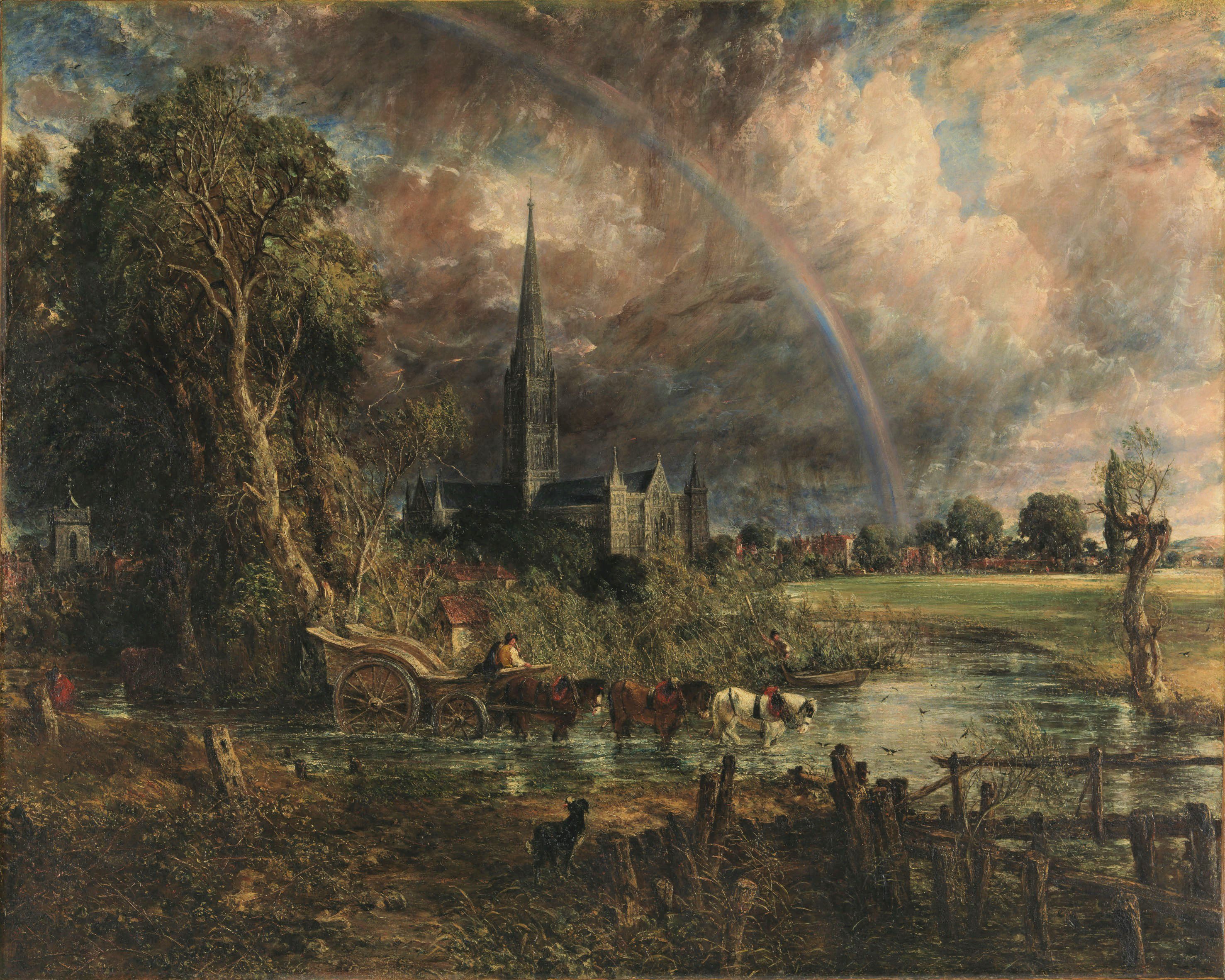
Constable valued tradition and stability. He believed in the importance of the Church of England and the agrarian way of life. His paintings often feature church towers and rural landscapes, symbolizing the enduring values of the English countryside.

Salisbury Cathedral from the Meadows (1831). Tate Britain.

POLITICS Constable was a Tory who believed in the traditional "rightness" of the English countryside and its practices. He saw a stable agriculture as the foundation for a prosperous and stable society 

SCANDAL Although not scandalous by nature, Constable’s lack of success in England compared to France led to some controversy among British art critics who struggled to appreciate his rural scenes.

HEALTH AND PHYSICAL FITNESS He faced significant health challenges following the death of his wife, Maria, who left him as a single father to seven children. This period took a toll on his health and well-being.

Constable struggled with the lack of recognition in England during his lifetime, which affected his mood and self-esteem

HOMES , Constable's painting Flatford Mill (Scene on a Navigable River) depicts a view toward his father's mill at Flatford. This painting was one of Constable's most ambitious to date, showing working life along the river he knew well from his childhood. The area around Flatford and Dedham Vale featured in many of Constable's most famous works. He said he "should paint his own places best."

John Constable - Flatford Mill

Constable made Hampstead his home for many years. Initially, he rented a house on Hampstead Heath, spending most summers there from 1819 onwards. In 1827, he and his family moved permanently to Hampstead, settling in a house on Lower Terrace.

The move to Hampstead was motivated by a desire to improve Maria's health. The cleaner air and peaceful environment of the village were believed to be beneficial for her. Constable grew to love the picturesque landscapes of Hampstead Heath, which frequently appear in his paintings. 

TRAVEL Constable, like many of his contemporaries, sought inspiration from the dramatic landscapes of Britain. He ventured to the Peak District in 1801 and the Lake District in 1806, immersing himself in the grandeur of these natural wonders.

During his honeymoon in 1816, Constable and his wife Maria visited Osmington, a picturesque village near Weymouth. There, he captured the beauty of the coastline, creating numerous oil sketches, drawings, and watercolors of the local coves and seascapes.

In the 1820s, the Constables frequently visited Brighton, hoping that the sea air would benefit Maria's health. While there, Constable produced a series of oil sketches, capturing the dynamic energy of the sea and the vibrant colors of the coastal landscape. Despite the therapeutic benefits of the seaside, Constable found the town itself rather uninspiring. He complained about the crowds and the lack of artistic opportunities, often expressing frustration in his letters to friends.

While Constable's work was celebrated in France, he never visited the country himself. His aversion to the French was so strong that he refused to travel to Paris to collect the gold medals awarded to him by the French king.

DEATH John Constable passed away on the night of March 31, 1837, at the age of 60. He died in the attic of his studio on Charlotte Street in Bloomsbury, London, reportedly from heart failure or indigestion. 

Constable was laid to rest in the graveyard of St John-at-Hampstead Church in Hampstead, London. He was buried alongside his wife, Maria Elizabeth Bicknell, who had predeceased him in 1828 due to tuberculosis. Their family tomb also contains several of their children, except for their eldest son, John Charles Constable, who did not attend the funeral due to illness and emotional distress. (1)

APPEARANCES IN MEDIA Constable's legacy was later celebrated through various exhibitions, and Leslie’s Memoirs of the Life of John Constable helped secure his place in art history.

In the 21st century, Constable’s life and work have been explored in documentaries such as Constable: A Country Rebel (BBC) and Constable in Love (BBC), which delve into his artistic legacy and personal life. His career and relationship with his contemporaries, particularly J.M.W. Turner, have also been examined in documentaries like The Art of the Landscape, highlighting the Romantic landscape painting movement.

Constable has appeared as a character in dramatizations of British art history. For instance, The Genius of Turner and Romantics & Revolutionaries include portrayals of Constable, focusing on his rivalry with Turner and his contributions to Romanticism.

ACHIEVEMENTS Constable’s major works, such as The Hay Wain and Flatford Mill, are celebrated as masterpieces of British art, known for their innovation in landscape painting. His legacy endures through his influence on both British and French art, despite only achieving fame in his homeland posthumously.

Source (1) Flatford and Constable

Tuesday, 1 January 2013

Joseph Conrad

NAME Joseph Conrad (born Józef Teodor Konrad Korzeniowski)

WHAT FAMOUS FOR Joseph Conrad is celebrated as one of the greatest English novelists. A master of psychological realism, Conrad is renowned for his exploration of the human condition, particularly in the context of isolation, moral ambiguity, and the psychological impact of colonialism. His novels are characterized by their complex narratives, vivid imagery, and deep psychological insights.

BIRTH December 3, 1857, in Berdychiv, a town in present-day Ukraine that was part of the Kingdom of Poland before 1793 and was under Russian control at the time of his birth.

FAMILY BACKGROUND Conrad was born to Polish nobility with strong literary and patriotic ties. His parents, Apollo and Ewa Korzeniowski, were ardent supporters of Polish independence and were involved in revolutionary activities. His father was a writer and translator who influenced Conrad's later passion for literature.

CHILDHOOD Conrad’s early years were marked by political turbulence and personal loss. His parents’ activism led to their arrest and exile by Russian authorities. His mother died of tuberculosis when he was only seven, and his father died of the same disease when Conrad was eleven, leaving him orphaned at a young age.

EDUCATION Joseph Conrad's early education was primarily overseen by his father, Apollo Korzeniowski. As a young boy, Conrad was exposed to literature through his father, who translated works by Shakespeare and Victor Hugo. This early exposure to great literary works in Polish and French laid the foundation for Conrad's future as a writer.

Conrad's formal schooling was sporadic and limited: He briefly attended school in Krakow, Poland and also spent some time studying in Switzerland However, Conrad found traditional schooling boring and was not a particularly enthusiastic student. His uncle, Tadeusz Bobrowski, who became his guardian after his parents' deaths, attempted to provide him with a more structured education.

Due to his poor health and unsatisfactory performance in school, Conrad received a significant portion of his education through private tutoring. This individualized approach allowed for a more flexible curriculum, though it did not necessarily lead to academic excellence. Conrad reportedly excelled only in geography during this period.

Despite his irregular formal education, Conrad developed impressive linguistic abilities and became fluent in French with a correct accent. He also had some knowledge of Latin, German, and Greek

Much of Conrad's practical education came from his experiences as a sailor. At the age of 16, he left Poland to pursue a maritime career. His years at sea provided him with a wealth of knowledge about different cultures, geography, and human nature, which would later inform his writing.

CAREER RECORD 

1874 On October 13, 1874 Conrad's Uncle Tadeusz sent him to Marseilles, France, to start a career as a merchant sailor, He provided him with a monthly stipend of 150 francs.

1878 Conrad joined the British merchant marine, eventually becoming a captain and serving under the Red Ensign for fifteen years. His seafaring experiences deeply influenced his writing, particularly in Heart of Darkness and Lord Jim

1894 Conrad retired from the sea, largely due to health issues and the increasing pull of his literary ambitions.

1895 Conrad published his first novel, Almayer's Folly. His subsequent works, including Heart of Darkness, Lord Jim, and Nostromo, solidified his reputation as a major literary figure.

APPEARANCE Joseph Conrad was a man of striking physical presence. He was of medium height, but his build was robust and compact, giving him a solid and imposing stature. As he aged, his figure became more portly, adding to his distinctive appearance.

His face was characterized by strong features. A broad forehead hinted at his intellectual depth, while his deep-set eyes held a penetrating gaze. His thick, dark mustache was a prominent facial feature, contributing to his overall rugged and distinctive look.

Some observers, perhaps struck by the contrast between his physical strength and a certain grace, likened Conrad to "a trained baby elephant." This comparison, while unusual, captures the essence of his physical appearance: a sturdy, imposing figure with an underlying sense of poise and intelligence. 

Conrad in 1904 by George Charles Beresford

FASHION Conrad dressed elegantly but conservatively, often in styles that reflected his naval career, preferring simple, well-tailored attire rather than following fashion trends.

CHARACTER Described as introspective and intensely private, Conrad was a man of paradoxes. He was deeply empathetic yet skeptical, with a keen awareness of human failings. His difficult early life and seafaring years shaped his often philosophical and pessimistic worldview and his bouts of melancholy.

SENSE OF HUMOUR Though Conrad’s humor was subtle, he enjoyed wit and irony, often using humor to illustrate the absurdities of human nature and the contradictions of modern society.

Conrad uses wit to criticize imperialism, as seen in this quote from Heart of Darkness: "The conquest of the earth, which mostly means the taking it away from those who have a different complexion or slightly flatter noses than ourselves, is not a pretty thing when you look into it too much." This line employs subtle humor to highlight the absurdity and injustice of colonial practices.

Conrad repeatedly uses the phrase "dead hippo" in serious contexts, which creates a humorous effect due to the word's inherent silliness in English. For example, in Heart of Darkness, Marlow solemnly states, "you can't breathe dead hippo waking, sleeping, and eating, and at the same time keep your precarious grip on existence." The repetition of this phrase in grave situations creates a comical contrast.

RELATIONSHIPS Joseph Conrad married Jessie George, an Englishwoman, on March 24, 1896 in an English registry office. his civil ceremony was considered unusual for the time.

The two first met in 1894 when she was working as a typist for the Calligraph Company and living with her widowed mother. The wedding took place shortly after Conrad's sudden proposal on the steps of the National Gallery. She was 23 years old at the time of their marriage and Conrad 38 years old. (1)

The couple had two sons together, named Borys and John.

This marriage marked a significant point in Conrad's personal life, as he settled into a more stable domestic situation after his years at sea. Despite challenges in their marriage, especially regarding his health and financial instability, they remained together until his death.

Joseph Conrad had several notable friendships throughout his life, particularly with other writers and intellectuals. Ford Madox Ford was a close friend and collaborator. They worked together on the novel Romance (1904) and shared ideas about literary impressionism. Other prominent writer friends included John Galsworthy and H.G. Wells.

MONEY AND FAME Conrad struggled financially for much of his life. While he eventually achieved fame and critical acclaim, he often relied on advances from publishers and loans from friends to support his family. His gambling debts in his youth nearly led to disaster when, in 1878, he attempted suicide but was saved by his uncle, who helped pay off his debts.

FOOD AND DRINK  As a sailor, Conrad would have been accustomed to simple, hearty meals. Later, after settling in England, Conrad likely adapted to British cuisine of the late Victorian and Edwardian eras. His struggles with gout suggest he may have enjoyed rich foods and alcohol, as these were often associated with the condition.

MUSIC AND ARTS While not especially noted for an interest in music, Conrad had a deep appreciation for the arts, particularly visual art, admiring painters for their ability to capture complex, layered emotions in a single image.

LITERATURE Conrad measured the reviews of his books with a ruler, judging the quality of feedback by the length of the reviews. Despite this seemingly objective approach, he often felt deeply about literary criticism, valuing the respect of his peers. Writing in English, his third language, Conrad developed a unique narrative style that blended intricate language with profound psychological insight.

Joseph Conrad, a man who seemed to have wandered in from some exotic, far-flung corner of the British Empire, was actually a Polish fellow who didn’t speak a word of English until he was well into his twenties. A bit of a late bloomer, you might say. Yet, he not only learned the language but became one of its greatest masters, bringing a unique, foreign perspective to English literature.

Conrad’s stories and novels are filled with exotic locales, perilous sea voyages, and morally ambiguous characters. He had a knack for taking ordinary situations and turning them into gripping tales of human frailty and the darker side of the human soul. His writing style is often described as impressionistic, a kind of literary pointillism that paints vivid pictures with words.

While he was writing at the height of British imperial power, Conrad’s work often challenged the very foundations of the empire. His novels often exposed the darker side of colonialism, the psychological toll it took on both the colonizers and the colonized. He was a keen observer of human nature, a master of the psychological novel, and a writer who continues to fascinate and disturb readers to this day.

NATURE The natural world had a special place in Conrad’s work, especially the sea. His portrayal of nature often highlighted its unpredictable and dangerous beauty, reflecting his years as a seaman.

PETS While living in India, Conrad owned a pet monkey. However, he didn't keep the monkey for long after returning to England. The monkey's fate was sealed when it destroyed some of Conrad's papers, prompting the author to sell it

Conrad was known to have a pet bulldog, whom he was fond of, reflecting his somewhat rugged and stoic personality.

HOBBIES AND SPORTS Aside from writing, Conrad enjoyed traveling, though his extensive maritime career somewhat lessened his enthusiasm for travel as a leisure activity. He also appreciated walks in nature, finding inspiration in quiet, scenic settings.

SCIENCE AND MATHS As a former sailor, Conrad possessed a sound knowledge of navigation and marine sciences, which he applied in his literary descriptions of sea life and maritime adventures.

PHILOSOPHY & THEOLOGY Conrad's philosophy was characterized by religious skepticism, humanist ethics, a belief in absolute truth, and a focus on individual moral responsibility, all underpinned by a strong sense of skepticism towards dogmatic thinking. His writings reflect a deep awareness of human isolation, struggle, and moral ambiguity.

POLITICS Conrad was wary of politics, often expressing skepticism towards nationalist and imperialist agendas, despite his parents’ Polish patriotism. His ambivalence toward political ideology is visible in works like Nostromo, which critiques imperialism.

SCANDAL In March 1878, at the conclusion of his tenure in Marseilles, France, a 20-year-old Joseph Conrad faced a profound personal crisis. Struggling with significant gambling debts and battling depression, Conrad attempted to take his own life by shooting himself in the chest with a revolver. Fortunately, the attempt was unsuccessful, and he survived the ordeal. His uncle, Tadeusz Bobrowski, was swiftly summoned by a concerned friend and came to his rescue, paying off Conrad's debts and preventing further tragedy.

This harrowing event marked the end of Conrad's time in France. In April 1878, shortly after the suicide attempt, he enlisted as a British merchant marine, a move that would eventually pave the way for his illustrious literary career. In an effort to protect his reputation, Conrad later concealed the true nature of the incident, falsely attributing his injury to a duel—a fabrication likely influenced by the stigma surrounding suicide attempts within his Polish aristocratic and Catholic upbringing.

The reality of Conrad's suicide attempt remained hidden from the public eye until the 1950s, when a letter from his uncle detailing the incident was discovered. This revelation provided deeper insight into a pivotal moment in Conrad's life, highlighting the struggles he overcame and the resilience that would later be reflected in his profound literary works. 

MILITARY RECORD Though Conrad never served in the military, he held a fascination with the discipline and hierarchy inherent in naval life, often incorporating these themes into his novels.

HEALTH AND PHYSICAL FITNESS Throughout his life, Conrad suffered from recurring health problems, including bouts of depression, exhaustion, and gout, which were exacerbated by the physical demands of his early seafaring career and later his intense writing schedule.

HOMES Conrad lived in various places in Poland and Ukraine as a child due to his family's political activism and exile. 

Nowy Świat 47, Warsaw, where Conrad lived with his parents in 1861 by Wistula

While Conrad traveled extensively during his seafaring years, he spent the latter part of his life (from 1896 onwards) primarily living in the Kent countryside in England, with his final decades spent in Bishopsbourne near Canterbury. His last home was called "Oswalds" in Bishopsbourne and the village hall is called "Conrad Hall" in his honour.

TRAVEL Conrad’s travels spanned continents, with his most significant journeys being the maritime adventures that inspired many of his novels. His journeys included voyages to Asia, Africa, and South America, which provided rich material for his storytelling.

DEATH Conrad died on August 3, 1924, at the age of 66 at his house, Oswalds, probably of a heart attack. He was buried in Canterbury Cemetery. His gravestone bears the words “Sleep after toyle, port after stormie seas,” a fitting tribute to his life.


APPEARANCES IN MEDIA Joseph Conrad’s works and life have influenced various forms of media, especially films, television, and even video games, thanks to his enduring themes of human nature, morality, and adventure. Here are some notable appearances and adaptations of his work:

1. Film Adaptations

Heart of Darkness (1939): Originally intended to be adapted by Orson Welles, this project was ultimately abandoned, but it later influenced other films, especially in terms of atmosphere and themes.

Apocalypse Now (1979): One of the most famous Conrad-inspired adaptations, Francis Ford Coppola’s Apocalypse Now is a loose retelling of Heart of Darkness, set during the Vietnam War. In place of Conrad’s protagonist Marlow, Captain Willard searches for the elusive Colonel Kurtz, mirroring Marlow’s journey in Heart of Darkness.

The Secret Agent (1996): This film, starring Bob Hoskins, Patricia Arquette, and Gerard Depardieu, is a direct adaptation of Conrad’s novel The Secret Agent, exploring themes of political terrorism and anarchism.

Conrad’s work has influenced many filmmakers. The spaceship Nostromo in the 1979 sci-fi film Alien is named after the shipmate in his novel Nostromo, and the Sulaco in Aliens takes its name from the port town in the same novel.

2. Television Appearances

Heart of Darkness (1993): A made-for-TV film adaptation starring Tim Roth and John Malkovich, this more faithful adaptation of Heart of Darkness follows Conrad’s original story of Marlow’s journey into the Congo.

Nostromo (1996): Nostromo, Conrad’s novel set in a fictional South American country, was adapted into a BBC television miniseries, featuring an international cast, including Claudio Amendola and Colin Firth.

The 2014 BBC documentary-drama The Real Marigold Hotel briefly discusses Conrad’s life as part of a series on influential British writers, acknowledging his contribution to English literature despite not being a native English speaker.

3. Video Game Adaptations: 

Conrad’s influence extends into video games, with Heart of Darkness inspiring the atmospheric themes of psychological horror games like Spec Ops: The Line (2012), which follows a plot similar to Heart of Darkness with soldiers facing moral degradation in a foreign desert setting.

4. Music References

Musical References: Musicians and bands have referenced Conrad's works, especially Heart of Darkness, in song lyrics, often as metaphors for inner struggles or existential journeys.

ACHIEVEMENTS Conrad’s influence on English literature is profound. His works are lauded for their deep psychological insight and complex characters, and his achievements are especially remarkable given that he wrote in English, his third language. His unique perspective brought a fresh depth to themes of isolation, existentialism, and human morality, earning him a lasting place in literary history.

Source (1) Sothebys

Saturday, 29 December 2012

Sean Connery

NAME Thomas Sean Connery

WHAT FAMOUS FOR Sean Connery is best known for his role as James Bond, originating the suave British secret agent on screen in Dr. No (1962) and solidifying the Bond character's legacy across seven films in the franchise. His career spanned six decades, making him a celebrated figure in cinema history.

BIRTH Connery was born on August 25, 1930, in Fountainbridge, Edinburgh, Scotland.

FAMILY BACKGROUND Raised in a working-class family, Connery's father was a lorry driver, and his mother was a cleaning lady. He grew up in poverty, which instilled in him a strong work ethic and sense of resilience. The family lived in an overcrowded tenement flat, and as a young child, Connery's cot was reportedly the bottom drawer of a cupboard.

CHILDHOOD Connery began working at an early age to support his family, taking on a milk delivery job around Edinburgh. One of his delivery stops was Fettes School, where, according to Bond creator Ian Fleming, Bond himself would later be "sent" following expulsion from Eton.

EDUCATION Connery's formal education was limited. He attended Tollcross elementary school, where he showed a remarkable aptitude for mathematics. At the age of 13, Connery left school to work full-time at a local dairy. Despite his short time in school, he developed a love for reading, particularly comic books

CAREER RECORD After leaving school, Connery took on various jobs to support himself and his family. These included working as a milkman for St. Cuthbert's Co-operative Society and, later, joining the Royal Navy at the age of 16. However, he was discharged three years later due to health issues.

Following his naval service, Connery worked a series of odd jobs, including lorry driver, lifeguard, laborer, artist's model, coffin polisher, bricklayer, and cement mixer.

At the age of 18, he began bodybuilding.

Connery transitioned to acting in the 1950s.

He gained international fame for his portrayal of James Bond in seven films.

Connery continued to have a successful acting career, starring in films such as The Untouchables, Indiana Jones and the Last Crusade, and The Rock.

APPEARANCE Sean Connery was a striking figure, standing at an impressive 6 feet 2 inches (188 cm) tall and weighing approximately 180 pounds (82 kg) during his prime. His tall, muscular build and ruggedly handsome features made him a captivating presence on screen.

As he aged, his distinctive features became even more pronounced. His eyebrows grew bushier, especially noticeable from the film Thunderball onwards. His dark hair, initially slicked back in his early Bond films like Dr. No and From Russia with Love, later transitioned to a side-parted style. To compensate for thinning hair, Connery wore wigs, particularly in later films, but embraced baldness in his private life.

This image of Sean Connery is from the collection of the ETH-Bibliothek 

FASHION Connery was renowned for his suave style, particularly his ability to effortlessly wear tailored suits. His tuxedo appearances, especially as James Bond, became iconic. In more casual settings, he favored a relaxed look, often seen in striped short-sleeved shirts, linen trousers, or even a pink dressing gown. Later in life, he occasionally incorporated elements of Scottish dress, such as tartan, into his red carpet attire.

CHARACTER Strong-willed, determined, and charismatic, Connery was known for his intense and commanding screen presence and his straightforward, no-nonsense personality. His early encounters with Edinburgh’s Valdor gang showcased his physical courage; he once fought off six gang members singlehandedly, earning their respect.

SENSE OF HUMOUR Connery possessed a dry, Scottish wit and wasn’t afraid to laugh at himself. He found humor in his life’s ironies, once saying about his experience in League of Extraordinary Gentlemen, "I made it… despite not understanding the script."

RELATIONSHIPS Connery was married twice. His first marriage was to Australian actress Diane Cilento who he wed on December 6, 1962. They divorced in 1973, after eleven years of marriage. Together, they had one son, Jason Connery, born in 1963. Years later, Cilento made allegations of abuse against Connery, which he vehemently denied.

Connery's first wife Diane Cilento in 1954

In 1970, Connery met Micheline Roquebrune, a Moroccan-French painter, at a golf tournament in Morocco. They married on May 6, 1975 and remained together until Connery's death in 2020. 

Their relationship was marked by a strong connection, despite language barriers. Connery often referred to Micheline as "an amazing woman" and "the love of my life." 

Micheline was a constant support for Connery, especially during his battle with dementia in his final years. She described him as a "gorgeous model of a man" after his passing.

MONEY AND FAME Despite his modest beginnings, Connery amassed significant wealth. He reportedly turned down a $400 million deal for the Gandalf role in Lord of the Rings because he didn’t understand it.

Connery was known for his shrewd business acumen and investments.

FOOD AND DRINK Connery was a fan of Scottish cuisine, often indulging in traditional dishes and fine Scotch whisky.

Connery was a connoisseur of fine wine, particularly enjoying red varieties. He was especially fond of Chilean Merlots, appreciating their value. His cellar also housed a selection of California wines, including some expensive vintages. During his time in Spain around 1975, he developed a taste for Vega Sicilia.

His passion for wine was further fueled by his annual trips to France with his friend David Murray. These visits allowed him to explore Murray's wine estates and sample a wide range of wines. Connery admired the French wine culture, noting the importance it held for everyone involved.

He was quick to point out that James Bond's wine expertise was a fictional creation developed by director Terence Young, rather than a reflection of his own knowledge at the time of filming.

MUSIC AND ARTS Sean Connery was a force of nature, a cinematic titan who roared onto the screen and redefined the spy genre. As the first man to play James Bond, he wasn’t just filling a role; he was carving it out of solid granite. With his brooding good looks, Scottish brogue, and that certain je ne sais quoi, he turned 007 into an icon. From the sleek sophistication of Dr. No to the outlandish adventure of You Only Live Twice, Connery owned the part.

But Connery wasn’t just a one-trick pony. He could do it all. He could be a brooding, tragic figure in The Hill, a cunning villain in Murder on the Orient Express, or a wise, world-weary mentor in Indiana Jones and the Last Crusade. He was equally at home in highbrow dramas and popcorn blockbusters.

And let’s not forget his voice. That deep, gravelly rumble could turn a simple line of dialogue into a cinematic event. It was a voice that could soothe or intimidate, depending on the mood.

Connery was a true original, a man who left an indelible mark on the world of cinema. He was more than just an actor; he was a legend.

Connery had a lifelong interest in the arts, including music and painting, and his second wife, Micheline, is a painter.

LITERATURE Though he admitted to not fully understanding the Lord of the Rings trilogy, Connery held a love for literature, especially classic Scottish works. 

Later in life, concerned about his lack of education, Connery began reading classic literature, including works by Proust, Tolstoy, and Joyce

NATURE Connery maintained a deep connection to his Scottish heritage and countryside, which he celebrated in his tattoos reading “Scotland Forever” and “Mum and Dad.”

PETS Connery’s love for animals was expressed through various charitable efforts.

HOBBIES AND SPORTS In his youth, Connery was an avid bodybuilder and competed in the 1953 Mr. Universe competition. 

Before Hollywood came calling, he played football for Bonnyrigg Rose, a Scottish team. In fact, Manchester United's legendary manager, Matt Busby, offered him a contract, but Connery had other plans.

Golf became a lifelong passion, ignited by his role in Goldfinger. He took lessons, got hooked, and spent countless hours on the greens. Vancouver was a favorite golfing spot for him, with courses like Capilano, Furry Creek, Point Grey, and Shaughnessy seeing their fair share of his drives.

Tennis was another sport Connery followed closely. He was a regular at the U.S. Open, seen courtside in 2015 and 2017. 

Connery narrated the 1982 World Cup film.

Connery's dedication to fitness was evident throughout his life, which is perhaps why People magazine named him "sexiest man alive" in 1989, at the ripe old age of 59.

SCIENCE AND MATHS Connery's roles in spy films occasionally involved high-tech gadgets and scientific plotlines.

PHILOSOPHY & THEOLOGY Connery valued loyalty and integrity and had strong personal convictions, shaped by his Scottish working-class roots and life experiences.

Connery was raised Catholic and took on roles that sometimes touched on religious themes, he did not publicly espouse a specific philosophical or theological stance. 

POLITICS Connery was a vocal advocate for Scottish independence and financially supported the Scottish National Party, reflecting his deep pride in his heritage.

SCANDAL Connery made controversial comments about slapping women, which were made in interviews in 1965 and 1987.

There were allegations of abuse from his first wife, Diane Cilento, which she wrote about in her 2006.

Sean Connery had a miserable experience making The League of Extraordinary Gentlemen (2003). He clashed repeatedly with director Stephen Norrington over creative decisions, and the shoot itself was notoriously chaotic (floods on set, rewrites, ballooning budget, and major tension between crew and leadership). It made him decide to retire from acting and publicly complain about "the idiots that make Hollywood films these days."

MILITARY RECORD Connery joined the Merchant Navy at 16 but had to leave due to stomach ulcers. He carried two tattoos from his time in the Navy, honoring Scotland and his parents.

HEALTH AND PHYSICAL FITNESS Known for his fitness, Connery's muscular physique helped define the Bond character. In his later years, he suffered from dementia and ultimately passed away peacefully.

HOMES In his early years, he lived in Scotland, a place he always held dear. As his fame grew, he began spending time in the French Riviera, owning Villa Le Roc Fleuri on the Cap de Nice. This luxurious villa was his home for about 12 years during the 1970s and 1980s.

In the early 1980s, Connery relocated to Marbella, Spain, where he owned a stunning villa near the ocean. He enjoyed the Mediterranean lifestyle and the world-class golf courses in the area.

Eventually, Connery and his wife, Micheline Roquebrune, settled in the Bahamas full-time in the 1990s. They made their home in the exclusive Lyford Cay neighborhood on New Providence Island, where they remained until his passing in 2020.

Connery owned homes around the world, including a property in the Bahamas where he spent his final years.

TRAVEL Connery’s work took him worldwide, and he frequently traveled for film roles. He chose the Bahamas as his retirement sanctuary.

DEATH Connery passed away in his sleep on October 31, 2020, in Nassau, Bahamas aged 90. He had been struggling with dementia in his final years.

Connery's ashes were divided and scattered in two significant locations. A portion was scattered at sea near the Bahamas, where he spent his final years and passed away. The other portion was scattered in his native Scotland, fulfilling his final wish.

His widow, Micheline Roquebrune, expressed her intention to bring Connery back to Scotland, stating, "We are going to bring Sean back to Scotland. That was his final wish." The plan was to scatter his ashes near Fountainbridge, Edinburgh, where he was born. A memorial service was also planned for Scotland, to be held once coronavirus travel restrictions eased.

The scattering of ashes in Scotland reportedly took place in 2022, at various locations that Connery cherished.

APPEARANCES IN MEDIA Sean Connery’s portrayal of Bond influenced countless films and media portrayals of spies. He also inspired a unique media legacy, such as being pulled over by a British traffic officer named “Sergeant James Bond” and narrowly missing roles in The Silence of the Lambs and Skyfall.

ACHIEVEMENTS Connery won an Academy Award for The Untouchables (1987), along with two BAFTAs and three Golden Globes. He was knighted by Queen Elizabeth II in 2000 and remains an icon in both Hollywood and his native Scotland.

Monday, 24 December 2012

Confucius

NAME Confucius, born K'ung Fu-Tsu (meaning "The Master"), was a Chinese philosopher and teacher whose Latinized name "Confucius" became widely known.

WHAT FAMOUS FOR Confucius is best known for founding Confucianism, a philosophical system emphasizing moral values, family loyalty, and social harmony. His teachings influenced Chinese society deeply and continue to shape Eastern thought.

BIRTH Confucius was born on September 28, 551 BC, in the Lu state (modern-day Shandong Province), China.

FAMILY BACKGROUND Born into a once-noble but impoverished family, his father, Kong He, was seventy and a former military officer, while his mother, Yan Zhengzai, was only fifteen. His father had fled from the State of Song, and Confucius had nine older sisters and a disabled older brother. After his father died when Confucius was three, his mother raised him alone, despite being rejected by her husband's family and prohibited from attending his funeral.

CHILDHOOD Growing up in poverty, Confucius subsisted on a diet of rice and cabbage, with occasional pork and bean broth. He was a shy and lonely child, often playing with clay toys and flying kites. From a young age, he was drawn to rituals, arranging ritual vases on tables and showing respect for traditional practices.

EDUCATION Despite his humble origins, Confucius received an education in the Lu state, known for preserving Zhou dynasty traditions. This education laid the foundation for his lifelong devotion to the principles of governance, morality, and ritual.

CAREER RECORD At the age of 16, Confucius took on a minor administrative role, overseeing granaries. Confucius worked various government jobs in his early 20s, including as a bookkeeper and caretaker of sheep and horses

However, his true calling emerged at 22 when he established his own school, marking the beginning of his lifelong pursuit of knowledge and education.

Around 501 BC, at age 50, Confucius was appointed to the minor position of governor of a town in Lu state. He eventually rose to become Minister of Crime in Lu.  His effective governance, characterized by the suppression of crime and the promotion of morality, earned him recognition. However, political intrigue and jealousy led to his forced exile.

In 497 BC, at age 54, Confucius left his position and went into self-exile after a political disagreement. He traveled for about 12 years, seeking a ruler who would embrace his ideals and implement his vision for a just and harmonious society. Despite his tireless efforts, he was unable to find a leader who shared his commitment to virtue and good governance.

At age 68, Confucius returned to his home state of Lu at the invitation of the chief minister. In his later years, he sometimes acted as an advisor to government officials in Lu on matters of governance and crime

APPEARANCE Confucius, a towering figure in both philosophy and stature, was said to be exceptionally tall for his time. Ancient texts describe him as being 9 chi and 6 cun tall, which could translate to anywhere from 6'5" (1.9m) to 7'2" (2.2m). While these measurements may be exaggerated, they suggest a man of imposing physical presence.

Beyond his height, Confucius was reportedly quite strong physically. Some accounts claim he possessed extraordinary abilities, such as being able to lift heavy city gate bolts. This physical prowess, combined with his intellectual brilliance, made him a truly remarkable individual.

His distinctive appearance was marked by an unusually shaped head, with sides that rose higher than the center. He was also said to have large ears and wide eyes, features often associated with wisdom and insight in Chinese culture. In later life, he was depicted with a long beard, a symbol of age, experience, and wisdom.

Portrait by Qiu Ying (1494–1552), Ming dynasty

It's important to remember that most depictions of Confucius were created centuries after his death.  Therefore, artistic interpretations may not capture his exact appearance. However, these portrayals typically depict him as an older man with a beard, dressed in long scholarly robes, often holding a scroll or book. This image has come to represent wisdom and learning within Chinese culture.

FASHION As a boy, Confucius wore plain metal necklaces resembling a dog collar, a practice intended to fool evil spirits into leaving him unharmed.

Confucius believed that clothing played a vital role in social interactions. He championed the concept of proper attire, advocating for dress that reflected both your social status and the occasion . Put simply, he emphasized wearing clothes that were appropriate for your place in society and the event you were attending 

For everyday wear, Confucius likely donned the traditional scholarly robes of his time, known as hanfu. This ensemble likely comprised several layers:

Yi (衣): An open-fronted garment with a cross-collar 

Ru (襦): A shirt with a similar open cross-collar, worn underneath the yi 

Shan (衫): An open cross-collar jacket worn over the yi for added warmth 

Chang (裳): A type of skirt or lower garment that completed the outfit 

For more formal events, Confucius may have chosen a sim-ui, a long white ceremonial robe reaching his ankles . This specific garment symbolized his dedication to Confucian scholarship.

Confucius favored simplicity and practicality in his clothing choices. He preferred unadorned robes in basic colors like blue, yellow, red, white, and black. Flashier colors like purple were not his style. It's likely he wore a simple cloth cap on his head.

CHARACTER Confucius valued compassion and justice, believing that good governance required personal moral integrity. His teachings emphasized family bonds, loyalty, and moral rectitude. He was highly self-disciplined and attentive to rituals.

SENSE OF HUMOUR Confucius’ sense of humor was often subtle and rooted in wisdom. In one instance, he encountered a woman living in a tiger-prone area who said she preferred it to living under oppressive government. Confucius remarked to his disciples, “Remember that oppressive government is worse than a tiger.”

RELATIONSHIPS Confucius married at the age of 19 to a woman named Qiguan (亓官氏) or Qiguanshi. Together, they had three children: a son named Kong Li (孔鯉), also known as Boyu (12), and two daughters, one of whom likely passed away in childhood (1).

While specific details about their relationship are scarce, some sources suggest that their domestic life may not have been entirely harmonious. One possible bone of contention was that Confucius was particular about food presentation, which did not align with his wife’s cooking style. It's even speculated that Confucius and Qiguan may have eventually divorced, though this remains uncertain. Most scholars believe they did indeed separate at some point.

Beyond her surname, very little information is available about Qiguan's background or personal life (4).

Confucius valued strong interpersonal relationships and emphasized the importance of filial piety, respect for elders, and loyalty to one's family and community.

MONEY AND FAME Despite his later fame, Confucius lived humbly and was never driven by wealth or personal gain. Instead, he sought to find a ruler who would implement his vision for a just society.

He accepted valuable aid from some of his students but he also welcomed students who could only afford to pay a small fee. 

FOOD AND DRINK Confucius was meticulous about food. He believed meat should be cut in square pieces, served with the correct sauce, and rice should be white and finely minced. These ideals reflected his emphasis on ritual and order.

Confucius and his disciples were parched from their journey. One of his followers stumbled upon a hidden puddle of rainwater and, filled with kindness, scooped some water into his rice bowl to offer to his revered teacher.  Confucius, ever the philosopher, declined the offering. He gently explained, "This small amount of water is insufficient for one, let alone for all of us. Let us continue our journey and trust that we will find sustenance."

MUSIC AND ARTS Confucius stressed the importance of music, for the Chinese music of this time had ceremonial and religious functions important in state functions and worship

Confucius collected and curated traditional Chinese songs, dances, and music as part of his dedication to preserving Chinese culture. His compilation included 300 songs, ceremonial pieces, love songs, and work songs.

LITERATURE Confucius was a prolific writer and editor.. He spent much of his life compiling and editing the ancient Chinese holy writings. His work with these texts helped preserve and pass down the history, poetry, and teachings of earlier eras. The Analects, is a collection of his sayings and teachings.

The Analects (of Confucius) vol.2 Hachi-itsu.

Modern books, such as Confucius Lives Next Door by T.R. Reid, explore how Confucian values still influence societies today, particularly in East Asia, underscoring the enduring relevance of his teachings in contemporary culture.

NATURE Confucius had a profound respect for nature and often drew inspiration from the natural world. He believed that humans should live in harmony with nature.

HOBBIES AND SPORTS Flying kites was one of Confucius’ childhood pastimes. As an adult, he was dedicated to ritual practices and scholarly pursuits rather than leisure activities. However, he may have enjoyed traditional Chinese pastimes such as calligraphy, painting, and playing the guqin (a traditional Chinese plucked string instrument).

SCIENCE AND MATHS While Confucius was not a scientist or mathematician in the modern sense, he valued the importance of practical knowledge and empirical observation, which are key principles in mathematics and science.

PHILOSOPHY & THEOLOGY Confucius positioned himself as a transmitter of ancient wisdom rather than an originator of new ideas. He developed his philosophy during a tumultuous period of Chinese history, the Warring States period (481-221 BC), characterized by political instability and social unrest.

As a dedicated teacher, Confucius gathered a group of devoted disciples who accompanied him on his travels. He sought a wise ruler who would implement his vision of a just and harmonious society. His teachings, rooted in reason rather than supernatural beliefs, emphasized the importance of ethical behavior, social harmony, and good governance. Confucius believed that leaders had a moral obligation to govern justly and fairly, treating their subjects with compassion and respect.

His philosophy is encapsulated in timeless sayings such as:

"What you do not want done to yourself, do not do to others."

"When you meet someone better than yourself, turn your thoughts to becoming his equal. When you meet someone not as good as you are, look within and examine your own self."

"The people may be made to follow a course of action, but they may not be made to understand it."

Confucius also stressed the importance of personal cultivation, advocating for five virtues: gravity, generosity of soul, sincerity, earnestness, and kindness. These virtues, he believed, were essential for achieving a harmonious and virtuous life.

It's worth noting that during Confucius's lifetime, a significant event occurred in the history of Judaism: the return of the Jewish people from exile and the rebuilding of the Temple in Jerusalem. While geographically distant, both Confucius and the Jewish people were seeking to restore moral and social order in their respective societies.

It's important to note that Confucianism is a dynamic philosophy that has evolved over time. Later scholars expanded upon Confucius' original ideas, and the philosophy has had a profound and lasting impact on East Asian cultures.

POLITICS Confucius believed in governance led by virtue and justice rather than by force or punishment. He sought a ruler who would adopt his model for ethical and humane governance, though he never succeeded in finding one willing to fully embrace his philosophy.

One day, Confucius encountered an elderly woman weeping bitterly beside a grave. Curious, he inquired about the reason for her sorrow. The woman explained that a ferocious tiger had claimed the lives of her husband, father-in-law, and most recently, her only son. Puzzled, Confucius asked, "Why, then, do you choose to live in such a dangerous place?" The woman replied, "Because there is no oppressive government here." Confucius turned to his disciples and said, "Remember this, my children..."

SCANDAL During his tenure as a high-ranking official in the state of Lu, Confucius issued a controversial order for the arrest and execution of Sau-Zhen-Mau, a respected figure. While the reasons cited were vague, this action raised concerns about the potential for abuse of power. It's worth noting, however, that some historians dispute this account, attributing it to later embellishments.

The King of Lu, disapproving of Confucius's actions, publicly snubbed him during a significant ritual, a clear sign of disapproval. This incident, along with other political factors, led to Confucius's forced exile from his homeland.

MILITARY RECORD Confucius came from the shi class, which traditionally served as warriors and minor aristocrats. However, by his time, many shi had become itinerant advisors and teachers rather than active military personnel

Confucius's teachings emphasized moral and ethical governance rather than military prowess. He focused on virtue, social harmony, and proper conduct as the basis for good rulership

HEALTH AND PHYSICAL FITNESS Confucius likely maintained a healthy lifestyle through a balanced diet, regular exercise, and meditation.

Confucius was aware of various remedies and treated ailments with herbal medicine, using mulberry for inner ear issues, yam for fatigue, and buckbean root for the common cold.

HOMES  The actual residences where Confucius lived during his life are unknown. 

The most famous residence associated with Confucius is the Kong Family Mansion in Qufu, Shandong Province. However, this mansion was not Confucius' personal home, but rather the historical residence of his direct descendants. The extant structures of the Kong Family Mansion mainly date from the Ming and Qing dynasties, long after Confucius' time. Today, the Kong Family Mansion is a museum and part of the UNESCO World Heritage Site "Temple and Cemetery of Confucius and the Kong Family Mansion in Qufu". It comprises 152 buildings with 480 rooms, covering an area of 12,470 square metres.

TRAVEL Confucius, disillusioned with the political climate of his time, abandoned his political career in Lu at the age of fifty. He embarked on a twelve-year journey across China, seeking a ruler who would embrace his vision of a just and harmonious society. This period, known as "touring the kingdoms," was a challenging one. Confucius encountered mixed reactions from the various rulers he met. Some were indifferent to his teachings, while others outright rejected his ideas. Despite these setbacks, Confucius persevered, driven by his unwavering belief in the power of his philosophy to transform society.

DEATH Confucius's later years were marked by profound loss. He mourned the deaths of both his beloved son and several cherished disciples. He died in 479 BC aged 72, feeling he had failed to realize his vision for a just society.

Confucius was laid to rest on the banks of the Sishui River, north of Qufu City in Shandong Province. His initial burial site was a modest affair, consisting of an axe-shaped tomb and a brick platform for offerings. Over time, the reverence for Confucius grew, leading to the expansion of his burial site.

Starting from the Han Dynasty, emperors began to expand the cemetery, transforming it into a vast complex. Today, the Cemetery of Confucius, or Kong Lin, spans over 183 hectares and houses the graves of more than 100,000 of Confucius' descendants. This sacred site has undergone numerous renovations and expansions, with its perimeter wall eventually reaching a length of 7.5 kilometers.

In recognition of its historical and cultural significance, the Cemetery of Confucius was designated a UNESCO World Heritage Site in 1994, alongside the Temple of Confucius and the Kong Family Mansion in Qufu.

APPEARANCES IN MEDIA Confucius’ life has been depicted in numerous books, films, and documentaries, illustrating his philosophical journey and his profound impact on Chinese culture. Here are a few ways Confucius has been represented in media:

1. Documentaries and Historical Dramas

Documentaries: Confucius appears in numerous documentaries focused on Eastern philosophy and Chinese history, such as Confucius: Words of Wisdom (2013) and Confucius Was a Foodie (2016), which explores Chinese culture and cuisine through the lens of Confucian values.

Historical Dramas: Confucius has been portrayed in historical films like Confucius (2010), starring Chow Yun-Fat, which dramatizes his life, his journey as a teacher, and the societal challenges he faced. This film blends fact with fiction to explore his philosophical journey and influence in ancient China.

2. Television Series and Educational Programs

Many educational shows, especially in China, have dedicated episodes to Confucian teachings, discussing concepts like ren (benevolence), li (ritual propriety), and xiao (filial piety). His teachings have been presented in children's programming and animated series, where the focus is on simplifying his ideas for a young audience.

In Western media, series on world religions and philosophy, like PBS’s Confucius and the Golden Rule, introduce Confucius and his values to viewers unfamiliar with his legacy.

3. Pop Culture References

Quotes and Parodies: Confucius’ aphorisms often appear in pop culture, sometimes humorously. His famous sayings are frequently quoted or paraphrased, sometimes in parody form (e.g., “Confucius say…” jokes).

Anime and Video Games: Confucius occasionally appears as a wise character or reference point in anime and video games, particularly in those featuring historical or mythological themes. Civilization VI includes Confucius as one of the "Great Philosophers" that players can recruit, showcasing his role as a cultural figure with unique bonuses for development.

ACHIEVEMENTS Confucius’ legacy endures through Confucianism, the state religion of China from 136 BC, and the guiding philosophy for millions for over 2,500 years. His teachings on ethics, family loyalty, and moral governance remain highly influential in China and beyond. 

His family, the Kongs, have the longest recorded pedigree chart in the world, with over 2 million descendants and a history preserved through 83 generations.

Sources Encarta Encyclopedia, Faber Book of Anecdotes