Showing posts with label Showman. Show all posts

Sunday, 11 August 2013

Sergei Diaghilev

NAME Sergei Pavlovich Diaghilev

WHAT FAMOUS FOR Sergei Diaghilev is renowned as the founder and impresario of the Ballets Russes, a revolutionary dance company that redefined ballet in the early 20th century by blending various art forms, including music, choreography, painting, and poetry.

BIRTH Sergei Diaghilev was born on March 31, 1872, in the Novgorod province of Russia.

FAMILY BACKGROUND Diaghilev came from an aristocratic family with a strong appreciation for culture and the arts.  His father, Pavel Diaghilev, was a wealthy landowner and a distinguished General to the Russian Tsar Nicholas II.

His mother: Yevgenia Evreinov, tragically died from childbed fever shortly after Sergei's birth..

His father married Yelena Valerianovna Panaeva on October 14, 1874. She loved Sergei and raised him as her own child, encouraging his artistic sensibilities.   

His family’s wealth and influence gave him access to a rich artistic upbringing, although their fortunes declined later in his life.

CHILDHOOD Diaghilev grew up in a household where music, literature, and art were deeply valued. This early exposure to creativity and intellectualism shaped his future passion for the arts. His artistic inclination was evident from a young age.

EDUCATION Diaghilev studied music and law during his university years in St. Petersburg. While his formal training in music did not lead to a career as a composer, it helped him develop a profound understanding of the performing arts. He also cultivated a love for visual art and began organizing art exhibitions during this time.

CAREER RECORD Founded the Mir Iskusstva ("World of Art") movement, a groundbreaking art movement that aimed to revitalize Russian art.

In 1909, he founded the Ballets Russes, which became one of the most influential ballet companies of the 20th century.   

The Ballets Russes premiered groundbreaking ballets by composers like Igor Stravinsky, Claude Debussy, and Maurice Ravel, and choreographers like Michel Fokine and Vaslav Nijinsky.   

He commissioned numerous groundbreaking works of art, including sets and costumes designed by artists like Léon Bakst, Pablo Picasso, and Henri Matisse.

APPEARANCE Diaghilev was known for his imposing physical presence. He had a broad build, a strikingly expressive face, and often sported a meticulously groomed mustache.

Diaghilev in 1910

FASHION Diaghilev had an impeccable sense of style, favoring elegant and sophisticated attire that reflected his refined tastes. He was often seen in tailored suits and luxurious fabrics, perfectly suited to his role as an impresario.

CHARACTER Diaghilev was charismatic, ambitious, and deeply passionate about the arts. He was a visionary who was unafraid to take risks and challenge conventions. His determination and ability to bring together artists of various disciplines made him a central figure in the cultural renaissance of his time. However, he was also known for being demanding and exacting, expecting nothing less than excellence from his collaborators.

SPEAKING VOICE Diaghilev's speaking voice was described as authoritative and commanding, reflecting his role as a leader and creative force. His voice carried a persuasive charm that helped him inspire and rally artists around his ambitious projects.

SENSE OF HUMOR He had a sharp wit and a dry sense of humor, which he often used to entertain his friends and colleagues. Diaghilev's humor was often self-deprecating and served as a tool to defuse tensions within his circle of collaborators.

RELATIONSHIPS Sergei Diaghilev never married. He was openly homosexual and did not enter into a heterosexual marriage, which was unusual for his time and social class.

Instead of a traditional marriage, Diaghilev had several significant romantic relationships with male dancers from his Ballets Russes company, including Nijinsky, whose meteoric rise he nurtured. He was also romantically linked to some of his collaborators, though his relationships were often tumultuous. His charisma and vision drew a devoted circle of artists who admired his genius and leadership.

While Diaghilev did not have a traditional family life, he considered the Ballets Russes company as his family. He took on a paternal role with many of the young dancers and artists he worked with, nurturing their talents and careers. This unconventional family structure allowed Diaghilev to dedicate his life fully to his artistic vision and the development of modern ballet

MONEY AND FAME Despite his artistic triumphs, Diaghilev’s career was marked by financial instability. He poured every resource into sustaining the Ballets Russes, often living on the edge of bankruptcy. Yet, his unwavering commitment to his vision earned him widespread recognition as one of the 20th century’s most influential cultural figures.

FOOD AND DRINK Diaghilev had a refined palate and enjoyed the culinary delights of the cities he visited, particularly Paris. He was known to savor fine dining, viewing food and drink as an extension of the artistic and cultural experience he sought to create.

WORKING LIFE In 1898, Diaghilev became the editor of World of Art (Mir Iskusstva), an influential magazine that championed modernism and showcased Russian and European art. Alongside his editorial work, he organized exhibitions of Russian art and arranged concerts that brought the nation's creative heritage to international attention. These efforts culminated in the landmark 1909 Russian opera and ballet season in Paris, marking the beginning of his association with ballet.

In 1909, Diaghilev founded the Ballets Russes, a company that revolutionized ballet by blending music, painting, and innovative choreography. He collaborated with world-renowned artists such as Igor Stravinsky, Erik Satie, Pablo Picasso, and Léon Bakst, as well as choreographers like Vaslav Nijinsky and George Balanchine. Stravinsky’s early success with The Firebird (1910), composed for the Ballets Russes, catapulted both the composer and the company to international fame.

The premiere of Stravinsky’s The Rite of Spring (1913), with its daring choreography by Nijinsky, provoked a near-riot in Paris and remains a defining moment in 20th-century art. Despite chronic financial struggles, the Ballets Russes thrived as a groundbreaking cultural force until Diaghilev’s death in 1929.

MUSIC AND ARTS  Music and art were central to Diaghilev’s life. Diaghilev collaborated with some of the most brilliant artists of his time, including dancers Anna Pavlova and Vaslav Nijinsky, choreographers Michel Fokine, Leonide Massine, and George Balanchine, and composers like Igor Stravinsky and Maurice Ravel. His productions were often visually stunning, with set designs by artists like Leon Bakst and Pablo Picasso.

Diaghilev toured the Ballets Russes extensively, helping to rejuvenate ballet as an art form and leaving a lasting legacy on the world of dance.

He not only promoted Stravinsky’s rise to fame but also worked with composers such as Claude Debussy and Sergei Prokofiev. Diaghilev’s collaborations with painters like Bakst and Picasso led to visually stunning productions that redefined stage design.

LITERATURE Diaghilev was well-read and drew inspiration from literature to shape his productions. He admired Russian literary giants like Pushkin and Gogol, and his love of storytelling influenced the narratives of many Ballets Russes performances.

NATURE Although primarily a man of the stage and city, Diaghilev appreciated the natural world as a source of artistic inspiration. The themes of many Ballets Russes productions reflect a fascination with the elements and pastoral imagery.

PETS Diaghilev was known to have a fondness for animals, particularly dogs, which often accompanied him during his travels. His pets provided companionship amidst the pressures of his demanding career.

HOBBIES AND SPORTS Though not an athlete, Diaghilev enjoyed walking and exploring new cities. He also took pleasure in collecting art and manuscripts, reflecting his deep passion for history and culture.

SCIENCE AND MATHS Diaghilev’s interests lay firmly in the humanities, and he had little connection to the sciences. However, his ability to manage complex productions and budgets required a sharp mind for organization and logistics.

PHILOSOPHY & THEOLOGY Though not overtly religious, Diaghilev had a philosophical outlook that emphasized beauty, innovation, and the synthesis of various art forms. His belief in art as a unifying force shaped his work with the Ballets Russes, where he combined music, painting, and dance into groundbreaking productions.

POLITICS Diaghilev was not deeply involved in politics but was affected by the shifting political landscape of early 20th-century Russia. The Russian Revolution of 1917 left him in permanent exile from his homeland, and he spent the rest of his life promoting Russian culture abroad while adapting to the cosmopolitan world of Western Europe.

SCANDAL Diaghilev was no stranger to scandal. The Ballets Russes provoked public outcry with its avant-garde productions, most famously at the 1913 premiere of Igor Stravinsky’s The Rite of Spring, which caused a near-riot in Paris. His personal life also stirred controversy, particularly his romantic relationships with male dancers such as Vaslav Nijinsky, which defied the social norms of the time.

HEALTH AND PHYSICAL FITNESS Diaghilev struggled with health issues throughout his life, including diabetes, which was difficult to manage in the early 20th century. His condition worsened in his later years, ultimately contributing to his death in 1929. Despite his health challenges, he maintained a rigorous schedule, driven by his passion for the arts.

HOMES Diaghilev lived a nomadic life, frequently traveling between Paris, London, and other European cultural hubs. He often stayed in hotels and rented apartments rather than maintaining a permanent residence. Venice held a special place in his heart, and it was there, in the city of canals, that he spent his final days.

TRAVEL Travel was central to Diaghilev’s life and career. He toured extensively with the Ballets Russes, bringing Russian art and culture to cities across Europe and North America. His frequent travels allowed him to forge connections with composers, artists, and dancers, creating a truly international network of collaborators.

DEATH Sergei Diaghilev died in Venice on August 19, 1929, at the age of 57. He was buried on the island of San Michele, in the cemetery reserved for illustrious figures. His death marked the end of the Ballets Russes, but his legacy lived on in the generations of artists and choreographers he inspired.

APPEARANCES IN MEDIA Diaghilev has been portrayed in numerous books, documentaries, and films about the Ballets Russes. His influence has also been explored in biographies and cultural analyses, cementing his status as a pivotal figure in the history of modern art and dance.

ACHIEVEMENTS He revolutionized the art of ballet, introducing innovative choreographic styles, innovative stagecraft, and collaborations with leading artists.   

He played a crucial role in the development of 20th-century art, fostering a spirit of experimentation and innovation.

Thursday, 29 November 2012

William "Buffalo Bill" Cody

NAME William Frederick "Buffalo Bill" Cody

WHAT FAMOUS FOR Buffalo Bill is best known for his role in shaping the myth of the American West through his legendary Wild West show, which toured internationally. He earned fame as a scout, hunter, and showman, and he remains a symbol of frontier life and cowboy culture.

BIRTH Born on February 26, 1846, on a farm just outside Le Claire, Iowa, United States.

FAMILY BACKGROUND William Frederick Cody was the third of seven children born to Isaac Cody and Mary Ann Bonsell Laycock Cody. His father was a farmer and lay preacher, while his mother was a school teacher who also helped with farming. She was descended from Pennsylvania Quaker pioneers.

CHILDHOOD When Buffalo Bill was just eight years old, in 1854, his family relocated to the Kansas Territory. This move exposed the young boy to the harsh realities of frontier life. He experienced his first wagon train journey, encountered American Indians, and witnessed the violent struggles of the Kansas Territory, known as "Bleeding Kansas."

Tragedy struck Buffalo Bill's childhood early. His father, Isaac, was stabbed for expressing anti-slavery views, leaving him gravely injured. Isaac tragically passed away in April 1857, when Buffalo Bill was only eleven years old. The loss of his father forced the young boy to take on the significant responsibility of supporting his family.

To help his family survive, Buffalo Bill began working at a tender age. At eleven, he became a "boy extra" for a freight carrier, delivering messages on horseback. He also embarked on his first journey across the Great Plains as a wagon train driver. By the age of fourteen, in 1860, he was riding for the Pony Express.

Cody in 1864 at the age of 19

Buffalo Bill's experiences on the frontier, coupled with the early loss of his father and the necessity to provide for his family, significantly shaped his character. These formative years prepared him for the adventures and career that would later define him as a legendary showman.

EDUCATION Cody had limited formal schooling due to his family’s need for him to help with farming and hunting. His early years were defined more by hands-on experience in the wild than traditional schooling.

CAREER RECORD Cody held many roles, from Pony Express rider and buffalo hunter to Army scout and performer. His nickname “Buffalo Bill” came from his contract to supply buffalo meat to the Kansas Pacific Railroad, where he shot over 4,000 bison in just 17 months.

Cody's Wild West show, founded in 1883, showcased real-life cowboys, sharpshooters, and Native Americans and toured internationally, further solidifying his legend.

APPEARANCE Cody was known for his flowing long hair, thick mustache, and goatee and flamboyant western attire, which included fringed leather jackets and cowboy hats.

Buffalo Bill Cody, standing just under six feet one inch tall, was considered tall and robust for his time. His height contributed to his commanding presence, which was further enhanced by his muscular build. He was described as having a "magnificent physical proportion," embodying the ideal of a frontiersman and showman.

Buffalo Bill c. 1875

FASHION Buffalo Bill’s fashion embraced the romanticized image of the American cowboy—elaborate, fringed buckskins and wide-brimmed hats. He also wore black thigh-high boots and beaded gloves. Cody would wave his hat as he made a sweeping bow to the crowd, which always brought the audience to its feet. His look became iconic, influencing cowboy fashion in pop culture.

CHARACTER Cody was charismatic, bold, and adventurous, traits that helped him thrive on the frontier and in the entertainment industry. He was also known for his generosity, particularly toward Native Americans who participated in his show.

SENSE OF HUMOUR Cody had a good-natured sense of humor, often telling tall tales of his exploits, blending fact with fiction, to entertain audiences both on stage and in personal conversations.

Cody named his .50 caliber rifle "Lucretia Borgia" after the infamous Italian noblewoman known for her beauty and deadliness. This choice shows a certain dark humor and playfulness in associating his weapon with a historical femme fatale.

RELATIONSHIPS Buffalo Bill married Louisa Frederici on her family farm in Arnold, Missouri on March 6, 1866. Their union produced four children, but sadly, only two survived to adulthood. The demands of his show business career often kept Cody away from home, straining their relationship. Years of jealousy, arguments, and family tensions contributed to a tumultuous marriage.

By 1891, the strain had become so significant that Cody entrusted his brother-in-law to manage Frederici's affairs. In 1904, after 38 years of marriage, Cody filed for divorce, accusing Louisa of attempted poisoning. However, this accusation was later proven false. The subsequent divorce trial became a public spectacle, with reporters exposing Cody's personal failings. Despite his efforts, Cody was unable to secure a divorce, as the judge ruled that incompatibility was insufficient grounds.

Surprisingly, Cody and Louisa reconciled in 1910. Louisa remained a constant presence in Cody's life, often accompanying him on his Wild West tours. She was a practical and resourceful woman who managed their household and properties during his frequent absences. Her frugality and business acumen contributed to their financial stability.

Despite their tumultuous relationship, Cody and Louisa's marriage endured for 51 years, weathering financial hardships, personal conflicts, and the pressures of Cody's fame. Their enduring bond is a testament to the resilience of their love.

William F. Cody and his wife, Louisa, and their daughters, Arta (left) and Orra (c. 1882)

MONEY AND FAMECody achieved great wealth and fame through his Wild West show, which made him an international celebrity. However, like many showmen of his time, he faced financial struggles later in life due to the high costs of running such a large touring production.

FOOD AND DRINK Cody’s time on the frontier required him to live off the land, hunting for food, particularly buffalo. He was a hearty eater, in line with the demands of his rugged lifestyle.

Given his lifestyle as a showman, Cody's diet would have included various meats, beans, bread, and whatever provisions were available during his travels.

Cody was known to enjoy whiskey. He developed a reputation as a drinker, particularly in his younger days. Accounts suggest that he enjoyed whiskey and would often tell stories while drinking, which contributed to his social persona among peers and officers during his time as a scout and performer.

However, Cody also demonstrated a level of self-control regarding alcohol. He generally abstained during the show season to set an example for his crew. In 1901, he noted that he was enjoying his travels more because he wasn't drinking, indicating a conscious effort to moderate his consumption for the sake of his responsibilities35. Despite his earlier habits, by 1905, he claimed to have quit drinking entirely as part of a personal spiritual awakening 

MUSIC AND ARTS  Imagine a time when the American West was still a frontier, a place of vast prairies, roping cowboys, and fierce Native American warriors. A man named Buffalo Bill Cody, with his handlebar mustache and steely gaze, dreamed of capturing the essence of this vanishing world and sharing it with the masses.

Cody's journey began in the 1870s with humble theatrical beginnings. He shared the stage with the legendary "Wild Bill" Hickok, a man so notoriously bad at acting he'd shoot at the spotlight if it bothered him. But Cody had a knack for showmanship, and soon he was touring the country with his own troupe.

In 1883, Cody founded Buffalo Bill's Wild West, a spectacle unlike anything the world had ever seen. It was a circus, a rodeo, and a history lesson all rolled into one. Cowboys, Indians, and even exotic performers from around the globe gathered under the Big Top. The show was a sensation, drawing crowds from far and wide.

The following year, the legendary sharpshooter Annie Oakley approached Buffalo Bill Cody with a proposition: to join his touring company. Cody, always on the lookout for talented performers, agreed, and the following year, Oakley took the stage in the Wild West Show. Her incredible marksmanship and captivating personality quickly made her a star. Soon, posters for the show prominently featured her image, drawing in even larger crowds.

But Cody wasn't content to simply entertain. He wanted to educate. His show featured reenactments of famous historical events, like Custer's Last Stand, though the accuracy of these portrayals was often questionable. He also brought in real-life Western figures like Sitting Bull, giving audiences a glimpse into the lives of the people who shaped the American frontier.

Cody's Wild West show featured live music and dramatic re-enactments, blending elements of theater, music, and spectacle. Cody had a keen sense for the power of storytelling and the performing arts.

Cody's Wild West Show toured the world, from the dusty plains of Kansas to the grand boulevards of London. He even met the Pope! But it wasn't all glamour and glitz. Cody faced challenges, from financial difficulties to personal scandals. Yet, he persevered, driven by a desire to preserve the spirit of the Wild West for generations to come.

LITERATURE Buffalo Bill became a central figure in the popular “dime novels” of the late 19th century, which fictionalized his life and exploits. Writers like Ned Buntline and Prentiss Ingraham created a legendary image of Cody as a brave frontiersman, scout, and cowboy hero. These stories blurred the line between fact and fiction, elevating Buffalo Bill to a national myth.

Buffalo Bill published his own autobiographies, such as The Life and Adventures of Buffalo Bill (1879) and Story of the Wild West and Campfire Chats (1888). These works, while somewhat embellished, helped cement his legacy as a hero of the Wild West.

NATURE Cody had a deep connection to the natural world, especially through his experience as a hunter. He witnessed firsthand the devastation of bison populations and later became an advocate for wildlife conservation.

PETS Cody kept horses, which were central to his life and career. Horses were featured prominently in his Wild West show as part of the acts.

HOBBIES AND SPORTS Cody was an avid horseman and hunter. His skills as a marksman were showcased in his performances, and he enjoyed hunting throughout his life.

Cody's ability to captivate audiences with his Wild West shows revealed his natural talent for storytelling and performance. He loved sharing tales of the frontier and bringing the American West to life.

Given his role in preserving and showcasing elements of Western culture, it's likely that Cody had a keen interest in collecting artifacts related to frontier life. These items served as tangible reminders of the past and helped him maintain a connection to his roots.

SCIENCE AND MATHS Cody's survival and hunting skills required a keen understanding of nature and animal behavior, as well as practical problem-solving.

PHILOSOPHY & THEOLOGY Though raised in a religious household, for much of his adult life, Cody did not formally embrace Christianity,  though he expressed belief in God. In a 1901 letter to his sister, he wrote that he wanted to "do right" and lead an honest life, but was skeptical of organized religion 

In 1905, at age 59, Cody experienced what he described as a spiritual awakening. He wrote to his sister that he had "found God" and realized how easy it was to "abandon sin and serve him." This led him to quit drinking entirely.  After his 1905 experience, Cody began to express his faith more openly, often closing letters to friends and family with "God bless you" 

On January 9, 1917, just 24 hours before his death, Buffalo Bill was baptized into the Catholic Church by Father Christopher Walsh. He told the priest that he had always believed in God but had never belonged to any religion, and wished to die in the Catholic faith.

 Buffalo Bill Cody being baptized into the Catholic Church on January 9, 1917

Cody wasn’t overtly philosophical. However, his father’s abolitionist beliefs influenced his views on freedom and equality. He was also a Freemason, achieving the 32nd degree of the Scottish Rite in 1894.

POLITICS Cody’s politics leaned progressive for his time. He advocated for Native American rights, employing them in his show and treating them with respect, though his show perpetuated some stereotypes. He was also a staunch supporter of women's rights.

Sitting Bull and Buffalo Bill, Montreal, Canada, 1885

SCANDAL Cody’s turbulent marriage to Louisa was public, and his attempts at divorce drew attention. He also faced financial difficulties later in life, losing much of his wealth despite his fame.

MILITARY RECORD Cody enlisted in the Union Army in 1863 at the age of 17, serving ith the 7th Kansas Cavalry. Cody primarily served as a Union scout during the Civil War. 

After the warm Cody served as a scout for the U.S. Army, earning the Congressional Medal of Honor in 1872 for valor during the Indian Wars. He was a scout for high-profile figures, including the Russian Grand Duke Alexei Alexandrovich.

HEALTH AND PHYSICAL FITNESS Cody remained physically active throughout his life, even in his later years. However, his health deteriorated due to kidney failure, which ultimately led to his death.

HOMES : In 1878, Cody moved his family to North Platte, Nebraska, where he assembled over 3,000 acres of land. He built a home called "Scout's Rest Ranch" here in 1886. This was his primary residence from 1886 to 1913.

Buffalo Bill co-founded the town of Cody, Wyoming and spent time there in his later years. His wife Louisa died in Cody in 1921.

TRAVEL Buffalo Bill Cody's Wild West show was a global sensation, captivating audiences on both sides of the Atlantic. The show toured Europe multiple times, leaving an indelible mark on the continent.

Cody's first European tour took place in 1887, coinciding with Queen Victoria's Golden Jubilee. The troupe's performances were met with great enthusiasm, culminating in a private "Royal Command" performance for the Queen at Earl's Court in London on May 9, 1887. Her Royal Highness wrote in her diary afterwards that it was "most exciting."

Image by ChatGBT

Five years later, in 1892, Cody's Wild West show was again invited to perform for Queen Victoria, this time at the prestigious Windsor Castle. These royal endorsements further solidified the show's reputation and popularity across Europe.

The Wild West show toured regularly to Europe from 1887 until 1906, captivating audiences in countries such as England, Italy, Germany, France, Austria-Hungary, and Belgium.

Notable performances included a tour of Italy in 1890, which culminated in a special blessing from Pope Leo XIII. In 1889, the show made a triumphant appearance in Paris, further cementing its international appeal.

By 1893, the Wild West show had grown to an impressive scale, boasting a company of over 650 people. This massive production included performers, support staff, and the legendary Wild West Show train, which transported the troupe and their equipment across Europe.

On October 29, 1901, while traveling near Lexington, North Carolina, a freight train collided with part of the train carrying Buffalo Bill's Wild West Show. The disaster resulted in the deaths of 110 horses, either immediately or due to injuries sustained in the crash. Miraculously, no human lives were lost, but Annie Oakley suffered severe injuries. Doctors feared she might never walk again. Defying the odds, however, Oakley made a remarkable recovery.

DEATH Buffalo Bill Cody died of kidney failure on January 10, 1917, at the age of 70, at his sister’s home in Denver, Colorado. He was surrounded by family and friends. 

His funeral was held on January 14, 1917 at the Denver Elks Lodge. Thousands of mourners were in attendance to pay their respects to the famous showman and Wild West icon.

Due to winter weather conditions making the burial site inaccessible, Buffalo Bill's body was not actually interred until June 3, 1917. On that day, an estimated 20,000-25,000 people journeyed up Lookout Mountain to view his open casket before he was finally laid to rest. The Colorado National Guard participated in the procession.

He is officially buried on Lookout Mountain near Golden, Colorado, about 30 minutes west of Denver.

APPEARANCES IN MEDIA Buffalo Bill, William Frederick Cody, made numerous appearances in various forms of media during his lifetime and after his death. These include:

1. Films Buffalo Bill appeared in some of the earliest silent films, making him one of the first real-life western figures to cross into the world of cinema. He was featured in The Indian Wars (1914), a film that re-enacted historical battles between Native Americans and the U.S. Army, which he helped produce. His Wild West show also heavily influenced the portrayal of cowboys and Native Americans in early Hollywood films.

2. Television and Movies (Posthumous) Buffalo Bill has been portrayed by numerous actors in films and TV shows after his death. Notable portrayals include:

Paul Newman in the film Buffalo Bill and the Indians, or Sitting Bull's History Lesson (1976), which offered a more critical and satirical view of Cody's legacy.

Joel McCrea in Buffalo Bill (1944), a more traditional biographical movie that emphasized his role in the American frontier.

Stephen Baldwin played him in Buffalo Bill: Beyond the Legend (1994), a documentary-style film.

3. Songs Buffalo Bill has been referenced in songs and folklore. One notable example is Bob Dylan's song "Bob Dylan's Dream," which references Buffalo Bill as a symbol of the Old West.

4. Video Games Buffalo Bill has appeared in modern media such as video games. In games like Call of Juarez: Gunslinger (2013), Buffalo Bill is featured as part of the mythos of the Wild West.

ACHIEVEMENTS Cody’s most significant achievement was founding and touring Buffalo Bill’s Wild West show, which became a cultural phenomenon. He was a key figure in the creation of the myth of the American frontier, helping to popularize it worldwide. He was also a recipient of the Congressional Medal of Honor.

Friday, 15 October 2010

P. T. Barnum

NAME Phineas Taylor Barnum, commonly known as P.T. Barnum

WHAT FAMOUS FOR P.T. Barnum is famous for his role as a showman, entrepreneur, and founder of the Barnum & Bailey Circus, known as "The Greatest Show on Earth."

BIRTH Phineas Taylor Barnum was born on July 5, 1810, in Bethel, Connecticut, United States.

FAMILY BACKGROUND Barnum was the son of innkeeper and store owner Philo Barnum and his wife, Irene Taylor. His family was of English descent and lived in modest circumstances.

CHILDHOOD Barnum's childhood was marked by curiosity and entrepreneurial spirit. He engaged in various money-making ventures from a young age.

EDUCATION Barnum's formal education was limited, and he primarily learned from practical experiences and self-education.

CAREER RECORD P.T. Barnum's career was diverse and marked by his success as a showman, museum owner, promoter, and circus entrepreneur. Here's his resume:

Briefly apprenticed to a storekeeper.

Owned a weekly newspaper known for sensational stories (early 1830s)

Exhibited hoaxes like the Feejee Mermaid and Joice Heth, the "161-year-old nursemaid of George Washington" (1835 onwards)

Founded the Barnum American Museum in New York City, featuring oddities and curiosities (1841-1868)

Toured with Jenny Lind, the "Swedish Nightingale" (1850)

Merged his museum with James A. Bailey's circus to form the world-renowned Ringling Bros. and Barnum & Bailey Circus (1871)

Served as Mayor of Bridgeport, Connecticut (1875-1876)

Authored several books, including his autobiography "Struggles and Triumphs" (1869)

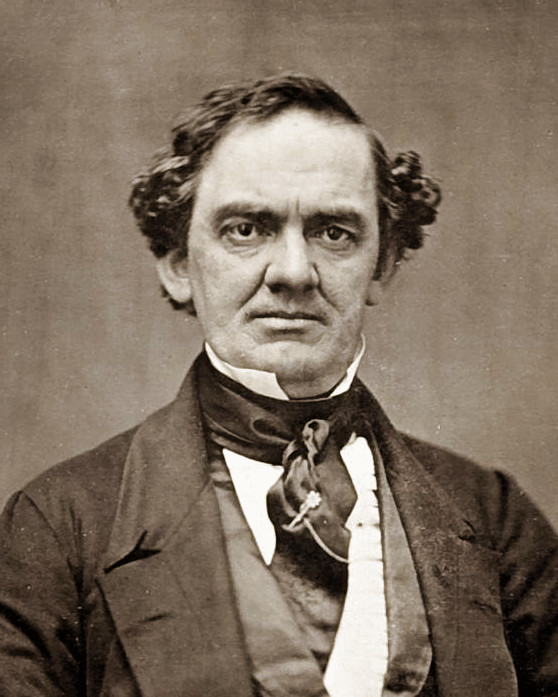
APPEARANCE Photographs depict Barnum as a well-dressed man with a beard and mustache. He was a charismatic and flamboyant figure, with a distinctive appearance characterized by his bold manner and expressive features. 

Barnum in 1851

FASHION Barnum embraced a flashy and theatrical sense of fashion, consistent with his role as a showman and promoter.

CHARACTER P.T. Barnum was known for his showmanship, charisma, and an eye for the sensational. He was a master marketer and self-promoter, often blurring the lines between truth and exaggeration ("There's a sucker born every minute"). However, he also displayed a keen business sense and a genuine interest in entertainment.

Bold and ambitious, Barnum possessed an enterprising spirit and a knack for captivating audiences.

SPEAKING VOICE P. T. Barnum’s speaking voice in surviving phonograph recordings sounds like an older 19th‑century New England showman: somewhat high‑placed, nasal, and formal, with clear but old‑fashioned American enunciation. The voice matches his public image—brisk, assertive, and self‑consciously grand, projecting confidence and salesmanship even in a brief ceremonial message. His accent is broadly American with a northeastern flavor, but not strongly regional by modern standards; vowels are relatively clipped, and r‑sounds are present but not heavily stressed.

SENSE OF HUMOUR Barnum had a knack for witty remarks and playful self-deprecation. He understood the power of entertainment and often employed humor to engage audiences..

RELATIONSHIPS P.T. Barnum married Charity Hallett on November 8, 1829, in New York. The marriage took place at Charity's uncle's house in New York City. At the time of their marriage, Barnum was 19 years old, while Charity was 21.

None of Barnum's family attended the wedding, and his mother reportedly pretended to know nothing about it. This suggests there may have been some family tension surrounding the marriage.

Charity Hallett was born on October 28, 1808, and she was a tailoress from Bethel, Connecticut, where she met Barnum. The couple remained married for 44 years until Charity's death on November 19, 1873. They had four daughters together, three of whom lived to adulthood.

In the 1870s, Charity had been diagnosed with heart disease and she died of paralysis at the family residence, 438 Fifth Avenue in New York City. At the time of her death, P.T. Barnum was believed to be in Europe, possibly attending a World's Fair in Vienna

After Charity's death in 1873, Barnum snagged Nancy Fish, a socialite from England 40 years his junior. They tied the knot on February 14, 1874 and by all accounts, it was a happy marriage, though one wonders if maybe Mrs. Barnum number two ever questioned the ethics of her husband's, shall we say, creatively curated exhibits.

Nancy Fish Barnum in 1888

Barnum formed partnerships with various business associates and performers throughout his career.

MONEY AND FAME Barnum was driven by a desire for wealth and fame, leveraging his marketing skills to achieve widespread recognition and financial success.

Barnum's American Museum was a smash hit, but its popularity presented a delightful problem. Crowds lingered for hours, captivated by the bearded lady or the three-legged cow. This wasn't ideal for business – new suckers, er, customers, were waiting outside! So, Barnum, ever the resourceful fellow,  plastered signs throughout the museum that politely directed lingering guests: "This Way to the Egress."

Now, "egress" wasn't exactly a household word back then. Most folks assumed it was just another peculiar exhibit, perhaps a fantastical land populated by backwards-walking people or something. So, they merrily followed the signs, only to find themselves deposited, blinking and slightly bewildered, back on the bustling sidewalk.  Much to their chagrin, re-entry required another dip into their pockets. Barnum, that sly dog, had  turned a necessary evil into a clever – and profitable –  way to keep the crowds flowing.

FOOD AND DRINK Barnum enjoyed the finer things in life and entertained lavishly, reflecting his status as a prominent public figure.

MUSIC AND ARTS Barnum appreciated the arts and incorporated music, theatrical performances, and visual spectacles into his circus shows and museum exhibits.

P.T. Barnum, ever the nose for a curious character, stumbled upon Joice Heth in the late 1830s. This blind, near-motionless former slave claimed the rather tall tale of being 161 years old and George Washington's own nursemaid. Barnum, ever the showman in the making, seized the opportunity and launched his career by flogging this marvel (or medical marvel, depending on your gullibility) to the public.

By 1841, Barnum had enough chutzpah (and presumably cash) to buy Scudder's American Museum in New York City. It wasn't your typical museum, mind you. Think more along the lines of a chaotic, crowd-pleasing smorgasbord of entertainment. Picture a zoo with a side of mummies, a lecture hall next door to a wax museum, the whole thing sprinkled with "freaks" and theatrical performances. At its peak, this glorious hodgepodge drew in a staggering 15,000 gawkers a day. Sadly, it all went up in smoke on July 13, 1865, one of the most spectacular fires New York had ever seen. (Though, you have to admit, a burning museum filled with "oddities" sounds like something Barnum himself might have dreamed up for a show.)

Speaking of dreams, Barnum had a knack for conjuring them for others. In 1850, he whisked Jenny Lind, the "Swedish Nightingale," across the Atlantic, showering her with a then-unheard-of $1,000 a night for 150 nights. She eventually left New York after her unprecedented two-year American tour, completing it on May 29, 1852. 

Castle Garden, New York, venue of Lind's first American concerts

But Barnum wasn't done there. By 1871, he'd outdone himself, creating the self-proclaimed "Greatest Show on Earth." Imagine a parade of marvels: General Tom Thumb, the pint-sized celebrity, a full-fledged circus, a menagerie of exotic beasts, and a collection of "freaks," all crammed into a hundred train cars. He even managed to snag Jumbo, the colossal elephant, and the Siamese twins, Chang and Eng, for good measure, feeding America's insatiable appetite for the extraordinary.

Barnum with General Tom Thumb

LITERATURE Barnum was an avid reader and writer, publishing several books, including his autobiography and works on entertainment and business.

His 1854 autobiography sold more than one million copies over the course of numerous revisions.

NATURE Barnum had a fascination with exotic animals and natural curiosities, which he often showcased in his exhibits and shows.

HOBBIES AND SPORTS Barnum's main hobby and passion were his entrepreneurial ventures, which consumed much of his time and energy.

SCIENCE AND MATHS While not formally trained in science or mathematics, Barnum applied practical knowledge and ingenuity to his business ventures.

PHILOSOPHY & THEOLOGY Barnum's worldview was shaped by a belief in the power of entertainment and spectacle to captivate and inspire audiences.

POLITICS Barnum dabbled in politics as a liberal Republican, serving in the Connecticut legislature and even becoming Mayor of Bridgeport. He was a champion of abolishing slavery, a stance that aligns oddly with his later crusade to outlaw contraception in Connecticut (a law that stuck around until the swinging sixties!).

SCANDAL His use of hoaxes and sensational exhibits caused controversy and accusations of deception. However, he often admitted to the fabricated nature of his displays, using the term "humbug" as a marketing tool.

MILITARY RECORD Barnum did not have a military career.

HEALTH AND PHYSICAL FITNESS Barnum maintained good health for much of his life, although he experienced health issues later in his career.

HOMES P.T. Barnum wasn't tied down to one place throughout his life. His career as a showman and businessman kept him on the move, reflected in his various residences:

Early Life (Connecticut): Born and raised in Bethel, Connecticut.

New York City : Established his famous Barnum American Museum in New York City, residing there during this period.  He lived at 438 Fifth Avenue in New York City during the early 1870s. 

Travels (Throughout Career): Touring with exhibits and the later circus would have involved stays in countless hotels and temporary lodgings across the US and abroad.

Bridgeport, Connecticut (Later Life): After achieving success, Barnum settled in Bridgeport, Connecticut, even serving as Mayor for a time. He constructed four notable mansions, each a testament to his evolving wealth and tastes.

Iranistan (1848-1857): This Moorish Revival masterpiece, inspired by the Royal Pavilion in Brighton, England, stood at the corner of Fairfield Avenue and Iranistan Avenue. Costing a staggering $150,000 (equivalent to over $4 million today), it was tragically destroyed by fire on December 17, 1857.

Book engraving of Iranistan, P.T. Barnum's residence in Bridgeport, Connecticut in 1848

Lindencroft (1860-1869): Located just 500 yards west of Iranistan, between Fairfield Avenue and State Street, this Italianate-style home provided shelter to Barnum during the Civil War era.

Waldemere (1869-1888): A grand, ornate Victorian "gingerbread" house by Long Island Sound, Waldemere was Barnum's residence while he served as mayor of Bridgeport and during his early circus years. It stood on what is now Marina Circle, adjacent to Seaside Park.

Marina (1888-1891): Barnum's final abode, Marina was built next door to Waldemere on Marina Circle. More modern and comfortable than his previous homes, it was his residence until his death in 1891. Sadly, it was demolished in the 1960s by the University of Bridgeport.

TRAVEL Travel was woven into the very fabric of Barnum's life and career:

Early Ventures: He might have traveled within the US to exhibit his hoaxes like the Feejee Mermaid.

Jenny Lind Tour (1850): A significant venture involved touring extensively with the Swedish singer Jenny Lind across the US.

Museum Acquisitions: Acquiring oddities and curiosities for his museum likely involved travel or dealings with international agents.

Circus Expansion: The growth of the Ringling Bros. and Barnum & Bailey Circus undoubtedly involved travel to new locations across the country.

DEATH P.T. Barnum, the famous showman and circus impresario, died at 6:22 pm at Marina, his residence in Bridgeport, Connecticut on April 7, 1891. His death was caused by a stroke. In accordance with his wishes, Barnum was buried at Mountain Grove Cemetery in Bridgeport, a cemetery he had personally designed as a "rural" retreat with gardens, rolling hills, and ponds.

Barnum's funeral was a notable event. It included a New Orleans-style procession led by a Dixieland jazz band playing brassy ragtime tunes—a fitting tribute to his flamboyant personality and career. His gravesite is marked by a large monument within the cemetery, which also contains the graves of family members and notable figures such as Charles S. Stratton (General Tom Thumb), one of Barnum's most famous performers. (1)

APPEARANCES IN MEDIA Barnum's life and legacy continue to captivate audiences. Numerous biographies delve into his life's story, while documentaries explore his impact on entertainment and showmanship.

The Greatest Showman (2017): This musical film, though a fictionalized account, draws inspiration from Barnum's life and the world of the circus.

ACHIEVEMENTS P.T. Barnum's legacy extends far beyond the flamboyant showmanship he was known for:

Revolutionized Entertainment: He transformed entertainment with his innovative museums and the awe-inspiring spectacle of the circus.

Marketing Pioneer: His strategies, though sometimes controversial, laid the groundwork for modern advertising techniques.

Preservation of Oddities: His museums, despite their sensational elements, did preserve some historical artifacts and curiosities for public viewing.

Circus Industry Legacy: By merging his museum with the Ringling Bros. circus, he created the foundation for the modern circus industry, a form of entertainment that continues to capture imaginations today.

Source (1) Connecticut Museum 

Just Posted

Here's my most recently posted Trivial Biographies: Kim Jong Un Nicole Kidman David Garrick Nikita Khrushchev Johannes Kepler John F. Ke...