Showing posts with label Circus Performer. Show all posts

Wednesday, 23 September 2015

Harry Houdini

NAME Harry Houdini, born Erik Weisz (also rendered Ehrich Weiss in American records). He was known professionally and universally as Harry Houdini, a stage name he adopted in homage to the French magician Jean-Eugène Robert-Houdin, adding an "i" to Houdin's name. He was widely nicknamed "The Handcuff King" and "The Escape King." (1) (2)

WHAT FAMOUS FOR Harry Houdini was a Hungarian-American escape artist, illusionist, and stunt performer, celebrated for his sensational escape acts. He became a global icon for his ability to free himself from handcuffs, straitjackets, jail cells, and water-filled tanks. Beyond magic, he was a noted skeptic who dedicated his later years to debunking fraudulent spiritualists and mediums.

BIRTH Born March 24, 1874, in Budapest, then part of the Austro-Hungarian Empire. Although Houdini was born in Budapest, he frequently claimed — and sometimes appeared to genuinely believe — that his birthplace was Appleton, Wisconsin, where he grew up. This appears to have been a deliberate piece of self-mythologising, designed to present himself as a wholly American self-made man. 

FAMILY BACKGROUND Houdini was born into a Jewish family. His father, Rabbi Mayer Sámuel Weisz (anglicised as Samuel Weiss), was a rabbi who emigrated to the United States in 1878, settling first in Appleton, Wisconsin, where he became the city's first rabbi at the Zion Reform Congregation.  (3) 

His mother was Cecilia Steiner. The family fell into dire poverty when Rabbi Weiss lost his position in Appleton in 1882 and the family relocated to Milwaukee. 

Houdini had six siblings: a half-brother Herman, and brothers Nathan, Gottfried William, Theodore Hardeen (his later stage partner), and Leopold, as well as a sister, Carrie Gladys, who was left nearly blind after a childhood accident. 

Houdini (left) with his brother Hardeen

CHILDHOOD Houdini arrived in the United States at the age of four. Growing up in poverty in Appleton and later Milwaukee and New York City, he was resourceful and driven from an early age. He sold newspapers and shined shoes to contribute to the family income. 

When he was around twelve years old, his father — sensing his own failures — reportedly asked the boy to promise to take care of his mother for the rest of his life; Houdini would honour that vow zealously throughout his life. (4) 

At thirteen, Houdini moved with his father to New York City, taking odd jobs and living in a boarding house before the rest of the family joined them; it was in New York that he first became captivated by trapeze and acrobatics. (5)

EDUCATION Houdini had little formal schooling. His father, a rabbi, taught him to read from books at an early age, and this instilled in him a lifelong passion for self-education through reading. (6) 

He was largely self-taught, learning the skills of his trade through obsessive practice and study rather than through any institutional training. His knowledge of locks, escapology, and the mechanics of illusion was acquired entirely through personal experimentation and the collection of books and printed sources. (7)

CAREER RECORD 1882 - Following his father's loss of his rabbinical post, the family moved from Appleton, Wisconsin, to Milwaukee and then to New York City, where the young Ehrich Weiss began working odd jobs. 

1891 - Began his professional career in magic, taking the stage name "Harry Houdini" as an homage to the French magician Jean-Eugène Robert-Houdin. He initially performed card tricks and traditional magic with his brother Dash as "The Brothers Houdini."

1899 - Met showman Martin Beck in St. Paul, Minnesota. Beck was impressed by Houdini's ability to escape from handcuffs and booked him on the Orpheum vaudeville circuit. Within months, he was performing at the top houses in the country.

1900 - Traveled to Europe, where his challenge to local police forces to keep him locked up made him an international sensation. He spent several years touring England, Scotland, the Netherlands, Germany, France, and Russia.

1912 - Introduced his most famous act, the Chinese Water Torture Cell, in which he was suspended upside down in a locked glass-and-steel cabinet full of water.

1920s - Shifted his career focus toward the scientific investigation of the supernatural, serving on a Scientific American committee that offered a cash prize to any medium who could successfully demonstrate supernatural abilities.

APPEARANCE Unlike the popular image of the tall, mysterious magician, Houdini was short and stocky. A physical examination conducted by Dr. Aleš Hrdlička at the Smithsonian Institution in the spring of 1926 — the last year of his life — recorded his standing height as 5 feet 5.276 inches (165.8 cm). He had a muscular, powerful physique, developed through years of intensive athletic training. He had dark, curly hair and an intensely focused, almost hypnotic gaze that served him well on stage. He was considered by many observers to have a magnetic, dynamic physical presence disproportionate to his modest height, and he himself viewed his compact build as an athletic advantage. (8)

Harry Houdini, three-quarter length portrait, facing front.

FASHION On stage, Houdini typically appeared in a long frock coat and tie in the manner of a gentleman performer, though for his escape acts he would strip to minimal clothing — often appearing in just a swimsuit or close-fitting garments — to demonstrate that he had no hidden devices. (9) 

Off stage and for interviews and press appearances, he dressed impeccably in tailored suits, always projecting the image of a prosperous, respectable professional. His stage costumes were specially designed to facilitate his escapes, though they appeared to audiences to be entirely ordinary. (10)

CHARACTER Houdini was ambitious, intensely driven, and a consummate self-promoter — qualities essential to his rise from poverty to world fame. He was meticulous and secretive about his professional methods, trusting only a tiny circle of confidants with his techniques. 

Houdini was also known for his loyalty, generosity, and deep personal warmth toward those close to him — above all his wife Bess and his mother. His mother's death in 1913 devastated him, and grief over her loss partly explains his later fierce campaign against mediums who he felt exploited bereaved families with fraudulent claims. (11)

He spent up to four hours a day training and preparing for performances — a discipline that verged on obsession. 

SPEAKING VOICE Houdini's speaking voice was recorded on a number of occasions, and surviving recordings describe it as an expressive, confident, distinctly American voice with traces of a New York accent. 

He was a commanding and entertaining public speaker, a quality essential to his work as a performer who regularly issued public challenges and addressed large theatre audiences and, later, congressional hearings. (11)

SENSE OF HUMOUR Houdini had a robust sense of humour and enjoyed playing pranks, particularly on sceptics who doubted his abilities. His competitive nature found expression in jokes at the expense of those who underestimated him. He was also famous for his theatrical showmanship and flair for the dramatic, which contained a strong element of self-deprecating wit — he relished presenting himself as an ordinary man doing extraordinary things. (10)

RELATIONSHIPS Houdini married Wilhelmina Beatrice Rahner, known as Bess, on June 22, 1894. (The couple sometimes gave the year as 1893.) Bess served as his stage assistant for many years, and their partnership was the foundation of both his career and his personal happiness. 

The couple had no children. 

Houdini was also extremely devoted to his mother, Cecilia; her death in July 1913 while he was performing in Copenhagen was described by those close to him as the greatest blow of his life. 

He developed a celebrated friendship with Sir Arthur Conan Doyle, whom he met in 1920; the friendship ultimately collapsed bitterly over the question of spiritualism, with Doyle — a passionate believer — insisting that Houdini himself must possess genuine psychic powers, a claim Houdini vigorously denied. (11) 

After Houdini's death, Bess held annual séances on Halloween for ten years in an attempt to receive a pre-arranged coded message from him; she eventually abandoned the effort, reportedly saying: "Ten years is long enough to wait for any man." (12)

MONEY AND FAME Houdini's rise from extreme poverty to extraordinary wealth was remarkable even by the standards of the American Dream. Between 1900 and 1920, his worldwide tours made him one of the highest-paid entertainers in the world. 

He purchased his Harlem townhouse for $25,000 in 1904, and he spent lavishly on his enormous personal library and research collection. A newspaper estimate put his holdings at approximately "15,000 books, fifty thousand prints, half a million cuttings, and four tons of theatrical bills." (13) 

He was a major celebrity of the first age dominated by the mass media, his name recognition spanning Europe, America, and Australia. 

FOOD AND DRINK Houdini's strict physical training regime meant that he was careful and disciplined about diet. He maintained his powerful, flexible body through rigorous daily exercise and controlled eating. There is evidence that he retained a taste for Hungarian cuisine from his childhood — the family spoke Hungarian at home and maintained connections to their cultural heritage, including its food. (3) 

He was famously abstemious with alcohol, as befitted someone whose life literally depended on his physical and mental acuity.

MAGIC CAREER If ever there were a man who refused to remain in one professional lane—indeed, who treated lanes as things to be wriggled out of while manacled upside down over a river—it was Harry Houdini. His career didn’t so much progress as escalate, like a polite card trick that suddenly acquires chains, padlocks, and a worrying amount of water. 

Houdini in a publicity shoot wearing chains and padlocks, 1899

Houdini began, as many great legends do, in places that smelt faintly of sawdust and regret. Around 1891, aged seventeen and not yet the terror of locksmiths everywhere, he performed card tricks in dime museums—those cheerfully dubious establishments where one might see a conjurer, a two-headed calf, and a man who claimed to swallow cutlery, all before tea.

At first he worked with a friend, then sensibly upgraded to his wife, Wilhelmina Beatrice Rahner—known as Bess—forming a double act that included the Metamorphosis illusion. This involved one of them being tied up in a sack, placed in a locked trunk, and then, in a feat of conjugal efficiency, swapping places in a matter of seconds. It was elegant, baffling, and—alas—insufficiently lucrative. Houdini was, at this stage, more admired than paid, which is never a sustainable business model.

Fortune arrived in 1899 in the form of Martin Beck, who spotted Houdini performing in a beer hall in St. Paul—proving that history is often made in venues better known for sticky floors. Beck suggested, with admirable clarity, that Houdini stop fiddling about with cards and instead concentrate on escaping from things, which he did rather well.

This advice proved transformative. Booked onto the Orpheum Circuit, Houdini quickly became a headliner and, before long, one of the highest-paid performers in American vaudeville. It turns out that audiences are far more willing to part with their money if they suspect the performer might drown.

From 1900 onward, Houdini took his talents to Europe, where he introduced the novel concept of publicly humiliating local law enforcement. In city after city, he invited police to bind him with their finest cuffs and lock him up, only to pop out again moments later looking mildly inconvenienced.

He escaped from cells, challenged German authorities (sometimes in court, which is not generally recommended), and threw himself handcuffed into rivers before crowds who presumably felt both thrilled and faintly complicit. At Scotland Yard, he slipped free of their prized handcuffs in minutes, which cannot have done wonders for morale.

Meanwhile, his brother Theodore Hardeen toured simultaneously as the “Handcuff King,” ensuring that Europe was thoroughly saturated with Houdinis—rather like a travelling franchise, but with more chains.

As Houdini’s fame grew, so did the level of jeopardy. His act evolved into a sort of ongoing argument with mortality:

The Handcuff Act invited anyone—police, audience members, or the suspiciously enthusiastic—to restrain him. He would even submit to a search to prove he wasn’t smuggling keys, which seems sporting.

The Milk Can Escape (1908) involved being locked inside a water-filled container while audiences collectively reconsidered their entertainment choices.

The Straitjacket Escape became vastly more exciting when performed dangling above city streets, thanks to Hardeen’s inspired suggestion that visibility and terror are natural companions.

The pièce de résistance was the Chinese Water Torture Cell (1912), in which Houdini was suspended upside down and lowered into a glass tank of water, allowing audiences to watch every uncomfortable second. He prudently copyrighted it after discovering that other magicians had an unhelpful tendency to borrow his ideas.

Houdini did not confine himself to theatres. He escaped from bridges, from jail cells, and, on one notable occasion, from a cell associated with Charles J. Guiteau—which is not the sort of Airbnb listing one normally seeks out.

In 1918, at the New York Hippodrome, he made an elephant vanish, because apparently escaping from handcuffs was no longer quite enough.

By 1925, Houdini had assembled a full evening show grandly titled “3 Shows in One,” combining magic, escapes, and a spirited debunking of fraudulent mediums—whom he pursued with the enthusiasm of a man who had spent years being locked in boxes and had little patience for nonsense.

He also became president of Martinka & Co., the oldest magic firm in America, suggesting that if he couldn’t escape something, he might as well run it.

Remarkably, his popularity never waned. Even in October 1926, as he continued to perform to packed houses, he was already suffering from the ruptured appendix that would kill him—a final, rather grim reminder that while Houdini could escape almost anything, biology was stubbornly non-negotiable.

MUSIC AND ARTS Houdini was deeply interested in the history and art of theatrical performance and magic. He amassed a vast private collection of theatrical posters, prints, playbills, programmes, and manuscripts documenting the history of conjuring and stage entertainment. (13) 

He was a pioneer in early cinema, starring in and producing his own adventure films in the late 1910s and early 1920s. (7) 

LITERATURE Houdini was a passionate and compulsive collector of books, particularly on magic, mysticism, conjuring, and the history of the theatre. His father, a rabbi, taught him to read from books as a small child, and the habit never left him. (6) 

He employed a librarian to organise his collection, which grew to an estimated 15,000 volumes. (13) 

Houdini was a published author himself, writing The Unmasking of Robert-Houdin (1908), in which he controversially challenged the reputation of his own namesake, as well as Miracle Mongers and Their Methods (1920) and A Magician Among the Spirits (1924), his definitive attack on fraudulent mediums. He had plans for a meticulously researched rebuttal of Thomas Frost's Lives of the Conjurors (1876), and the ambition to publish drove much of his extraordinary book-collecting. (14)

NATURE Despite his urban career, Houdini appreciated the outdoors for the physical training it provided. He often performed outdoor stunts, such as being hung from skyscrapers or submerged in rivers, to draw massive crowds.

PETS The Houdinis were passionate and devoted animal lovers who kept a surprisingly rich menagerie at their Harlem townhouse. Their first dog was Charlie, a small white Pomeranian given to them by the Grand Duke of Russia in 1903, who accompanied them on their European tours and had to be smuggled across international borders. Charlie died in 1909, and Houdini's diary entry reveals the depth of his feeling: "Charlie, our dog, dying. Have taken him away from Surgeon Thompson so he can die at home. Bess crying. I don't feel any too good." (15)

Their second dog, Bobby, a fox terrier, was acquired by Bess from a Harlem butcher shop owner who had refused to let her give the animal a bone — she simply bought the dog instead. Houdini trained Bobby to escape from ropes, miniature handcuffs, and a tiny straitjacket specially made to fit him. Houdini called him "a wonderful card dog" and "the greatest somersault dog that ever lived."  In 1918, Bobby's act headlined at the 14th Annual Society of American Magicians dinner, billed as the "Only Handcuff King Dog in the World." Bobby died on December 15, 1918, and Houdini wrote an affectionate eulogy published in MUM Magazine. (16)

Beyond the two dogs, the household at 278 West 113th Street also contained a talking parrot named Laura who lived in their bedroom, a second parrot named Polly, a canary named Houdini, a large rabbit named Rudy, a pet turtle named Petie, and a six-foot-square aviary filled with birds. Most patriotically, Houdini also kept an American eagle named Abraham Lincoln. (15)

While not quite a household pet, Houdini's most celebrated animal associate was Jennie the elephant, whom he made vanish on stage at the New York Hippodrome in 1918, and of whom he said she was "as gentle as a kitten." (15)

Houdini and Jennie, the Vanishing Elephant, January 7, 1918

HOBBIES AND SPORTS Houdini was an exceptional natural athlete who trained for up to four hours each day. (10)

He was a strong swimmer and an expert at holding his breath — a vital skill for his underwater escapes — and he pursued physical fitness with the dedication of a professional sportsman. 

He was also a passionate early aviator, purchasing a French Voisin biplane in 1909 and becoming one of the first men to fly a powered aircraft on Australian soil. 

His most enduring non-professional obsession was book and ephemera collecting, hunting bookshops — often second-hand — in every city he visited on tour. 

SCIENCE AND MATHS Houdini possessed a remarkable practical and mechanical intelligence. His escape artistry required expert knowledge of lock mechanisms, metallurgy, knot theory, and anatomy. (4) 

He was a skilled lockpick and had a deep understanding of the physical limits and flexibility of the human body. His interest in aviation reflected a broader fascination with the new technologies of his era. He was also well versed in the tricks and devices used by fraudulent mediums — he was able to replicate almost every spiritualist phenomenon through purely mechanical or psychological means, and he took considerable pride in this scientific competence. (11)

PHILOSOPHY & THEOLOGY Though born into a Jewish family and the son of a rabbi, Houdini's personal religious beliefs and philosophy was rooted in rationalism; he believed that the human mind and body could overcome any physical "shackle,"

His passionate campaign against fraudulent spiritualists was not a campaign against religion per se, but against deception and exploitation of the grief-stricken. 

His rational intelligence ultimately overpowered any inclination toward supernatural belief. He told Congress in 1926: "This thing they call Spiritualism, wherein a medium intercommunicates with the dead, is a fraud from start to finish." (11)

POLITICS Houdini's politics were broadly those of an immigrant made good — a strong patriot and believer in American opportunity and individualism. He became an American citizen and consistently presented himself as a wholly American success story. (3) 

His most overtly political act was his campaign before the United States Congress in 1926 to outlaw fraudulent fortune-telling and spiritualist fraud, appearing before congressional hearings for four days and naming specific practitioners. 

SCANDAL Houdini's bitterest public controversy arose from his campaign against the Boston medium Mina Crandon, known as "Margery," widely considered the most credible and celebrated spiritualist medium of the 1920s. Houdini infiltrated a session of the Scientific American committee examining her claims and publicly exposed what he declared to be her fraudulent methods, producing a pamphlet, Houdini Exposes the Tricks Used by the Boston Medium "Margery" (1924). (11) 

Crandon's supporters, including Conan Doyle, were furious, and the affair became a media sensation. His public humiliation of mediums and fortune-tellers made him enemies in the spiritualist community, and there were suggestions — never substantiated — that some of his enemies may have arranged the fatal assault by the McGill student in 1926. (17)

MILITARY RECORD Houdini served no military service. During World War One, however, he contributed patriotically by teaching American soldiers how to escape from restraints in the event of capture and by performing shows for the troops. 

HEALTH AND PHYSICAL FITNESS Houdini was in exceptional physical condition throughout his performing career. He could dislocate his shoulders at will, an ability crucial to many of his escapes. (10) 

In the last year of his life, in 1926, he was physically examined and measured by Dr. Aleš Hrdlička of the Smithsonian Institution, who confirmed his height at 5'5.276" and documented his notably powerful physique. (8) 

HOMES Houdini's primary home for most of his adult life was the brownstone townhouse at 278 West 113th Street, Harlem, New York City, which he purchased on August 11, 1904, for $25,000. At the time, the neighbourhood was largely home to prosperous Jewish and German immigrants. The house served not only as his home but as his office, workspace, and private library — a dozen and a half rooms lined with shelves of books, prints, and theatrical memorabilia. Houdini called it "the finest private house that any magician has ever had the great fortune to possess." The house still stands today and has become a site of pilgrimage for Houdini enthusiasts. (18) 

TRAVEL Houdini was one of the great travellers of his era. From 1900 onward, he undertook multiple extended tours of Britain, the Netherlands, Germany, France, and Russia, and later performed in Australia (1910) and across the United States.

In every city he visited, he made a point of challenging the local police to restrain him — a brilliant piece of publicity that ensured press coverage wherever he went. He habitually visited bookshops in every city he passed through, building his extraordinary library one volume at a time. (19)

In 1909, Houdini became fascinated with aviation and purchased a French Voisin biplane for $5,000, hiring a full-time mechanic, Antonio Brassac. He made his first successful flight on November 26, 1909, at the Hufaren parade grounds near Hamburg, Germany. 

In 1910, he had the plane dismantled and shipped to Australia, where he was planning an extended tour. On March 18, 1910, he made three flights at Diggers Rest, Victoria, near Melbourne. It was reported at the time as the first powered aerial flight in Australia, though this claim is now disputed. (20_

 Houdini also taught himself to drive a car during this period purely in order to get himself out to the airfield. After his Australian tour, he abandoned the plane and, characteristically, never drove again.

DEATH  On October 22, 1926, while in Montreal to perform shows, a McGill University student named J. Gordon Whitehead approached Houdini in his dressing room and, without proper warning, punched him several times hard in the stomach, apparently testing his famous ability to absorb blows. Houdini had not had time to brace himself. 

He continued to perform despite increasing pain, and on October 24 was rushed to Grace Hospital in Detroit, where surgeons found his appendix had ruptured several days earlier, causing peritonitis. He died on October 31, 1926 — Halloween — at the age of 52. 

The official cause of death was peritonitis caused by a ruptured appendix. Whether the punches directly caused the rupture, or whether a pre-existing appendicitis was fatally exacerbated by the trauma, remains debated by medical historians. 

He was buried at Machpelah Cemetery in Queens, New York, with his head resting on a pillow of his mother's letters. 

Before his death he had made a pact with Bess that he would attempt to communicate from beyond the grave using a pre-arranged coded message: "Rosabelle believe." No verified contact was ever made. (9)

APPEARANCES IN MEDIA Houdini himself appeared in several silent films, including The Master Mystery (1919), The Grim Game (1919), Terror Island (1920), and The Man from Beyond (1922), for which he founded his own production company. 

After his death, his legend grew substantially through popular culture. Tony Curtis played him in the biographical film Houdini (1953), described by IMDB as a "memorable performance." (20)

 He has appeared or been referenced in countless films, television programmes, novels, and stage shows. A TV film, Houdini (2014), starred Adrien Brody and the television series Houdini & Doyle (Fox, 2016) dramatised his friendship and feud with Arthur Conan Doyle. 

He has also been the subject of documentaries and museum exhibitions, and the Library of Congress maintains a dedicated online American Memory collection in his honour. 

His name has entered the English language as a byword for a miraculous escape: "to do a Houdini."

ACHIEVEMENTS The most celebrated escape artist and illusionist in history, widely regarded as the greatest magician who ever lived. 

Pioneer of escapology as a distinct performance art form. 

One of the first men to pilot a powered aircraft, and the first to make a sustained powered flight on Australian soil  

Built one of the world's greatest private libraries of magic and theatrical history, estimated at 15,000 books, 50,000 prints, half a million cuttings, and four tons of theatrical bills. 

A major figure in early silent cinema, founding his own film production company.

Successfully lobbied the United States Congress on the subject of fraudulent fortune-telling in 1926. 

His name has become a permanent part of the English language and popular culture as a synonym for miraculous escape. 

Sources: (1) Wikipedia: Harry Houdini (2) Britannica: Harry Houdini (3) Learn Hungarian Anywhere: Harry Houdini (4) EBSCO Research Starters: Harry Houdini (5) Biography.com: Harry Houdini (6) Crafty Moms Share: Houdini's Library (7) Library of Congress: Great Escapes – Houdini Collection (8) Wild About Houdini: Smithsonian Doctor's Report (9) Wikiwand: Harry Houdini (10) Houdinarian Society: Houdini's Legacy (11) Smithsonian Magazine: Houdini and Spiritualism (12) Biography Host: Harry Houdini (13) Picture Book Builders: Houdini's Library (14) Harry Ransom Center: Harry Houdini Papers (15) Wild About Houdini: Houdini's Pets (16) Famous Dogs in History: Bobby, Houdini's Magical Dog (17) CBS News Detroit: Houdini Dies in Detroit on Halloween (18) Wild About Houdini: Discovering 278 (19) Goodreads: Houdini's Library (20) Encyclopaedia of Trivia: Harry Houdini (21) IMDB: Harry Houdini Biography

Thursday, 30 April 2015

Mata Hari

NAME Mata Hari, born Margaretha Geertruida Zelle, and known familiarly to her family as "Grietje." After her first marriage she was also known as Margaretha MacLeod, and she occasionally used the stage name "Lady MacLeod" during her early Paris years. (1), (2)

WHAT FAMOUS FOR Mata Hari was the stage name of Margaretha Geertruida (Grietje) Zelle, a Dutch-Frisian exotic dancer who had relationships with both German and French officers during the First World War, and who has become the archetype of the seductive female spy. She rose to fame in Paris as an "exotic" dancer performing supposedly sacred Javanese and Hindu-inspired dances, before being arrested, tried and executed by the French on charges of espionage for Germany. Her name remains synonymous with the femme fatale, even though historians still dispute how much genuine spying she actually did. (3)

BIRTH Margaretha Geertruida Zelle was born on August 7, 1876, in Leeuwarden, the capital of the Dutch province of Friesland. She was the eldest of four children and the only daughter of Adam Zelle and Antje van der Meulen.  (4)

FAMILY BACKGROUND Her father, Adam Zelle, was a prosperous hat merchant of some local standing who made further money through investments in the oil industry, allowing the family a comfortable, even indulgent, early lifestyle. 

Her mother, Antje van der Meulen, came from a well-off Frisian family, and Margaretha had three younger brothers.

The family's fortunes collapsed when Adam Zelle went bankrupt in 1889, an event that fractured the household and forced her parents to separate. (5)

CHILDHOOD  Nicknamed "Grietje," as a young girl Margaretha was known as flamboyant and strong-willed, often turning up to school in eye-catching new dresses paid for by her father's earlier prosperity. 

Her father's bankruptcy when she was thirteen ended this privileged phase abruptly, and her parents' subsequent divorce was followed swiftly by the death of her mother in 1891. Left effectively parentless, she was sent to live with her godfather, Mr. Visser, in the town of Sneek, an arrangement she found stifling. (5)

EDUCATION Margaretha attended exclusive private schools in Leeuwarden until the age of thirteen, when her father's financial ruin cut short this comfortable schooling. 

She was later enrolled in Leiden to train as a kindergarten teacher, but the course ended in scandal after the school's headmaster began flirting with her openly, prompting her outraged godfather to withdraw her. She then went to live with an uncle in The Hague, effectively ending her formal education in her late teens. (6)

CAREER RECORD 1895: Married Dutch Colonial Army Captain Rudolf MacLeod after responding to a newspaper advertisement for a bride.

1897-1902: Lived in the Dutch East Indies (modern-day Indonesia) with her husband, where she studied local dance traditions and joined a local dance company.

1903: Moved to Paris following her separation, working briefly as a circus horse rider and artist's model under the name Lady MacLeod.

1905: Debuted her orientalist dance act at the Musée Guimet in Paris as Mata Hari, claiming to be a Hindu princess raised in sacred temples. She quickly became a sensation across major European capitals.

1912-1915: As her dancing career waned due to age and younger imitators, she transitioned into a high-class courtesan, catering to wealthy politicians and military officers across neutral and belligerent European nations.

1916: Recruited by French intelligence (Deuxième Bureau) to spy on German officers in occupied Belgium in exchange for travel permits to visit her wounded lover.

1917: Executed by French military firing squad following a high-profile military court trial for espionage (7)

APPEARANCE Mata Hari was tall for a woman of her era, standing around five feet nine or ten inches (roughly 1.75 metres), with a dark, hourglass figure of narrow waist, wide hips and long legs. 

She had dark hair, worn up in elaborate styles, olive skin, and striking dark eyes that some accounts describe as green-brown, all of which lent credibility to her invented "Oriental" persona. 

Contemporaries agreed she was not a classic beauty by the fashionable pale, fine-featured standards of the day, but photographs show a strikingly handsome and commanding presence. (8), (9)

Mata Hari, c. 1910

FASHION On stage, Mata Hari performed in elaborate, jewel-encrusted "temple dancer" costumes inspired loosely by Javanese and Indian dress, gradually removing veils and ornaments during her act, culminating in near-nudity covered only by a jewelled breastplate. Several of her costumes were designed by notable names of the era, including the Russian-French artist Erté, who created stage pieces for her before going on to define Harper's Bazaar's visual style for decades (2)

Off stage, Mata Hari was, by all accounts, an obsessively fashionable woman who remained immaculately and expensively dressed even during the roughest periods of her life, including her father's bankruptcy and the breakdown of her marriage. As a wealthy Parisian courtesan she spent lavishly on couture gowns, furs, fans and jewellery, travelling with a wardrobe so extensive it reportedly filled around ten trunks, and she was a regular fixture in the fashionable illustrated press of the day, photographed in gowns by designers such as Buzenet. (10), (11)

Her sense of style stayed with her to the very end: even on the morning of her execution, October 15, 1917, she dressed with care, reportedly wearing a grey silk gown, a fur stole about her shoulders, openwork silk stockings and a pearl necklace, a final act of composed self-presentation from a woman whose look had always been central to her public identity. 

CHARACTER Contemporaries and biographers describe Mata Hari as flamboyant, headstrong, and reckless with money, someone who had always been used to getting her own way even as a child. 

She was also resourceful and reinvented herself repeatedly, from abandoned colonial wife to Parisian sensation, showing considerable nerve and self-confidence. This same recklessness, however, extended to her private life and eventually to her wartime dealings, where naivety about the risks of moving between belligerent intelligence services likely contributed to her downfall. (12)

SPEAKING VOICE A polyglot with a charming accent, she was fluent in Dutch, French, German, English, and Indonesian.

Contemporaries who interacted with her during interrogation described her manner as calm, articulate and persuasive even under sustained pressure. She reportedly maintained her composure and continued proclaiming her innocence in fluent, confident French throughout the sixteen or more interrogation sessions she endured before her trial. (12)

SENSE OF HUMOUR Accounts of Mati Hari's arrest suggest a certain dark theatrical wit: when French police and a judge burst into her hotel suite, she reportedly excused herself to dress, then returned and calmly offered the officers chocolates from a captured German helmet.

 On the morning of her execution she is said to have blown a kiss to the firing squad moments before the shots were fired, a final flourish of the showmanship that had defined her career.  (13)

RELATIONSHIPS Mata Hari married Rudolf MacLeod in 1895. Her marriage  was miserable and physically abusive, marred by his alcoholism and rampant infidelity. 

She had two children with him, a son, Norman, who died young in 1899, reportedly poisoned by a servant, and a daughter, Jeanne (known as "Non"), whom she later lost custody of after their bitter 1902 divorce. 

Rudolph and Norman John MacLeod

As a courtesan in Paris she took a long succession of wealthy and powerful lovers, reportedly including diplomats, bankers, military officers of several nations, and even the composer Giacomo Puccini. 

Her most significant late romance was with Vadim Masloff, a young Russian army captain some twenty years her junior, whom she met in 1916 and whose gassing and wounding at the front spurred the request for travel permits that drew her deeper into espionage entanglements. (14)

MONEY AND FAME At the height of her fame between 1905 and around 1912, Mata Hari commanded enormous fees as a dancer and lived lavishly as one of the era's most celebrated courtesans, supported by wealthy patrons including a French banker with whom she had a long relationship. 

Hari's reckless extravagance, passion for gambling, and lavish lifestyle left her perpetually in financial distress, forcing her to rely on payments from wealthy lovers and intelligence services.

As she aged, she grew anxious about maintaining her expensive lifestyle once her dancing career inevitably faded, and her later espionage work for both France and Germany was motivated partly by financial need as much as by romantic entanglement. (15)

FOOD AND DRINK Accustomed to the finest dining, she frequented grand Parisian hotel restaurants and high-society banquets. (12)

Detailed records of her everyday tastes in food and drink are sparse, though accounts of her final years describe a woman who, after the disappearance of Vadim Masloff from her life, drank heavily and lived recklessly. (16)

MUSIC AND ARTS Mata Hari's entire public career was built on performance art, presenting invented "sacred" Javanese and Hindu-style dances to Parisian audiences hungry for Orientalist spectacle, first at the Musée Guimet in 1905. Her act blended elements of striptease with exotic dance and drew comparisons to the Ballets Russes and other Orientalist entertainments then fashionable in Europe, and she is credited by some historians with helping popularise striptease as a stage art form. 

She was also connected to the classical music world through the composer Giacomo Puccini, reportedly one of her lovers, and she performed in a staging of Jules Massenet's opera Le Roi de Lahore in 1906. (10)

LITERATURE Mata Hari was an avid writer of personal correspondence, maintaining long, expressive journals and detailed letters home throughout her travels in the Dutch East Indies and across Europe.

Her life has generated an enormous body of literature since her death, including numerous biographies such as Sam Waagenaar's 1965 study and Pat Shipman's 2007 book Femme Fatale: Love, Lies, and the Unknown Life of Mata Hari. (17), (18)

NATURE While in the Dutch East Indies with her first husband, Margaretha immersed herself in the natural and cultural landscape of Java, studying local customs and traditional dance, an experience that directly shaped the exotic persona she later built in Paris. (5), (6)

PETS Wealthy lovers in Paris are said to have kept her supplied with horses, among other luxuries.

HOBBIES AND SPORTS An accomplished equestrian from her youth, she briefly worked as an equestrian performer in Paris circuses prior to her dancing breakthrough.

Dance itself, first learned informally in Java and later developed into her stage act, functioned as both her profession and her central creative pursuit. (19)

SCIENCE AND MATHS Mata Hari possessed no formal training in sciences or mathematics; her attempt to navigate the complex, technical world of military ciphers and coded telegrams proved disastrously fatal (18)

PHILOSOPHY & THEOLOGY Mata Hari's stage persona rested on an invented spiritual biography, presenting herself to Parisian audiences as a Javanese princess of priestly Hindu birth raised in the sacred dance traditions of an Indian temple. This fabricated religious mystique, though entirely fictional, was central to her appeal and reflected the era's fashionable fascination with Eastern spirituality rather than any genuine theological study on her part. (6) (9)

POLITICS Mata Hari held no formal political affiliations, but her position as a Dutch national from a neutral country allowed her to travel relatively freely across national borders during the First World War, a freedom that placed her at the centre of Allied and German intelligence interest. (5)

SCANDAL Mata Hari's entire adult life was shadowed by scandal, from her provocative near-nude performances and the many wealthy lovers who scandalised polite society, to the sensational newspaper coverage of her 1917 espionage trial. 

Mata Hari performing in 1905

During her time in Java she was already the subject of local gossip for adopting native dress and spending recklessly, foreshadowing the far larger public scandal that would engulf her in Paris two decades later. (6)

ESPIONAGE Mata Hari drifted into espionage around 1916 in much the way some people drift into yoga classes or pyramid schemes: it seemed a plausible way to solve a financial problem. Captain Georges Ladoux of French intelligence enlisted her to gather information from her German acquaintances, a task that conveniently came with travel money for visiting her wounded lover, Vadim Masloff. The Germans, meanwhile, later insisted that they had recruited her as well, bestowed upon her the melodramatic code name H-21, and passed instructions through a succession of officers with names that sounded as though they had escaped from the cast list of a wartime operetta.

The arrangement might have continued indefinitely had French counter-intelligence not intercepted a German telegram mentioning agent H-21. On February 13, 1917, police arrived at her room in the Hotel Elysée Palace on the Champs-Élysées and arrested the woman who had once been Europe’s most celebrated exotic dancer. She was interrogated repeatedly by Captain Pierre Bouchardon, whose idea of conversation was rather more strenuous than most people’s, and eventually stood trial on 24 July 1917. The prosecution accused her of spying for Germany and helping bring about the deaths of at least 50,000 Allied soldiers—a figure so impressively large that it has always invited a raised eyebrow.

What she actually accomplished as a spy is still argued over by historians. Some believe she was a dangerous intelligence asset; others think she was mostly a glamorous woman with expensive tastes who happened to know too many officers on both sides. In wartime France, however, nuance was in short supply, and a famous foreign courtesan made a far more satisfying villain than the messy reality of military failure. 


MILITARY RECORD Her wartime activities placed her at the intersection of Allied and German military intelligence rather than in any combat or command role.

HEALTH AND PHYSICAL FITNESS Mata Hari relied heavily on her physical fitness and stamina as a dancer, maintaining a demanding, athletic performance schedule throughout her career in her twenties, thirties and into her early forties. By the time of her final years, some accounts describe her as having put on weight and living a less disciplined, harder-drinking lifestyle following the collapse of her relationship with Vadim Masloff. (15), (16)

HOMES  Mata Hari lived at various times in Leeuwarden, in the Dutch East Indies with her husband, and after her divorce, chiefly in Paris, where she stayed in a series of increasingly modest hotels including the Grand Hôtel, the Hôtel Castiglione, and finally the Hôtel Elysée Palace on the Champs-Élysées, where she was arrested. She never established a settled long-term family home after her divorce, living an itinerant life supported by patrons and hotel accommodation. (11), (20)

TRAVEL Mati Hari was an incessant traveler who crisscrossed Europe continuously via rail during wartime—visiting Paris, London, Madrid, Berlin, and The Hague—a degree of international mobility permitted only because of her neutral Dutch citizenship.

In 1916 she was detained and interrogated by British intelligence official Sir Basil Thomson after her ship called at the port of Falmouth, during which she reportedly admitted to working for French intelligence. 

Earlier in her life, travel to the Dutch East Indies with her husband, and later her permanent relocation to Paris, marked the two most transformative journeys of her life. (6)

DEATH Mata Hari was put on trial in Paris in July 1917 and found guilty of spying for Germany, a verdict the military tribunal reached in under an hour, and was consequently blamed for contributing to the deaths of at least 50,000 soldiers. 

She was executed by a firing squad of the French Army on October 15, 1917, at a military ground near Vincennes, on the outskirts of Paris, at the age of 41. Witnesses reported that she refused a blindfold and faced her executioners with composure, reportedly blowing them a kiss moments before the fatal shots were fired. (13)

APPEARANCES IN MEDIA Her life inspired dozens of cinematic portrayals, most famously Greta Garbo in the 1931 classic Mata Hari,  and Jeanne Moreau in 1964's Mata Hari, Agent H21. Her story has also been adapted into numerous novels, ballets, and operas.

Her story has continued to be retold in later films, television dramas, novels and biographies, cementing her status as the enduring cultural archetype of the glamorous, dangerous female spy. (1), (18)

ACHIEVEMENTS Mata Hari achieved lasting fame as one of the most celebrated dancers and courtesans of Belle Époque Paris, credited by some historians with helping popularise exotic striptease as a form of stage entertainment in early twentieth-century Europe. 

Beyond her performing career, her name has become permanently embedded in popular culture and language itself, synonymous worldwide with the seductive female spy, an extraordinary posthumous legacy for a woman whose actual espionage activities remain, even today, a matter of historical dispute. 

Sources: (1) Wikipedia (2) Simple Wikipedia (3) Encyclopedia of Trivia (4) Fries Museum (5) The Mata Hari Pandect (6) IamExpat (7) Biography.com (8) Steampunk Wiki (physical description sourced from biographies) (9) Service Historique de la Défense 10) Museum Pakhuis Koophandel ("Mata Hari: Lady of Fashion" exhibit) (11) Gods and Foolish Grandeur (12) The Independent (13) Euronews (14) Hazel Stainer (15) BBC Culture (16) Kulturologia (17) Christie's (18) EBSCO Research Starters (19) Wikipédia (French) (20) Mahler Foundation

Sunday, 25 January 2015

Cary Grant

NAME Cary Grant — born Archibald Alexander Leach He legally changed his name to Cary Grant when he became a naturalized United States citizen on June 26, 1942.

WHAT FAMOUS FOR One of classic Hollywood’s most elegant leading men: a suave screen actor known for his debonair persona, impeccable comic timing and romantic leads in films of the 1930s–1960s. He was honoured with an Honorary Oscar in 1970 (presented by Frank Sinatra) for his contribution to cinema.

BIRTH Grant was born on January 18, 1904, at 15 Hughenden Road in Horfield, a suburb of Bristol, England. 

FAMILY BACKGROUND Grant came from an impoverished working-class family in Bristol. He was the second child of Elias James Leach and Elsie Maria Leach (née Kingdon). His father worked as a tailor's presser at a clothes factory, while his mother worked as a seamstress. His older brother John William Elias Leach had died of tuberculous meningitis two days before his first birthday in 1900.

His paternal grandfather John Leach, born in 1842, was recorded as a potter on the 1881 census. After John's death in 1890 at age 48, his widow Elizabeth became a tailoress to support her large family of ten children. Two of her sons followed her into the tailoring industry, with Elias working as a tailor's presser. Grant's maternal family background included the surname Kingdon.

CHILDHOOD Grant had an extremely traumatic and unhappy childhood marked by poverty and family tragedy. When he was nine years old, his father placed his mother in Glenside Hospital, a squalid mental institution, and told him she had gone away on a "long holiday," later declaring that she had died. 

Cary Grant did not discover the truth about his mother's confinement until he was 31 years old, shortly before his father's death in 1935. Until that time, Grant believed his mother had either left the family or died, as his father had told him she was "gone on a long holiday" and later claimed she was dead. The revelation — that his mother had survived 20 years in a mental asylum (Glenside Hospital and then other institutions), abandoned and hidden by his father — haunted him profoundly for the rest of his life and deeply affected his personal relationships and sense of identity. After learning the truth, Grant arranged for her discharge and cared for her until her death

After his mother's institutionalization, Grant and his father moved into his grandmother's home in Bristol. When Grant was ten, his father remarried and started a new family. Grant's wife Dyan Cannon later described his childhood as "just horrendous".

Archibald found solace in the theatre, working evenings at Bristol playhouses while still at school. He befriended a troupe of acrobatic dancers known as The Penders or the Bob Pender Stage Troupe and in 1917, at just 13 years old, he forged a letter “purportedly from my own father” to Bob Pender, enclosing a snapshot of himself. In the letter, he conveniently neglected to mention that he was under fourteen and therefore not legally allowed to leave school. Using this deception, he briefly joined Pender’s troupe in Norwich, but his father found him and hauled him back to Bristol.

EDUCATION Grant attended Bishop Road Primary School from age 4 when his mother sent him there in 1908. The school, which opened in 1896, was notable for educating both Cary Grant and Nobel Prize winner Paul Dirac. 

In 1915, Grant won a scholarship to attend Fairfield Grammar School in Bristol, although his father could barely afford to pay for the uniform. He was capable in most academic subjects but excelled at sports, particularly fives. 

Fairfield Grammar School by Sharon Loxton

On March 13, 1918, the 14-year-old Grant was expelled from Fairfield for various infractions including being discovered in the girls' lavatory. Grant's expulsion ended his formal education, and he rejoined Bob Pender's acrobatic troupe three days after being expelled.

CAREER RECORD Began as a stage performer with Bob Pender’s Stage Troupe — initially a stilt walker, learning pantomime and acrobatics.

At 16 (1920) he travelled to the United States on the RMS Olympic for a two-year tour; the troupe’s Broadway show Good Times ran for 456 performances.

After the troupe returned to Britain he chose to stay in the U.S., embedding himself in vaudeville, then moving into films and becoming one of Hollywood’s biggest stars.

APPEARANCE Grant was 6 feet 0.5 inches (1.84 m) tall with strikingly handsome features and dark hair that made him one of Hollywood's most attractive leading men. He was known for his signature tan and immaculately groomed appearance. His good looks were evident from an early age, making him a popular figure at school. Grant's appearance was carefully maintained throughout his career, contributing to his status as the epitome of masculine glamour.

A childhood skating accident left him one tooth short; a dentist later pushed the remaining teeth together to hide the gap — an idiosyncratic detail behind that famously perfect grin. (1)

Cary Grant in 1958 By farid_s_v. - Flickr.

FASHION Cary Grant was regarded as a timeless style icon, embodying an effortless kind of elegance that never went out of fashion. His approach to dressing was rooted in refinement, simplicity, and flawless tailoring. He preferred slim-cut, single-breasted navy suits worn with crisp white shirts and spread collars, a combination that became a signature look. For warmer months, he turned to lightweight blazers in neutral tones, pairing them with sleek leather oxfords and understated accessories such as tortoiseshell frames and simple gold cufflinks. His ties were typically 3 to 3.5 inches wide, chosen in solid colors or discreet patterns that complemented rather than distracted. 

Grant’s philosophy was to let good tailoring and restraint do the work, resulting in outfits that could be formal or casual, but always polished, never fussy.

CHARACTER Beneath Cary Grant’s polished exterior lay a man plagued by insecurity and self-doubt. His confidence, so dazzling on screen, was in many ways a careful construction. Privately, he wrestled with the lifelong question of how Archie Leach had become Cary Grant, never fully at ease with the persona he created. His traumatic childhood left him wary of intimacy, and he was known to be controlling in relationships, struggling to form lasting attachments. Though his public image was one of charm, wit, and sophistication, in private he was complex and often conflicted.

Accounts describe him as meticulous to the point of stinginess—charging for autographs, keeping exhaustive expense records, even counting logs on the fire and bottles of liquor—yet he could also be strikingly generous, as when he donated his earnings from The Philadelphia Story to the British war effort. 

Later in life, he turned to psychotherapy and became a vocal proponent of LSD therapy in the 1950s, using it in an attempt to probe the roots of his failed marriages and unresolved childhood trauma. The contrast was stark: publicly urbane and debonair, privately restless and searching.

SPEAKING VOICE His voice was instantly recognizable: a smooth, cultured, and transatlantic accent. It was a careful blend of his native Bristolian working-class dialect and the polished American speech he cultivated to sound more sophisticated.  His accent was not put on for movies but developed organically as he lived and performed in both the UK and US when young.  


SENSE OF HUMOUR Grant possessed natural comedic talent that contributed significantly to his success. He was known for his perfect comic timing and ability to excel in screwball comedies. Grant could be dangerous, mysterious, lovable, romantic, hilarious, extremely sexy, and just plain gorgeous, often throwing all of that at audiences at once. His sense of humor was evident both on and off screen, and he was known for his quick wit and ability to deliver dialogue with perfect timing.

Grant was a master of physical comedy, a testament to his vaudeville training.

RELATIONSHIPS Cary Grant was married five times. 

Virginia Cherrill: Married on February 9, 1934, at the Caxton Hall register office in London. Cherrill was a British actress, best known for her role in Charlie Chaplin's City Lights. They divorced in March 1935 following charges that he had hit her. The divorce case was bitter with Cherrill demanding $1,000 a week from him in benefits from his Paramount earnings and widely reported in the press

Barbara Hutton: Married in 1942, location reportedly California. Hutton was the Woolworth heiress and one of the wealthiest women in the world - the press dubbed them “Cash and Cary.” They divorced in 1945, but remained fond friends.. 

Betsy Drake: Married on December 25, 1949, in a private ceremony aboard the ocean liner SS Île de France in the Atlantic Ocean while en route to Europe. An American actress and writer, she co-starred with Grant in several films. Drake and Grant separated in 1958, divorcing on August 14, 1962. It was his longest marriage

Dyan Cannon: Married on July 22, 1965 at the Desert Inn in Las Vegas. An actress and singer,  she was 33 years younger than him. Dyan Cannon described her first dinner at Cary Grant’s house “the strangest date of my life.” Instead of a candlelit table, Grant instructed her to eat her meal perched on his bed while they watched the medical drama Dr. Kildare on television. (1)

They had a daughter, Jennifer Diane Grant, Grant's only child, born February 26, 1966, when he was 62. 

Grant was abusive towards Cannon and they divorced in March 1968.

Jennifer and Cary Grant, Century Plaza Hotel - President's Suite 1976

Barbara Harris: Married on April 11, 1981 in California. A British hotel public relations agent 46 years his junior., they first met in 1976 at the Royal Lancaster Hotel in London, where Harris was working at the time and Grant was attending a Fabergé conference. They remained together until his death.

Grant had numerous affairs and relationships, including an intense affair with Sophia Loren while married to Betsy Drake. 

He shared a house with actor Randolph Scott for ten years after meeting him on the set of Hot Saturday in 1932.

MONEY AND FAME Grant was known as one of the highest-paid actors in Hollywood and the first actor to work as an independent, not on contract with a film studio. He made around $300,000 per film as a freelance actor. 

Grant invested his money well and served on the board of Rayette-Fabergé for 18 years after retiring from acting. He was extremely wealthy at the time of his death, with a net worth of around $60 million (approximately $130-166 million in today's money). 

Despite his wealth, he was notoriously frugal and accused of being a cheapskate. He charged fans 15 cents for an autograph, kept detailed logs about his spending, and never picked up restaurant tabs. 

His marriage to Barbara Hutton associated him briefly with one of the era’s great fortunes and tabloid storylines.

FOOD AND DRINK  He had a recipe for award-winning oven barbecued chicken, and was known to enjoy quintessential American foods.

Food anecdotes are part of his lore: his favourite foods included Nathan’s Coney Island hot dogs and classic fish and chips. When visiting the UK he would stop at Rendezvous Fish Bar in Bristol to buy fish and chips and eat them in his Rolls-Royce. (1)

Grant's favorite drink was a "Port Wine Sangaree," which he regularly ordered at Delmonico's restaurant. The cocktail featured port, rum, brandy, bitters, and maple syrup. (2)

Grant was photographed with cigars and cigarettes but actually despised smoking, as it was one of the risk factors typically associated with strokes.

MUSIC AND ARTS His mother had taught him song and dance when he was four and was keen on his having piano lessons.

Grant's early exposure to the arts came through visiting the theater with his father, particularly pantomimes at Christmas. At age 13, he was responsible for the lighting for magician David Devant at the Bristol Empire in 1917. . 

Grant enjoyed performances of Charlie Chaplin, Chester Conklin, Fatty Arbuckle, Ford Sterling, Mack Swain, and Broncho Billy Anderson at the cinema. 

His early experiences in the theatrical world honed his skills in timing, stage presence, and audience engagement.

MOVIE CAREER If you were to draw up a list of unlikely training grounds for one of Hollywood’s most elegant leading men, an acrobatic troupe from Bristol would surely be near the top. Yet that’s exactly where Cary Grant—then still plain Archie Leach—got his start. As a teenager he signed on with Bob Pender’s troupe, the kind of outfit that specialized in tumbling, pratfalls, and the sort of daredevil antics designed to make mothers wince. The group toured America, where Archie quickly fell in love with vaudeville, Broadway lights, and the distinct possibility that show business might be a lot more fun than working in the Bristol docks.

By the early 1920s, he was in New York for good, popping up in productions like Good Times and Shubert’s Boom-Boom. He wasn’t yet Cary Grant, but audiences noticed the comic timing, the athletic grace, and the way he seemed to glide through scenes as if he’d been born wearing tap shoes. It was here—in chorus lines, comedy sketches, and endless nights on the boards—that Archie Leach began fine-tuning the wit and polish that would one day make him Hollywood’s suavest leading man.

Grant’s film debut came in 1932’s This Is the Night, where he was cast as a javelin thrower—a part he didn’t much care for but which prompted critics to remark on his striking looks and screen presence. 


The 1930s brought a series of dramas and comedies, but it was the Mae West pairings (She Done Him Wrong and I’m No Angel) that gave him the nudge into stardom. West had a way of making her co-stars memorable, and Cary was no exception.

By the late 1930s, he’d found his sweet spot in screwball comedy, the genre in which he positively sparkled. Films like The Awful Truth, Bringing Up Baby, His Girl Friday, and The Philadelphia Story showcased his unmatched comic rhythm and “light touch.” He could tumble across a room in pursuit of Katharine Hepburn’s leopard one moment and then deliver a line so silky you barely noticed he’d just upended a chair.

Unlike most stars of his time, Grant had the temerity to break away from studio contracts. Becoming Hollywood’s first major freelance actor, he picked his own scripts and negotiated profit shares—moves that were both revolutionary and wonderfully self-serving.

The 1940s and ’50s saw him seamlessly hop between high drama (Penny Serenade, None but the Lonely Heart), which earned him two Oscar nominations, and lighter adventures with Ingrid Bergman (Indiscreet), Sophia Loren (Houseboat), and Audrey Hepburn (Charade). His collaborations with Alfred Hitchcock—Suspicion, Notorious, To Catch a Thief, and North by Northwest—are still regarded as some of the most stylish marriages of suspense and sophistication in cinema.

By the time he retired after Walk, Don’t Run in 1966, Grant had starred in 76 films and established himself as the patron saint of debonair charm. He left the screen not with a grand farewell, but simply to enjoy family life—proof that even Hollywood’s most polished leading man preferred a quiet exit.


LITERATURE  Cary Grant was a lifelong reader with broad intellectual interests, who was especially drawn to books about philosophy, psychology, and self-help. 

Grant worked on an unpublished autobiography that provided insights into his life and career. Excerpts from his unpublished autobiography were featured in documentaries about his life. 

NATURE Grant had a fondness for the ocean and enjoyed spending time on his yacht. During his marriage to Barbara Hutton in the 1940s, the couple traveled and entertained aboard the famous yacht "Lady Hutton" (also known as Mälardrottningen), which Hutton had received as a gift and later sailed with Grant. 

PETS Grant was known to be a dog lover who owned several pets throughout his life. Among the dogs he owned were a Scottish Terrier named Archie Leach (his own real name) and a dachshund.

He was photographed walking a Siamese cat in Beverly Hills in 1955 (see below). 

Source Reddit

HOBBIES AND SPORTS  Grant excelled at sports during school, particularly fives — a kind of handball played against the walls — and his early apprenticeship with an acrobatic troupe left him with a toolkit few leading men could boast: pantomime, juggling, slapstick sketches, and a knack for balancing on stilts. These skills were not just parlor tricks. They threaded through his career, surfacing in pratfalls, nimble escapes, and, most famously, in North by Northwest, where at 54 he was still sprinting across open fields with unnerving speed for a man in a tailored suit.

His comic timing in films like The Awful Truth even hinted at martial arts training — Grant once slipped a move resembling judo or karate into a tussle without breaking a sweat. 

Offscreen, he carried his love of movement into tennis and golf, staying fit with the same dedication he brought to polishing his on-screen persona. 

Later, as wealth and celebrity settled around him, his hobbies expanded into the leisurely pursuits of yachts, cars, and extended voyages, though he never quite lost the physical poise that began with cartwheels and circus tricks back in Bristol.

PHILOSOPHY & THEOLOGY Grant was a student of philosophy and self-improvement and underwent LSD therapy in the 1950s and 1960s as a means of addressing his "prolonged emotional detachment" issues.  The therapy was seen as Grant's way of addressing his deep psychological issues and finding some form of spiritual or emotional healing.

POLITICS Grant was politically conservative and a Republican, but preferred to keep his political views relatively private.. He introduced First Lady Betty Ford at the 1976 Republican National Convention, where he spoke about equal rights for women and expressed his support for women being treated as "intelligent equals". 


SCANDAL Grant faced persistent rumors throughout his career about his sexuality, particularly regarding his 12-year cohabitation with actor Randolph Scott. The 1934 photo shoot of Grant and Scott depicted them as a happy couple, which caused panic at Paramount Studios and forced Grant into his first marriage. His daughter Jennifer Grant has consistently denied rumors about his sexuality, stating she never saw evidence of homosexuality and would have supported him if he had been gay. Grant openly admitted that each of his ex-wives had accused him of being homosexual.

Grant has been accused of abusing two of his wives, with allegations that he "threw" his first wife Virginia Cherrill "to the floor" and "beat" his third wife Dyan Cannon "with his fists." (3)

His openness about LSD use and public therapy was eyebrow-raising at the time.

MILITARY RECORD Grant did not serve in the military during World War II. However, he worked for the British Security Coordination (BSC) during World War II, a covert organization established by British MI6. Grant was involved in efforts to monitor suspected Nazi sympathizers within the Hollywood community. 

Grant donated his entire salary from The Philadelphia Story (1940) to the British war effort and after becoming an American citizen in 1942, his salary from Arsenic and Old Lace (1944) to U.S. War Relief. 

HEALTH AND PHYSICAL FITNESS Grant maintained excellent physical condition throughout much of his life, with his acrobatic training contributing to his athletic abilities. He was a proponent of a healthy diet and regularly exercised.

He suffered from anxiety and depression throughout his life. 

HOMES Grant's primary residence was a Beverly Hills estate that he purchased in 1946 for approximately $46,000. The property was located on nearly 3 acres with sweeping views from downtown Los Angeles to the Pacific Ocean. Grant continuously renovated the circa-1940s house throughout his ownership, though he later regretted not completely rebuilding it from the start. 


His widow Barbara Harris inherited the property and eventually tore down the original house, building a contemporary 15,700-square-foot mansion that was listed for $77.5 million in 2025. 

Grant also lived at various addresses in Bristol during his childhood, including 50 Berkeley Road, where a national blue plaque was unveiled in 2024.

TRAVEL Grant developed a love of travel early in life, which was strengthened during his time as a messenger boy at Southampton docks. His passion for travel was one of his primary motivations, as he stated: "I had no definite ambition... I knew I loved travel". This wanderlust led him to join the acrobatic troupe that toured internationally, and eventually brought him to America, where he decided to stay. Throughout his career, Grant continued to travel extensively for both work and pleasure.

DEATH Cary Grant died on November 29, 1986, at 11:22 PM at St. Luke's Hospital in Davenport, Iowa, from a massive stroke. He was 82 years old. 

Grant had been scheduled to perform in A Conversation with Cary Grant at the Adler Theatre but felt ill during rehearsal. He was taken to his hotel room and then to the hospital, where he never regained consciousness. Dr. James Gilson, who treated Grant, said nothing could have been done even if he had been brought to the hospital earlier. Grant's reported final words were "I'm sorry that I can't go on," apologizing for not being able to perform. 

His body was flown back to California the next day for cremation with no funeral, as he had requested in his will.

APPEARANCES IN MEDIA A major figure of classic Hollywood: star of numerous celebrated films (his filmography is the principal record of his media presence). He later performed a one-man show, A Conversation with Cary Grant, and his life continued to be pictured in photographs and profiles.

Grant has been the subject of numerous documentaries and media appearances, including Becoming Cary Grant (2017), a revealing documentary featuring excerpts from his unpublished autobiography and footage shot by Grant himself. 


Grant was played by John Gavin in the 1980 made-for-television biographical film Sophia Loren: Her Own Story, and by James Read in the 1987 TV serialisation Poor Little Rich Girl: The Barbara Hutton Story. A 2023 ITV drama titled Archie starring Jason Isaacs was created about his life. 

Multiple biographical works have been written about him, including Scott Eyman's Cary Grant: A Brilliant Disguise.

ACHIEVEMENTS Longstanding Hollywood stardom across decades.

Significant box-office and critical success in leading roles.

Honorary Academy Award (1970) for lifetime contribution to motion pictures.

Noted philanthropic gesture: donating his Philadelphia Story earnings to the British war effort and Arsenic and Old Lace earnings to U.S. War Relief .

Naturalized U.S. citizen who successfully reinvented himself from itinerant stage performer to one of film’s most enduring icons.

Thursday, 24 November 2011

Calamity Jane

NAME Martha Jane Canary (also spelled Cannary in some sources) was her birth name, though she became widely known as Calamity Jane throughout the American West and in popular culture. She was occasionally referred to as Martha Jane Canary-Burke after her marriage.

WHAT FAMOUS FOR Calamity Jane was famous as an American frontierswoman, sharpshooter, and storyteller. She was known for her association with Wild Bill Hickok, her time as a scout, and her appearances in Wild West shows. She also had a reputation for exhibiting compassion, particularly towards the sick and needy

BIRTH Martha Jane Canary was born on May 1, 1852, in Princeton, Missouri. This date comes from her own autobiography, though like many details of her life, some historians question its accuracy.

FAMILY BACKGROUND Martha was born to Robert Wilson Canary, who reportedly had a gambling problem, and Charlotte M. Canary. She was the eldest of six children, having two brothers and three sisters. The 1860 census listed the family as living about 7 miles northeast of Princeton in Ravanna, Missouri. Her parents were reportedly of modest means, with some sources suggesting they were involved in petty crime and often financially destitute.

CHILDHOOD In 1865, when Martha was around 13 years old, the family joined a wagon train heading from Missouri to Virginia City, Montana, likely seeking fortune in the goldfields. Tragedy struck during this journey when her mother died of pneumonia in Blackfoot, Montana in 1866. Following this loss, Martha's father took the children to Salt Lake City, Utah, where he briefly worked as a farmer.

Further hardship came when her father died on May 1, 1867, leaving 14-year-old Martha in charge of her five younger siblings. Showing remarkable resilience, Martha loaded the family's belongings onto a wagon and moved them to Fort Bridger, Wyoming, and later to Piedmont, Wyoming. During these difficult early years, Martha spent much of her time hunting with men and developing the outdoor skills that would later define her reputation. (1)

EDUCATION Martha received little to no formal education during her tumultuous childhood. Despite this lack of schooling, historical accounts indicate she was literate, as evidenced by her ability to dictate her autobiography later in life.

CAREER RECORD  After becoming responsible for her siblings, Martha worked various jobs to support her family. Her employment history included roles as a cook, dishwasher, waitress, dance hall girl, nurse, ox-team driver, and allegedly as a prostitute at the Fort Laramie Three-Mile Hog Ranch beginning in 1874.

In 1870, she reportedly became a scout for General George Custer at Fort Russell, Wyoming, adopting the uniform of a soldier-a significant departure from women's traditional roles of the era. By 1875, she had traveled with a U.S. Army troop into the Black Hills of South Dakota and subsequently drifted to Deadwood.

In Deadwood, she worked as a bullwhacker, hauling goods and machinery to outlying camps. Her fame grew substantially in 1895 when she joined Buffalo Bill's Wild West Show, where she performed sharpshooting skills and toured throughout the Midwest. 

On January 20, 1896,  Calamity Jane made her first documented stage engagement at the Palace Museum, Minneapolis, under Kohl and Middleton’s management.

She later appeared at the 1901 Pan-American Exposition in Buffalo, New York, although reports indicate she was fired for erratic behavior and alcoholism.

APPEARANCE Historical accounts describe Martha as an attractive woman with dark eyes. What made her appearance particularly notable for her era was her preference for men's clothing, which she adopted both for practicality in her frontier lifestyle and as an expression of her independent character. (2)

Calamity Jane 1880

FASHION Calamity Jane's distinctive style centered on her preference for men's attire, which was highly unusual for women of her time. She regularly wore men's work clothes, which suited her active outdoor lifestyle and various occupations. Period descriptions and later portrayals typically feature her in elements such as:

Suede fringe jackets

Brown derby or bowler hats (common in the actual Wild West)

Waistcoats or vests

Bandanas

Bullet belts (bandoliers)

Jeans or khakis

Plain men's work shirts or plaid shirts

This masculine dress helped her blend into the predominantly male environments where she worked and lived. (3)

CHARACTER Calamity Jane possessed a complex character that combined toughness with compassion. She was widely known for her daredevil ways, independence, and determination to live as she chose in a man's world. She had a pronounced fondness for adventure and outdoor activities and worked hard to fit into frontier society, which was predominantly male.

Contemporaries described her as cantankerous, loud, profane, and often drunk. She was known for being foul-mouthed and rough in demeanor. Despite this exterior, those who knew her recognized a soft side-she was loyal and exhibited genuine compassion toward the sick and needy, particularly during a smallpox epidemic in Deadwood.

A defining characteristic was her tendency to exaggerate the tales of her life, contributing significantly to her own legend. (4)

SPEAKING VOICE While no recordings of the actual Calamity Jane exist, portrayals in media suggest she had a distinctive speaking style. In the HBO series Deadwood, she was depicted with a deep, sometimes difficult to understand voice. The character was portrayed as "perpetually drunk and always yelling," which may reflect historical perceptions of her speaking manner. Her coarse language and distinctive frontier vocabulary were also notable aspects of her verbal communication.

SENSE OF HUMOUR Historical accounts and later portrayals suggest Calamity Jane possessed a sharp, earthy sense of humor. In the Deadwood TV series, which drew on historical accounts, she's characterized as "always clowning people so hard" with a biting, sarcastic wit. She was known for humorous references to bodily functions and delivering cutting remarks. Her humor appears to have been brash and unrefined, matching her frontier persona and helping her navigate the harsh realities of her life.

RELATIONSHIPS Calamity Jane's personal relationships are among the most myth-laden aspects of her biography. She was known to be an acquaintance of Wild Bill Hickok, though most historians discount the romantic relationship often portrayed in fiction. Despite this historical assessment, she requested to be buried beside him, which Deadwood businessmen honored upon her death.

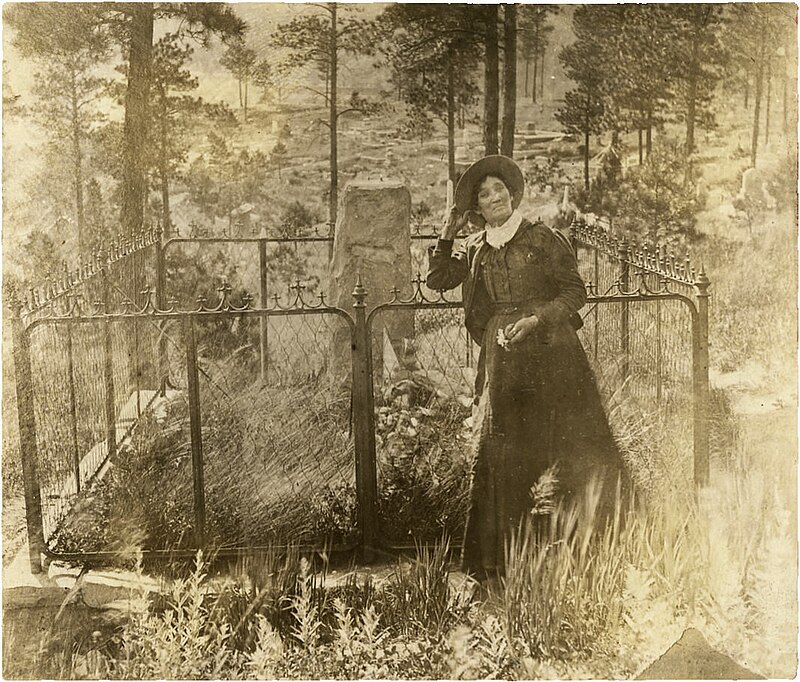
Calamity Jane at Wild Bill Hickok's Gravesite, Deadwood, Dakota Territory, 1890s

Her verified relationships included a marriage to Clinton Burke (sometimes referred to as Edward or Charley), a hack driver, in 1891 after they had lived together for seven years. Some accounts suggest she was married several times throughout her life.

Regarding children, sources indicate she had between one and four offspring. A woman named Jean Hickok McCormick claimed to be Jane and Wild Bill Hickok's daughter (born in 1873), but this was later disproven. Another claimed daughter was Maude Weir, supposedly born in 1881. Jane's first verified child was a boy born in November 1882, whom she called "Little Calamity". (5)

MONEY AND FAME Despite her considerable fame, Calamity Jane died in poverty. Her notoriety grew substantially in the late 1870s when she captured the imagination of magazine writers who covered the early days of Deadwood. One dime novel dramatically dubbed her "The White Devil of the Yellowstone".

Her fame increased further when she joined Buffalo Bill's Wild West Show in 1895. During her tours, she sold copies of her exaggerated autobiography to fans for pennies, suggesting she struggled financially despite her celebrity. By the end of her life, despite her legendary status, she had returned to Deadwood in a state of poverty and poor health.

CALAMITY JANE The origin of the nickname "Calamity Jane" is one of those splendidly American mysteries—half history, half hokum, and wholly entertaining. Like so many things from the Wild West, it comes to us swaddled in anecdote, bravado, and the kind of myth-making that could only thrive in a land where anyone with a horse and a good lie could be famous by sundown.

According to Calamity Jane herself—never a woman to let the truth spoil a good story—she earned the moniker heroically in the early 1870s while gallivanting with the military near Goose Creek, Wyoming. In her 1896 autobiographical pamphlet (a delightfully self-serving little booklet she distributed with great flair), Jane recounts how she saved the life of a wounded Captain Egan by scooping him up mid-fall like a cavalry Florence Nightingale and carrying him back to safety. So grateful was the captain, she claimed, that he declared her henceforth "Calamity Jane, the heroine of the plains"—which, you have to admit, is quite a nickname to pull from thin air if it didn’t happen.

Naturally, not everyone bought the Goose Creek episode, and alternative explanations abounded. One had it that Jane warned all would-be troublemakers that to cross her was to “court calamity”—which, frankly, sounds more like something invented by a dime novelist than a frontier scout. Another, far less gallant, suggested that Jane simply caused calamity wherever she went—like a human dust storm with a fondness for whisky and the occasional gunfight.

What we do know—because newspapers tend to be marginally less poetic than personal legend—is that by 1876 she was showing up in the Deadwood press as "Calamity Jane," already a known quantity, already wrapped in myth. As for the actual, definitive origin of the name? It’s probably a muddle of fact, exaggeration, and good old-fashioned frontier marketing.

And that, in the end, is perfectly fitting. After all, if there’s one thing the Wild West excelled at, it was turning chaos into legend and colorful characters into immortals—preferably before anyone had a chance to check the details.

FOOD AND DRINK The most documented aspect of Calamity Jane's consumption habits was her notorious drinking. Multiple sources describe her as a heavy drinker who suffered from severe alcoholism, particularly in her later years. She was described colloquially as one who "drank like a fish". This drinking contributed to her erratic behavior and ultimately to her poor health and early death.

MUSIC AND ARTS Calamity Jane's appearances in Wild West shows-including those associated with Buffalo Bill Cody and other similar productions-were highly performative in nature. The shows themselves were theatrical spectacles, blending staged reenactments of frontier life, sharpshooting exhibitions, dramatic rescues, and romanticized portrayals of cowboys, Native Americans, and legendary figures like Jane herself.

Performers, including Calamity Jane, were celebrated for their riding and shooting skills, often exaggerating their abilities and personas for the crowd. Jane was billed as a "notorious frontierswoman," and her reputation as a skilled horsewoman and marksman was central to her act.

LITERATURE Calamity Jane's most significant literary contribution was her autobiographical booklet, which she dictated in 1896. This short work was created primarily for publicity purposes to help attract audiences to her touring appearances. Historians note that much of the information in this pamphlet is exaggerated or completely inaccurate, reflecting Jane's tendency to embellish her life story.

In this autobiography, she mentioned her fondness for adventure and outdoor exercise, providing some authentic insight into her character despite the document's overall unreliability as a historical source.

NATURE Calamity Jane had a pronounced affinity for the outdoors. Her autobiography specifically mentions her "fondness for adventure and outdoor exercise". From childhood, she loved the outdoors and natural settings of the American frontier. This connection to nature shaped her life choices, skills, and the masculine clothing she adopted for practical purposes in outdoor settings.

HOBBIES AND SPORTS Calamity Jane's primary recreational activities centered around frontier skills that later became essential to her survival and legend. She had a special fondness for horses and began riding at an early age, eventually becoming an expert rider "able to ride the most vicious and stubborn of horses". A considerable portion of her early life was spent riding, and she became known as a remarkable equestrian.

Hunting was another significant activity, which she engaged in from a young age during the family's journey west. She was also renowned for her shooting abilities, earning a reputation as an excellent markswoman. These skills-riding, shooting, and hunting-served both as hobbies and practical necessities in frontier life.

1885 photos of Calamity Jane

SCIENCE AND MATHS She accompanied the Jenney expedition between May 25, 1875 and October 14, 1875, which was led by government geologists investigating mineral resources in the Black Hills of South Dakota. While her role was not scientific-Calamity Jane was likely a teamster or camp follower-her presence on such expeditions was unusual for a woman of her time.

PHILOSOPHY & THEOLOGY Calamity Jane is repeatedly described as exhibiting deep compassion and generosity, especially toward the sick and needy, often giving away her belongings to those who needed them more. Her actions-such as nursing smallpox victims and helping the destitute-reflect a kind of practical morality rooted in empathy rather than doctrine.

Some contemporary reflections see in Jane's life a kind of "fierce, table-flipping passion" for others, a love that was not quiet or conventional but active and sacrificial. While she was often viewed as amoral due to her drinking, swearing, and unconventional lifestyle, accounts suggest she knew right from wrong and sometimes expressed regret for her choices, seeking acceptance and respectability (6)

SCANDAL Calamity Jane's entire lifestyle was considered scandalous by the standards of her era. Her habit of wearing men's clothing was particularly shocking for the time, directly challenging 19th-century gender norms. Her drinking, swearing, and general behavior further contributed to her scandalous reputation.

Western dime novel authors capitalized on her notoriety by publishing "saucy tales" about her, further embellishing her already colorful life story. Many of these sensationalized accounts focused on alleged romantic relationships, particularly with Wild Bill Hickok, though historians generally dispute these claims.

MILITARY RECORD While Calamity Jane claimed significant military service, historical evidence for these claims is mixed. She reportedly became a scout for General George Custer at Fort Russell, Wyoming, in 1870, adopting the uniform of a soldier. According to her own account, she participated in the "Indian Campaign" in Arizona.

She claimed to have been on the Newton-Jenny Expedition in 1875 and General Crook's expedition of 1876, purportedly dressing in soldier's uniforms to avoid detection as a woman. According to legend, she earned her nickname "Calamity Jane" during an Indian campaign where she rescued a Captain Egan, who upon recovering supposedly said, "I name you Calamity Jane, the heroine of the plains".

Historians note that many of these military accounts come from Jane's own telling and may be exaggerated or fabricated, as was common in frontier self-promotion.

HEALTH AND PHYSICAL FITNESS In her prime, Calamity Jane was exceptionally physically capable, known as an expert rider and markswoman. Her outdoor skills and physical resilience allowed her to thrive in the demanding conditions of frontier life.

However, her health deteriorated significantly in her later years due to her hard-living lifestyle, particularly her severe alcoholism. By the turn of the century, she suffered from poor health that contributed to her early death at age 51. 

Calamity Jane shares a drink with Teddy Blue Abbott, c. 1887.

Some accounts suggest she may have contracted smallpox as a child, which provided her with immunity that later enabled her to nurse smallpox victims.

HOMES Calamity Jane's itinerant lifestyle meant she rarely maintained a permanent residence. Born in Princeton, Missouri, she lived briefly in Virginia City, Montana following the family's wagon train journey. After her mother's death, she spent time in Salt Lake City, Utah, before moving to Wyoming where she settled her siblings in Piedmont.

Throughout her adult life, she moved frequently, spending significant time in Deadwood, South Dakota. In 1882, she reportedly bought a ranch on the Yellowstone River and kept a wayside inn, though this appears to have been a relatively brief period of stability. Her unsettled lifestyle reflected the transient nature of frontier existence and her own restless character.

TRAVEL Calamity Jane's life was characterized by constant movement across the American West. Her first major journey was the wagon train from Missouri to Virginia City, Montana in 1865. Following her parents' deaths, she traveled to Salt Lake City, Utah, and later to Fort Bridger and Piedmont, Wyoming.

Her travels continued throughout her life as she moved to the Black Hills of South Dakota and Deadwood. She toured the Midwest with Buffalo Bill's Wild West Show, went to California in 1883, and traveled to Texas in 1884. This perpetual motion reflected both the opportunities and challenges of frontier life and Jane's own restless spirit.

Calamity Jane once got so drunk she rented a horse and buggy for a one-mile ride and ended up 90 miles away at Fort Laramie.

DEATH Calamity Jane died on August 1, 1903, in Terry, South Dakota, near Deadwood. She was 51 years old according to most sources, though one account suggests she was 47. By this time, her health had severely deteriorated from years of hard living and alcoholism.

Following her death, Deadwood businessmen quickly retrieved her body and, honoring her request, buried her next to Wild Bill Hickok at Mount Moriah Cemetery in South Dakota. This final resting place alongside the legendary gunfighter helped perpetuate the myths surrounding their relationship and cemented both figures in Western folklore. (7)

APPEARANCES IN MEDIA Calamity Jane's colorful persona has made her a recurring figure in depictions of the American West. During her lifetime, she appeared in Buffalo Bill's Wild West show and at the 1901 Pan-American Exposition.

After her death, her life story inspired numerous portrayals, including the 1953 musical film Calamity Jane starring Doris Day. She was memorably portrayed in the HBO series Deadwood as a complex, foul-mouthed, but ultimately sympathetic character. A 2016 documentary, Calamity Jane: Wild West Legend, further explored her life and legacy. Her enduring presence in media reflects her status as one of the most fascinating and unconventional figures of American frontier history.

ACHIEVEMENTS Calamity Jane's achievements are tied to her persona as a frontierswoman, her sharpshooting skills, her ability to navigate the Wild West, and her enduring fame as a figure of that era.

Sources (1) History Hit (2) New World Encyclopedia (3) Dress Parade (4) Legends of America (5) History Answers (6) Image Journal (7) Deadwood.com