Friday, 22 March 2013

Davy Crockett

NAME David "Davy" Crockett

WHAT FAMOUS FOR American frontiersman, soldier, and politician known as the "King of the Wild Frontier." Renowned for his wilderness skills, sharp wit, and bravery, he became a folk hero in American culture.

BIRTH Born on August 17, 1786, in Greene County, within the short-lived state of Franklin (later incorporated into Tennessee).

FAMILY BACKGROUND Davy was the fifth of nine children born to John and Rebecca Crockett, subsistence farmers of Scotch-Irish descent. His family faced financial hardships and moved frequently.

CHILDHOOD Crockett's early life was marked by financial hardship and frequent moves. His family relocated several times in search of economic stability. At the tender age of twelve, he was indentured to Jacob Siler to help alleviate the family's debt burden. This experience exposed him to the harsh realities of frontier life, as he worked as a cowboy on a grueling 400-mile cattle drive to Virginia. 

At the age of 13, Crockett attacked a school bully and, fearing his father's punishment, ran away. He spent two and a half years traveling through Virginia, Tennessee, and North Carolina, learning essential woodsman skills. When he returned home, his family barely recognized him.

EDUCATION Crockett's formal education was extremely limited. He received only about one hundred days of tutoring from a neighbor and briefly attended school before leaving due to an altercation with a bully. 

His early years on the frontier provided him with practical knowledge of survival, hunting, and storytelling, which later defined his persona.

CAREER RECORD As a teenager, to support his family and gain independence, Crockett took on various jobs. He herded cattle and worked as a cowboy for Jacob Siler, apprenticed as a hatter under Elijah Griffith, and labored for farmers John Gray and John Canady to repay family debts.

Crockett was a skilled hunter and trapper, spending much of his early life exploring the American frontier.

He served as a scout in the Creek War under Andrew Jackson.  

Crockett later became a politician, serving in the Tennessee State Legislature and the U.S. House of Representatives, representing Tennessee.

Crockett fought in the Texas Revolution and died at the Battle of the Alamo.

APPEARANCE Crockett was described as an "uncommonly fine looking man" with an amiable expression and prominent, striking features. At age 15, he was nearly 6 feet (1.8 meters) tall and very strong

Portraits depict him as stocky and middle-aged, rather than resembling the tall, handsome Fess Parker who played him on television.

David Crockett by Chester Harding

FASHION He typically dressed more like a gentleman than a backwoodsman. 

He is famously associated with wearing a coonskin cap, though in reality, he rarely donned it, preferring practical attire suited for frontier life. Contemporary drawings show Crockett wearing a broad-brimmed felt hat, popular in the mid-19th century, rather than the iconic coonskin cap. The coonskin cap was likely a later addition to his image, first appearing in drawings after 1835.

CHARACTER Crockett was known for his courage, resilience, and sharp wit.  He was a strong advocate for the common man and often spoke out against corruption and injustice. His reputation as an honest and forthright individual made him beloved among his constituents.

SENSE OF HUMOUR He had a sharp sense of humor, often weaving self-deprecating humor and tall tales into his speeches and writings. For instance, when introducing himself to his new colleagues in Congress, he reportedly said: "I am that same Davy Crockett, fresh from the back woods, half-horse, half-alligator, a little touched with the snapping turtle...I can whip my weight in wildcats...and eat any man opposed to Jackson."

RELATIONSHIPS Davy Crockett married Mary "Polly" Finley on August 16, 1806, just one day before his 20th birthday. They had three children together: John Wesley, William and Margaret. Sadly, Polly Crockett died in 1815, leaving Crockett a widower with three young children.

Image by Perplexity

Davy Crockett married Elizabeth Patton in 1815, shortly after Polly's death. Elizabeth was a widow with two small children of her own. Crockett and Elizabeth had three more children together: Rebecca Elvira, Robert Patton and Matilda.

His family life was marked by frequent moves as he sought new opportunities on the frontier, balancing his roles as a husband and father with his political career and adventurous spirit

MONEY AND FAME As an adult, Crockett attempted to establish himself financially. He built businesses on Beans Creek in Franklin County, Tennessee. However, a devastating flood in 1821, just two weeks after his election to the General Assembly, destroyed all his ventures. He received some land from his father-in-law, but he was forced to sell portions of it to pay off debts.

Crockett's political career provided some financial stability. He served in the Tennessee state legislature and later in the U.S. House of Representatives. His friend Marcus Winchester financed his early political career, but despite this support, Crockett often found himself outspent by his opponents.

While not wealthy in monetary terms, Crockett's fame grew exponentially. He became renowned for his skill as a bear hunter, famously claiming to have killed 105 bears in a single season. His reputation as a frontiersman and politician made him a popular figure. Books and plays about his life, often exaggerating his exploits, were written even during his lifetime. After his death at the Alamo, his legend grew to mythical proportions.

Crockett's legend had a significant economic impact after his death. The Crockett Almanac was a wildly popular magazine published between 1835 and 1856. In the 1950s, a Disney-inspired Crockett craze led to sales of approximately $300 million in Crockett-related merchandise. The book The Story of Davy Crockett saw a 30-fold increase in sales during this period.


FOOD AND DRINK Crockett was renowned for his hunting skills, particularly bear hunting. It's estimated that he killed over 105 bears in a single season. Bear meat likely formed a substantial part of his diet. Deer was another common source of food for frontier families like the Crocketts.

As a frontiersman, Crockett's diet included: Potatoes and other root vegetables, wild plants and foraged foods from the forest.

In one instance, Crockett and his fellow soldiers were reduced to eating potatoes found in a cellar after a battle, despite the tubers being contaminated with oil from burned Indian cabins.

Crockett was known to enjoy and provide alcoholic beverages. He referred to alcohol as "the creature." During his political campaigns, he would often buy drinks for potential voters. His friend Marcus Winchester even provided him with cash to purchase alcohol for his supporters.

MUSIC AND ARTS Contemporary accounts mention Crockett's ability to entertain fellow frontiersmen with his violin. Crockett's fiddling provided entertainment around campfires and at the Alamo, he and John McGregor reportedly used their instruments to drown out the Mexican troops' "song of death."

LITERATURE Crockett was a skilled storyteller and his autobiography A Narrative of the Life of David Crockett of the State of Tennessee (1834), became a bestseller and enhanced his mythical status.

Crockett was featured in numerous dime novels and tall tales during the 19th century, portraying him as a larger-than-life frontier hero capable of superhuman feats.

NATURE Crockett was deeply connected to the natural world. From a young age, he was drawn to the wilderness, learning to hunt, fish, and track game. The forest was his refuge, especially when political and personal stresses mounted. He approached nature as a science and hunting as an art, combining the two with excitement. Crockett considered the wilderness his "cathedral," finding solace and purpose in the outdoors.

Crockett frequently explored new hunting grounds, often hiking far into unexplored territories. He hunted various game, including turkeys, deer, feral hogs, and elk, but bears were his favorite.

PETS While not traditional pets, Crockett had a strong bond with his hunting dogs. He preferred mongrel hounds to purebred dogs for bear hunting. Some of his dogs' names included Soundwell, Old Rattler, Tiger, and Sport. His favorite hound was reportedly named Jolar, meaning "eagle-eyed" in ancient Gaelic-Scots. These stocky crossbred dogs were essential companions in Crockett's bear hunting adventures.

HOBBIES AND SPORTS Hunting was both a necessity and a hobby. His legendary marksmanship contributed to his folk-hero status.

SCIENCE AND MATHS Crockett’s knowledge was practical and based on survival skills, with no formal engagement in scientific or mathematical pursuits.

PHILOSOPHY & THEOLOGY David Crockett's philosophy and theology were shaped by his frontier experiences and the cultural context of early 19th-century America. While not a formal theologian or philosopher, his views can be gleaned from his actions and recorded statements.

While not overtly religious, Crockett had some spiritual inclinations. He was raised in a Baptist family but did not formally join a church. His writings occasionally reference God, suggesting a belief in a higher power.

Crockett adhered to a personal moral code. He believed in honesty and integrity, as evidenced by his quote, "better to keep a good conscience with an empty purse, than to get a bad opinion of myself, with a full one." His actions often demonstrated a sense of fairness and justice, such as his opposition to the Indian Removal Act.

Crockett believed in individual freedom and often championed the rights of the common man, as demonstrated by his opposition to the Indian Removal Act.

POLITICS Crockett's political views were shaped by his frontier experiences. He advocated for the rights of common people over the wealthy. His famous quote, "Be sure you're right, then go ahead," encapsulates his approach to decision-making. He valued independence, stating, "I am at liberty to vote as my conscience and judgment dictates to be right, without the yoke of any party on me."

Crockett was a member of the National Republican Party and after 1833 the Whig Party. He was a staunch critic of Andrew Jackson, particularly opposing the forced removal of Native Americans.

SCANDAL Crockett’s public opposition to Jackson alienated him from his political base, leading to his loss of re-election to Congress.

MILITARY RECORD David Crockett's military career was primarily centered around his involvement in the Creek War and the Texas Revolution.

Crockett enlisted as a scout in the Tennessee militia in September 1813. He joined Francis Jones's Company of Mounted Riflemen for a 90-day term and served under Colonel John Coffee in the war against the Creek Indians. He participated in the massacre of Tallushatchee, Alabama, in November 1813.

Crockett re-enlisted as third sergeant for a six-month term with the Tennessee Mounted Gunmen under Captain John Cowan in September 1814. During this period, Crockett was known more for his hunting skills than his combat prowess. He often provided wild game for the soldiers and felt more suited to this role than fighting Creek warriors.

After the Creek War, Crockett continued his involvement with the militia. He was elected lieutenant colonel of the Fifty-seventh Regiment of Tennessee Militia in 1818 and served as colonel of the Fifty-seventh Militia Regiment of Lawrence County.

In early 1836, Crockett joined the Texas Revolution. He arrived in Texas in February 1836 and joined the Texas volunteers at San Antonio de Bexar. He participated in the defense of the Alamo against General Antonio Lopez de Santa Anna's forces and died at the Battle of the Alamo on March 6, 1836.

While Crockett's military career was relatively brief, his participation in the Creek War and his heroic death at the Alamo significantly contributed to his legendary status. His courage and frontier skills, combined with his political career, helped shape the image of Crockett as an American folk hero.

The Fall of the Alamo by Robert Jenkins Onderdonk below depicts Davy Crockett swinging his rifle at Mexican troops who have breached the south gate of the mission.


HEALTH AND PHYSICAL FITNESS Years of frontier living kept Crockett physically fit, though the harsh conditions took their toll.

HOMES He lived in modest cabins throughout Tennessee, reflecting his frontier lifestyle.

TRAVEL Crockett traveled extensively during his early years, political career, and in his final move to Texas.

DEATH Crockett died on March 6, 1836, during the defense of the Alamo. Surviving the initial assault, he was reportedly bayoneted to death after Mexican forces overran the mission.

APPEARANCES IN MEDIA Crockett has been featured in countless books, movies, and television shows, 

The 1950s Davy Crockett television series, produced by Walt Disney and starring Fess Parker, was a cultural phenomenon. Key episodes included Davy Crockett: Indian Fighter (1954) and Davy Crockett at the Alamo (1955). These episodes were later compiled into a movie, Davy Crockett, King of the Wild Frontier.

"The Ballad of Davy Crockett" was written by Thomas W. Blackburn and George Bruns for the Disney series. This catchy song became a chart-topping hit in 1955, immortalizing the refrain, "Born on a mountaintop in Tennessee..."


In the 1950s, the Disney series sparked a nationwide craze for coonskin caps and Davy Crockett-themed toys, cementing him as a pop culture icon.

The Alamo (1960): Portrayed by John Wayne, Crockett is depicted as a brave, patriotic defender during the Battle of the Alamo.

The Last Command (1955): Starring Arthur Hunnicutt as Crockett, this film also dramatized the events of the Alamo.

Statues depicting Crockett are scattered across the United States, particularly in Tennessee and Texas, where he is celebrated as a hero.

ACHIEVEMENTS Crockett’s legacy as a defender of the common man and a symbol of rugged American individualism endures. His opposition to the Indian Removal Act and his sacrifice at the Alamo are pivotal moments in American history.

Sunday, 17 March 2013

Francis Crick

NAME Francis Harry Compton Crick

WHAT FAMOUS FOR Francis Crick is renowned for his co-discovery of the DNA double helix, a milestone in molecular biology.

BIRTH Born on June 8, 1916, in Northampton, England.

FAMILY BACKGROUND Francis Crick was the elder son of Harry and Annie Elizabeth Crick (née Wilkins.  His father and uncle ran a family boot and shoe factory. While Crick had a younger brother, A. F. who became a doctor, a more significant influence came from his grandfather, Walter Drawbridge Crick. An amateur naturalist, Walter nurtured Francis's scientific curiosity.

CHILDHOOD From a young age, Francis exhibited a strong interest in science. He devoured books on the subject and was fortunate to have his uncle Walter nearby. In a dedicated shed, Walter imparted various scientific skills to young Francis, including glass blowing, chemical experiments and making photographic prints. This early exposure to hands-on science undoubtedly shaped Crick's future path. Notably, by the age of 12, he had abandoned religious beliefs, preferring a scientific lens to understand the world.

EDUCATION Crick's formal education began at Northampton Grammar School, followed by a scholarship to the prestigious Mill Hill School in London at age 14. Here, he excelled in science subjects like mathematics, physics, and chemistry, even winning the Walter Knox Prize for Chemistry.

He continued his academic journey at University College London, obtaining a B.Sc. in physics in 1937.  While he initially started postgraduate research under Prof E. N. da C. Andrade, World War II intervened, forcing a temporary shift in his focus.

After the war, Crick transitioned to biology, pursuing his Ph.D. at Cambridge University's Caius College. He completed his doctorate in 1954, focusing on X-ray diffraction of polypeptides and proteins. This transition from physics to biology proved to be pivotal, laying the groundwork for his groundbreaking collaboration with James Watson on the structure of DNA.

CAREER RECORD During World War II, he worked for the British Admiralty,

In 1951, Crick began working with James Watson at the Cavendish Laboratory in Cambridge. Their collaboration, along with contributions from Rosalind Franklin and Maurice Wilkins, led to the identification of DNA's helical structure. Their pivotal work on DNA's structure was announced on February 28, 1953, in the Eagle pub near Cambridge's Cavendish Laboratory.

Crick and Watson's working style was characterized by candid communication, intense discussions, and a theoretical focus. They were not afraid to challenge each other's ideas, often engaging in heated debates both in their office and at the nearby Eagle pub. While they did not conduct experiments themselves, they excelled at interpreting and integrating the data of other researchers.

In 1977, Crick joined the Salk Institute for Biological Studies in La Jolla, California, as a research professor.

APPEARANCE See photo below

Francis Crick in his office. By Francis_Crick.png: Photo: Marc Liebermanderivative 

FASHION Crick was known to be always careful and well-groomed in his dress, usually wearing a colorful tie.

CHARACTER Crick was described as driven, intellectually curious, and highly competitive, with a youthful arrogance and impatience with sloppy thinking.

SENSE OF HUMOUR  Throughout his life, Crick maintained a balance between being a serious, committed scientist and someone with a playful, sometimes flippant personality. In the early 1970s, Peter Medawar suggested that Crick recast an essay he had written with Leslie Orgel about the origins of life for the fashion magazine Vogue. In response to this suggestion, Crick humorously quipped that they had originally considered Playboy magazine instead.

Crick’s sharp wit often shone in conversations. He once quipped that scientific breakthroughs require “ruthlessness” and “impatience with nonsense.”

RELATIONSHIPS Francis Crick was married twice. His first marriage was to Ruth Doreen Dodd whom he wed on February 18, 1940. They had one child together, Michael. The marriage ended in divorce on May 8, 1947.

On August 14, 1949, Crick married French artist Odile Speed. This marriage lasted until his death in 2004. With Odile, Crick had two daughters: Gabrielle and Jacqueline.

Odile, was an artist who famously drew the illustration of the double helix structure of DNA for Crick and Watson's groundbreaking paper in Nature in 1953. The Cricks were known for hosting lively parties in Cambridge and later in California, where they moved in the 1970s when Francis Crick became a professor at the Salk Institute.

Francis Crick and James Watson were drawn together by their shared fascination with DNA and the groundbreaking work of scientists like Linus Pauling. Their mutual intellectual curiosity formed the bedrock of their partnership.

Their collaboration was fueled by a blend of complementary traits: youthful arrogance, ruthlessness, and impatience with sloppy thinking. This combination of qualities allowed them to tackle the complex puzzle of DNA structure with unwavering determination.

MONEY AND FAME Crick received global recognition and numerous accolades, including a Nobel Prize in 1962, but remained focused on scientific discovery rather than wealth.

Below is a stained glass window in the dining hall of Caius College, in Cambridge, commemorating Francis Crick and representing the double helical structure of B-DNA. The stained glass was designed by Maria McClafferty and installed between 1992 and 1993

By Wikipedia user: Schutz

FOOD AND DRINK Crick was known to enjoy a hearty meal and often dined in the company of colleagues, discussing scientific theories.

Crick and his wife Odile enjoyed champagne on special occasions. When they learned about his Nobel Prize win, Odile rushed to get ice to cool champagne for a celebration.

The Cricks were renowned for their lively social gatherings. They hosted parties at their home, the Golden Helix, in Cambridge, which often featured champagne and entertaining conversations. Later, in the 1960s, their parties became more bohemian and wild.

MUSIC AND ARTS Crick appreciated Odile’s artistic talents and supported her creative pursuits, which included painting and teaching. While not an artist himself,  Crick had a fine sense of aesthetic elegance, reflected in his scientific discoveries and writing. He enjoyed the company of artists and creative individuals at their social gatherings

LITERATURE He enjoyed reading extensively, particularly scientific texts and philosophical works.

NATURE Crick was fascinated by the origins of life, even hypothesizing that life on Earth might have arrived via an unmanned rocket carrying microbial spores from an advanced civilization.

HOBBIES AND SPORTS Crick enjoyed intellectual hobbies, including chess and philosophical debates.

SCIENCE AND MATHS In the grand and occasionally haphazard saga of scientific discovery, few moments shine as brightly—or come with as many footnotes of controversy—as James D. Watson and Francis Crick’s unmasking of DNA’s structure in 1953. Their revelation of the double helix was, to put it mildly, a rather big deal. It fundamentally changed how we understand life itself, which is no small accomplishment for two men tinkering with metal models in a Cambridge lab.

The tale begins in 1951 at the Cavendish Laboratory, where Watson, a young and enthusiastic American, joined forces with Crick, a brash and brilliant Brit who, at the age of 35, had not yet completed his PhD but had plenty of opinions to make up for it. They made an unlikely but effective pair—Watson brought an unfiltered enthusiasm for the problem, while Crick had a penchant for grand theories and a voice that, according to colleagues, could carry across entire buildings.

Now, contrary to the neat and tidy version of history often told, Watson and Crick did not pull their discovery out of thin air. They leaned heavily—some might say rather too heavily—on the work of others, particularly Rosalind Franklin and Maurice Wilkins at King's College London. Franklin, a meticulous scientist, had produced astonishing X-ray diffraction images of DNA, most notably the now-famous "Photograph 51." This image, which vividly suggested a helical structure, found its way to Watson without Franklin's knowledge—an ethical footnote that historians and biographers have debated ever since.

Armed with Franklin’s data (whether they should have been or not), Watson and Crick embarked on an ambitious exercise in model-building, assembling DNA’s structure with metal plates and wire, as if life’s blueprint were some particularly tricky bit of Meccano. They soon arrived at their now-famous conclusion: DNA was not a single spiral, as some had suspected, but a double helix—a gloriously twisted ladder in which the rungs were formed by specific base pairings: adenine with thymine, guanine with cytosine, held together by delicate hydrogen bonds.

On April 25, 1953, their findings appeared in Nature under the unassuming title "Molecular Structure of Nucleic Acids: A Structure for Deoxyribose Nucleic Acid." It was, as scientific papers go, astonishingly short—barely a page and a half—but its impact was seismic. The discovery explained, with almost poetic simplicity, how genetic information could be copied and passed down through generations, providing the missing key to the mystery of heredity.

Recognition followed, albeit unevenly. In 1962, Watson, Crick, and Wilkins were awarded the Nobel Prize in Physiology or Medicine. Franklin, who had tragically died of cancer in 1958 at just 37, was ineligible under the Nobel committee’s rules, which do not allow posthumous awards. This remains one of the great injustices of scientific history, though her contributions are now widely acknowledged.

The double helix has since become one of the most iconic images in all of science, its influence reaching far beyond genetics into medicine, biotechnology, forensics, and even popular culture. All of which makes it easy to forget that this revolutionary discovery was, at its heart, the result of two audacious minds, a bit of inspired guesswork, and an arguably ill-gotten photograph.

PHILOSOPHY & THEOLOGY By the age of 12, Crick had abandoned religious beliefs, preferring a scientific lens to understand the world.

As an avowed atheist, Crick dismissed conventional religion, focusing instead on scientific explanations for life's origins.

POLITICS Crick was outspoken about the ethical implications of scientific discoveries but avoided overt political affiliations.

SCANDAL Crick’s atheism was considered controversial, particularly as he worked in the Cavendish Laboratory, which bore a biblical inscription: “Great are the works of the Lord.”

During a celebration of Crick's Nobel Prize win, there was an incident involving fireworks. A policeman arrived at Crick's home to investigate a complaint that the noise was disturbing a neighbor's greyhounds.

MILITARY RECORD During World War II, Crick worked for the Admiralty Research Laboratory, where he helped design an undetectable mine for the Royal Navy.

HEALTH AND PHYSICAL FITNESS Crick remained active throughout his life, maintaining a sharp mind and keen energy for scientific work.

HOMES After joining the Medical Research Council Unit in 1949, Crick and his wife, Odile, settled in Cambridge. They initially made do with a small, austere flat, reflecting their modest circumstances. Later, they moved to a more comfortable home at 19 Portugal Place, affectionately known as "The Golden Helix." This house became renowned for the lively parties the Cricks hosted, drawing in a vibrant mix of scientists and intellectuals.

In the late 1970s, the Cricks embarked on a new chapter, relocating to California when Francis accepted a distinguished professorship at the Salk Institute. They divided their time between two homes: a suburban hilltop residence in La Jolla and a desert retreat.

TRAVEL Crick traveled widely, presenting lectures and collaborating with international researchers.

DEATH Francis Crick passed away on July 28, 2004, in San Diego, California, at the age of 88. His death came after he had been diagnosed with colon cancer.

Crick spent his last days at the University of California, San Diego (UCSD) Thornton Hospital in La Jolla, where he ultimately succumbed to his illness.

Following his death, Crick's body was cremated. In accordance with his wishes, his ashes were scattered in the Pacific Ocean. This choice of final resting place reflects Crick's connection to California, where he had lived and worked for many years at the Salk Institute for Biological Studies.

APPEARANCES IN MEDIA Crick and Watson's DNA discovery has been depicted in various documentaries, and films, cementing their legacy in popular culture.

The Race for the Double Helix (1987) is a BBC drama, starring Jeff Goldblum as James Watson and Tm Pigott-Smith as Francis Crick, portrays the events leading up to the discovery of the DNA structure. 

Crick occasionally participated in televised discussions and lectures, sharing his insights on genetics and the origins of life.

ACHIEVEMENTS Co-discovery of the DNA double helix.

Nobel Prize in Physiology or Medicine in 1962, shared with James Watson and Maurice Wilkins.

Major contributions to the understanding of genetic coding and molecular biology.

Thursday, 14 March 2013

Michael Crichton

NAME John Michael Crichton

WHAT FAMOUS FOR A prolific American author and filmmaker, known for his techno-thrillers and medical fiction.

BIRTH Born on October 23, 1942, in Chicago, Illinois, USA.

FAMILY BACKGROUND Crichton was the eldest of four siblings in a middle-class family. His father, John Henderson Crichton, was a journalist and advertising agent, and his mother, Zula Miller Crichton, was a homemaker with a deep appreciation for the arts.

CHILDHOOD As a child, Crichton’s health was often fragile, leading him to spend many hours indoors. However, this didn’t dampen his curiosity. Encouraged by his parents, he immersed himself in books, science experiments, and model trains. His mother, a talented pianist, exposed him to the arts, fostering a lifelong love of learning.

By the age of 14, Crichton had already published his first article in The New York Times. As a teenager, he excelled academically, played basketball, and edited the school newspaper. This multifaceted young man laid the foundation for a remarkable career as a writer and polymath.

EDUCATION Crichton's academic journey was as fascinating as his literary career. He initially studied English at Harvard University but switched to biological anthropology, graduating summa cum laude in 1964. He then pursued medical studies at Harvard Medical School, obtaining his M.D. in 19692. However, Crichton never practiced medicine, instead choosing to focus on his passion for writing.

During his time as a medical student, Crichton began his writing career under the pseudonyms John Lange and Jeffrey Hudson.

Michael Crichton felt one of his college writing professors was giving him unfair grades. To prove it, he submitted an essay by George Orwell under his own name and the professor gave him just a B-. 

CAREER RECORD Crichton began writing novels under pseudonyms during medical school to support himself. 

His breakout novel, The Andromeda Strain (1969), was a bestseller and launched his career. 

He created and produced the hit TV series ER.

APPEARANCE Michael Crichton was a striking figure, known for his towering 6'9" frame and lean physique. With his dark hair, often combed back, and a set of paper-white teeth, he cut an imposing figure.

Despite his imposing height, he carried himself with an easygoing demeanor, never seeming to use his stature for intimidation. Instead, he presented a relaxed and approachable persona.

Crichton at Harvard University in 2002. Jon Chase photo/Harvard News Office

FASHION Crichton's style was typically casual and understated. He was often seen in jeans and a casual shirt, though he could also adopt a more formal, scholarly look for professional settings. 

CHARACTER Crichton was a deeply curious and meticulous individual, known for his work ethic and ability to delve into complex scientific concepts.

SENSE OF HUMOUR Crichton possessed a dry, intellectual sense of humor, which occasionally surfaced in his works through satirical elements. His Orwell essay experiment showcased his sharp wit and critique of academia.

RELATIONSHIPS Michael Crichton was married five times throughout his life. 

Joan Radam: Married on January 1, 1965, divorced in 1970.

Kathy St. Johns: Married on December 31, 1978, divorced on September 5, 1980,  because according to Crichton his attorney wife was "pursuing a career".. Crichton reportedly met St. Johns in the Hollywood Hills

Suzanne Childs: Married on October 22, 1981, divorced on December 30, 1983.

Anne-Marie Martin: Married in 1987, divorced in September 2002. They had a daughter named Taylor

Sherri Alexander: Married in Hawaii on May 4, 2005, until his death on November 4, 2008. They had a son  John Michael Todd Crichton, who was born on February 12, 2009, three months after Crichton's death.

Despite his multiple marriages, Crichton expressed a desire to have a family life, once stating, "I'd like to get married again and have children, and live like a normal person." However, his personal relationships were often overshadowed by his dedication to work.

MONEY AND FAME Michael Crichton amassed a substantial fortune and widespread fame through his multifaceted career as an author, screenwriter, and producer. At the time of his passing in 2008, his net worth was estimated at a staggering $400 million, equivalent to approximately $480 million in today's currency.

Crichton's literary prowess was a primary driver of his wealth. His novels, including the iconic Jurassic Park, have collectively sold over 200 million copies worldwide, consistently topping bestseller lists.

His influence extended beyond the literary realm to Hollywood. Numerous Crichton novels were adapted into blockbuster films, and he personally wrote and directed movies such as Westworld and The Great Train Robbery. Additionally, he created the long-running and highly successful TV series ER, which generated over $3 billion in syndication fees.

Crichton's unparalleled success across various media platforms solidified his fame. In 1993, he achieved the extraordinary feat of simultaneously having the #1 movie (Jurassic Park), #1 TV show (ER), and #1 book (Disclosure). Jurassic Park alone became one of the highest-grossing films of all time, and Crichton received a substantial $1.5 million for the film rights, along with an additional $500,000 as a consultant.

FOOD AND DRINK Michael Crichton had a unique approach to eating, especially when he was deep in the throes of writing. He believed in the power of routine to maintain focus and productivity.

To achieve this, Crichton often stuck to a strict dietary regimen while working on a book. For instance, during the writing of Congo, his daily meal consisted of barbecued beef and salad. Similarly, while penning The Great Train Robbery, his diet was limited to tuna fish.

To complement his meals, Crichton was a fan of Coca-Cola. His refrigerator was often stocked with a dozen cans, a testament to his reliance on this beverage during intense writing sessions. He also kept pre-made ham and cheese sandwiches on hand, a convenient snack to fuel his creativity.

While Crichton had a penchant for Asian cuisine, particularly Japanese, Chinese, and Thai, he often eschewed food and drink at social gatherings. This disciplined approach to eating and socializing underscored his dedication to his craft.

MUSIC AND ARTS Crichton enjoyed classical music. He was also a fan of musicals and expressed interest in potentially working on a movie adaptation of A Chorus Line. 

He often used art and design as inspiration for his writing. His novel Jurassic Park was deeply influenced by aesthetics and visualization.

Crichton was also a notable art collector with a collection that included works by Picasso, Lichtenstein, and Jasper Johns. In 2010, a Christie's auction of about 80% of his collection netted $93 million.

He often used art and design as inspiration for his writing. His novel Jurassic Park was deeply influenced by aesthetics and visualization.

LITERATURE Before he was a household name, Crichton was penning thrillers under pseudonyms like John Lange and Jeffrey Hudson. His debut novel, A Case of Need, a medical mystery, even snagged a prestigious Edgar Allan Poe Award. But it was The Andromeda Strain that truly launched him into the stratosphere. This sci-fi thriller, published under his own name, was a page-turner that had readers gripped, and it set the stage for a career of blockbuster hits.

From the terrifying The Terminal Man to the mind-bending Sphere, Crichton’s books were a rollercoaster ride of science, suspense, and a healthy dose of paranoia. He even tackled the big screen, directing the groundbreaking Westworld and creating the iconic TV series ER.

A voracious reader, Crichton admired classic authors like George Orwell and was deeply influenced by science fiction and non-fiction writers alike.

NATURE Crichton loved nature and wilderness exploration, which inspired settings in his novels, such as the remote jungles of Congo and Jurassic Park.

PETS Crichton's affinity for animals is evident in his detailed depiction of wildlife in his works.

HOBBIES AND SPORTS Crichton enjoyed scuba diving, photography, and travel. His hobbies often informed his novels' richly detailed settings.

As evident in his novels, Crichton had a keen interest in biology and anthropology, emerging technologies and medical science.

In high school, Crichton was the star basketball center due to his height (6 feet 5 inches by sophomore year).

He had an interest in sports performance, noting how athletes achieve seemingly impossible feats

SCIENCE AND MATHS A lover of science, Crichton used his background in anthropology and medicine to ground his speculative fiction in real scientific principles, making his stories compelling and believable.

PHILOSOPHY & THEOLOGY Michael Crichton's philosophy was characterized by a blend of scientific skepticism, openness to unconventional ideas, and concern about the societal impacts of technology and environmental policies. His views often challenged mainstream scientific and environmental narratives, making him a controversial figure in these debates.

While not overtly religious, Crichton grappled with existential questions. He criticized the inability of science to answer "why" questions about existence and meaning and recognized the human need for understanding beyond pure materialism. However, he was also critical of traditional religious answers to these questions.

Crichton’s works often explored philosophical themes like ethics in science, the dangers of unchecked technology, and human hubris.

POLITICS Crichton was critical of political correctness and bureaucracy, themes that appeared in his novels and essays. His views on climate change, expressed in State of Fear, sparked controversy.

SCANDAL Crichton’s critique of global warming in his novel State of Fear drew criticism from environmentalists and scientists, who argued his portrayal was misleading. It sparked public debates about climate change and environmentalism. The author appeared in media defending his portrayal of global warming as a complex and not universally settled issue, sparking backlash and discussions in both scientific and public forums.

MILITARY RECORD Crichton showed interest in the ethical implications of military technology in works like The Andromeda Strain.

HEALTH AND PHYSICAL FITNESS Crichton maintained good health through much of his life but was diagnosed with lymphoma in 2008, which led to his untimely death.

HOMES  Crichton owned several homes, reflecting his love for nature and solitude. They included:

A sprawling home in New York state, which was given to his ex-wife Anne Marie Crichton as part of their divorce settlement.

A Hawaiian estate, which Crichton retained after the divorce.

A home in Santa Monica, California, where he was living separately from Anna-Marie at the time of their divorce.

TRAVEL Crichton was an avid traveler and explorer. He began writing about his travels at a young age, having a travel column published in The New York Times at just 14 years old. He explored destinations like Africa, Asia, and the Pacific, which inspired the exotic locales of his novels.  Crichton's adventures around the world helped shape his writing and led to his non-fiction book Travels.

DEATH Michael Crichton died on November 4, 2008, in Los Angeles of lymphatic cancer at the age of 66.

Crichton's struggle with cancer was kept private, with his family describing it as a "courageous and private battle" in their statement following his death. The author had managed to keep his illness out of the public eye, which came as a surprise to many when his passing was announced.

A private funeral was planned for the author. The family did not disclose specific information about the burial location or ceremony

Following his death, Steven Spielberg, who directed Jurassic Park, praised Crichton's talent and described him as a "gentle soul"

APPEARANCES IN MEDIA Michael Crichton made numerous appearances in media throughout his career, reflecting his status as a literary and cinematic icon. Here are the key highlights:

Crichton frequently appeared on television programs and interviews to discuss his works and ideas. He was known for his articulate explanations of scientific concepts and their role in his storytelling, appearing on shows like The Today Show, Charlie Rose, and The Oprah Winfrey Show.

Crichton made a brief cameo in Jurassic Park: The Ride at Universal Studios, where he appeared in the ride’s promotional and background materials.

Crichton’s career and works have been featured in several documentaries, including retrospectives on Jurassic Park and ER. These programs often focus on his groundbreaking fusion of science and fiction, as well as his influence on the film and television industries. 

Many of Crichton’s novels, including Jurassic Park, The Andromeda Strain, Congo, Sphere, and Timeline, have been adapted into major motion pictures. These films often included his input as a consultant, and his influence can be seen in the scientific rigor and storytelling style.

The Simpsons parodied Jurassic Park in multiple episodes. Perhaps the most iconic homage is in "Itchy & Scratchy Land" (Season 6, Episode 4). This episode parallels Jurassic Park with its depiction of a theme park gone awry, albeit with animatronic cartoon characters instead of dinosaurs. The park's logo, high-tech security systems, and chaotic failure are all direct nods to Crichton’s classic story.

ACHIEVEMENTS Authored over 25 novels, with many adapted into iconic films.

Created the Emmy-winning TV series ER.

Jurassic Park grossed over $1 billion, revolutionizing CGI in cinema.

Awarded the Mystery Writers of America Edgar Award for A Case of Need.

Posthumously remembered as one of the most influential science fiction and techno-thriller writers of his time.

Saturday, 9 March 2013

Joan Crawford

NAME Joan Crawford (born Lucille LeSueur)

WHAT FAMOUS FOR Joan Crawford was a legendary American film actress celebrated for her transition from silent films to talkies, her Academy Award-winning performance in Mildred Pierce (1945), and her iconic roles in classic Hollywood cinema.

BIRTH Crawford was born on March 23, 1908, though some sources suggest she may have been born as early as 1903. Her birthplace was San Antonio, Texas.

FAMILY BACKGROUND Born Lucille Fay LeSueur, she was the youngest child of Thomas E. LeSueur, a laundry laborer, and Anna Bell Johnson. Her father abandoned the family shortly before her birth.

Her mother later remarried Henry Cassin, a theater owner. Crawford, known as Billie Cassin during her childhood, believed Cassin to be her biological father.

CHILDHOOD Crawford grew up in poverty, working various jobs to help support her family. She had a tumultuous relationship with her stepfather, Henry Cassin, who managed a theater in Lawton, Oklahoma, sparking her early interest in performing.

After her mother and stepfather separated, the family faced financial difficulties. To help support her family, Crawford began working at a young age, scrubbing floors at the tender age of nine.

EDUCATION Her formal education was limited. Crawford attended St. Agnes Academy and Rockingham School, often working to pay for her tuition. Due to her heavy workload, she frequently missed classes, and her academic record was reportedly falsified. In 1922, she briefly attended Stephens College in Columbia, Missouri, but left after just three months, realizing she was not prepared for college-level work.

Despite her educational challenges, Crawford showed early promise as a performer. Her stepfather introduced her to the world of theater and performing, and she even won her first dancing contest at the Jack O'Lantern Cafe in Kansas City. After leaving Stephens College, she returned to Kansas City determined to pursue a career as a dancer.

CAREER RECORD Crawford began her career as a dancer and chorus girl before being discovered by Metro-Goldwyn-Mayer (MGM). Here's her resume

Began her career as a dancer in traveling theatrical companies

1924: Made her Broadway debut.

1925: Signed a contract with Metro-Goldwyn-Mayer.

Rose to stardom in the 1930s and 1940s

1945 Won an Academy Award for Best Actress for her performance in Mildred Pierce

Continued to act in films and television throughout the 1950s and 1960s

APPEARANCE Joan Crawford, a petite woman standing at just 5'3", was naturally a freckle-faced redhead. However, this was far from the image she projected on screen. Her most striking features were her large, expressive eyes and her full, sensual lips, which she often accentuated with bold makeup. Her iconic look, which has been imitated but never truly replicated, included several signature elements:

Arched eyebrows: A style she popularized in the early 1930s.

Wide, emphasized eyes: Achieved through makeup and a daily boric acid rinse.

A bold red lip: A dramatic slash of lipstick that drew attention to her mouth.

Broad, padded shoulders: A trademark that created a striking V-shaped silhouette.

Crawford in 1925

FASHION Crawford’s style evolved throughout her career, reflecting the changing trends of the times. In the 1920s, she embraced the flapper era, sporting cropped hair and a natural acting style. By the 1930s, she had refined her classic look with the help of designer Gilbert Adrian, adopting broad shoulders and glamorous gowns. As the 1940s progressed, her style matured, often portraying working women in simpler, less extravagant costumes. In the 1950s, she took on a more androgynous look in films like "Johnny Guitar," with leather boots, breeches, and a severe haircut.

Crawford was obsessive about her appearance. She followed a strict skincare regimen, including daily ice facials, and exercised rigorously to maintain her figure. She also worked closely with renowned photographers like George Hurrell to ensure her public image was always flawless.

She stated in her  book My Way of Life: "A turquoise necklace with amethyst earrings is a crime."

By constantly reinventing her look and maintaining a tight control over her image, Joan Crawford cemented her status as a timeless Hollywood icon.

1936 publicity photo of Joan Crawford

CHARACTER Ambitious and determined, Crawford earned a reputation for being strong-willed and often domineering. She was known for her intense work ethic and perfectionism. 

SENSE OF HUMOUR Joan Crawford's sense of humor often manifested in her sharp wit and sometimes outrageous statements, often with a touch of self-deprecation or irony

Her book My Way of Life contains several humorous quotes that showcase her unique wit and perspective. Here are some of the funniest examples:

On staying slim: "I've persuaded myself that I hate things that are bad for me—fattening foods, late nights and loud, aggressive people head the list."

On constant exercise: Crawford advises to "Clench your buttocks in the grocery line! Firm your calves while you brush your teeth! Do odd, scary facial exercises that creep out your taxi driver!"

RELATIONSHIPS Joan Crawford's romantic life was as eventful as her Hollywood career, featuring four marriages and several notable relationships. Her four marriages were to;

(a) Her first marriage was to Douglas Fairbanks Jr. Crawford and Fairbanks Jr. first met in 1927 after Joan Crawford saw Fairbanks Jr. perform in the stage play Young Woodley. Impressed by his performance, Crawford sent him a note, which led to their first meeting. Their relationship developed further in 1928 when Crawford attended another of Fairbanks Jr.'s performances and sent him a telegram complimenting his work. They began dating seriously during the filming of Our Modern Maidens (1929), which solidified their romance and led to their engagement.

They married on June 3, 1929, in a small, secret ceremony at St. Malachy's Roman Catholic Church (also known as "The Actors' Chapel") in Manhattan, New York City. The ceremony was attended by Fairbanks Jr.'s mother, Beth Sully, but not by his famous father, Douglas Fairbanks Sr., or his stepmother, Mary Pickford, who initially disapproved of the match.

The relationship was marked by increasing personal and professional differences, and both later acknowledged infidelities and growing apart during the marriage. Crawford and Fairbanks divorced in 1933. (1)

(b) Actor Franchot Tone in 1935. They married after appearing together in Today We Live (1933). Their marriage lasted until 1939.

(c) Actor Phillip Terry: Wedding: July 21, 1942 (Crawford married him after only six weeks of dating). Divorced: 1946

(d) Pepsi-Cola president Alfred Steele: Wedding: May 10, 1955, in Las Vegas. Crawford described her union with Alfred Steele as her happiest, saying, "He was so right for me in every way." Unfortunately, this marriage was cut short by Steele's death in 1959.

Crawford and Steele return from their European honeymoon https://calisphere.org/item/c99b8cb7e0a015c491988be2407152e7/

Crawford and Clark Gable had a close relationship that spanned decades. They co-starred in eight films together, more than with any other actor. Rumors of an on-and-off affair between them persisted for years, though the exact nature of their relationship remains speculative. 

Before and between her marriages, Crawford was known to have had several relationships and flings, particularly during her early years in Hollywood as a young dancer and rising star

Crawford never had any biological children of her own. She had reportedly tried to have children with her previous husbands Douglas Fairbanks Jr. and Franchot Tone, but there were rumors of abortions and several miscarriages She adopted five children in her lifetime:

Christina Crawford: Adopted in early 1940 when she was less than a year old.

Christopher Crawford (I): Adopted in June 1941 but was later reclaimed by his biological mother after about a year.

Phillip Terry Jr. (later renamed Christopher Crawford): Adopted in 1943 with her then-husband Phillip Terry. After their divorce in 1946, Crawford changed his name to Christopher.

Cynthia "Cindy" Crawford: Adopted in 1947 

Cathy Crawford: Adopted in 1947 as a twin to Cindy 

Crawford's relationships with her two older children, Christina and Christopher, were described as acrimonious. She ultimately disinherited these two children

MONEY AND FAME Crawford achieved significant wealth and fame, maintaining her star status for decades. She later became a spokesperson and board member for Pepsi-Cola.

FOOD AND DRINK Joan Crawford was known for her disciplined approach to diet and fitness, a trait essential to maintaining her Hollywood image. Her eating habits were characterized by moderation and a focus on protein. She was a slow eater, often enjoying meals in small portions. Her typical breakfast included fruit, tea, and a single egg. When filming, she would have a light breakfast of fruit and tea, followed by a more substantial meal of eggs, bacon, or sausage.

Lunch was typically light as well, perhaps a small steak with tomatoes or boiled chicken. Crawford avoided sweets and potatoes, recognizing their impact on weight gain. She preferred savory flavors to sweet, and enjoyed snacks like hard-boiled eggs, raw carrots, and green onions. Fish was a favorite, as she believed it was a "wonderful beauty food."

Crawford had some distinctive food preferences. She enjoyed tomatoes with a tangy dressing of lemon or vinegar and black pepper. 

Her unique connection to Pepsi-Cola also shaped her dietary habits. She became involved with the company through her marriage to Alfred Steele, the company's president. After his death, she took his place on the board of directors and became a passionate ambassador for the brand. She was known for her love of Pepsi and vodka, a drink she often insisted others enjoy with her.

Crawford's relationship with Pepsi-Cola became a significant part of her public image and career in her later years. Her dedication to the brand and her business acumen were evident in her tireless promotion of Pepsi products.

MUSIC AND ARTS Crawford enjoyed music and often attended classical and contemporary concerts.

Joan Crawford, a woman of formidable ambition and a wardrobe to match, began her career hoofing it around the country in traveling theatrical companies. After a brief Broadway stint, she was plucked from obscurity by the mighty MGM. Initially, she was stuck playing bit parts, a situation that, to put it mildly, did not amuse her. Undeterred, she launched a relentless publicity campaign, positioning herself as the nation's go-to flapper. By the 1930s, she was a major star, her name rivaling those of Norma Shearer and Greta Garbo.

Crawford's films often followed a familiar pattern: a plucky young woman, usually from humble beginnings, clawing her way to success and romance. These "rags to riches" tales were a perfect fit for Depression-era audiences, particularly women who saw in Crawford a symbol of hope and aspiration. She became one of Hollywood's highest-paid stars, but as the 1930s wore on, her films began to underperform. By the end of the decade, she was unceremoniously labeled "box office poison."

After a hiatus, Crawford staged a triumphant comeback with her Oscar-winning performance in Mildred Pierce. 

Though she continued to act in films and television throughout the 1960s, her career eventually wound down. Her final film, the delightfully dreadful Trog, marked the end of her on-screen career. She retreated from public life, becoming increasingly reclusive until her death in 1977.

LITERATURE Crawford was an avid reader with a preference for self-improvement and motivational books.

Her biographies include: 

Mommie Dearest (1978): Christina Crawford's memoir became a cultural phenomenon, overshadowing much of Joan's career legacy.

Joan Crawford: A Biography (1974) by Bob Thomas: A more balanced portrayal, focusing on her professional achievements.

Not the Girl Next Door (2008) by Charlotte Chandler: An intimate look at Crawford’s life, based on interviews and archival materials.

NATURE Although her Hollywood life was glamorous, Crawford appreciated the peace of gardens and natural landscapes.

PETS Joan Crawford was a devoted dog owner throughout her life, with several canine companions playing significant roles in her personal life and public image.

One of her most famous dogs was Woggles, a Scottish Terrier owned in the early 1930s. Woggles was a beloved Hollywood pet, appearing in countless photographs and receiving fan mail and gifts from young admirers. Sadly, the little terrier passed away at the young age of two.

During her marriage to Franchot Tone, Crawford owned two Dachshunds named Stinky and Pupschen. Stinky belonged to Joan, while Pupschen was initially Franchot's. After their divorce in 1939, Joan gained custody of Pupschen. These dogs were among her most photographed pets.

Another beloved companion was Cliquot, a Poodle who often appeared in photographs with Crawford. The actress was known to spoil her canine companions.

In addition to these dogs, Crawford owned a variety of other pets throughout her life. In 1933, she and her then-husband Douglas Fairbanks Jr. had a menagerie of pets, including a St. Bernard named Jacques, a Scottish Terrier named Typhoon, a puppy offspring of Typhoon, and a Kinkajou, a small rainforest mammal.

In her later years, Crawford owned a Shih Tzu named Princess Lotus Blossom. This dog appeared in one of Crawford's last public photos in 1976.

HOBBIES AND SPORTS One of her notable hobbies was knitting. Often seen knitting on film sets, she found this activity to be a calming and productive way to pass the time between scenes. It not only helped her relax but also kept her hands busy during moments of nervousness. However, her knitting habit once led to a minor on-set dispute with co-star Norma Shearer during the filming of "The Women."

Despite her glamorous image, Crawford had a surprising passion for domestic chores. She enjoyed cleaning, ironing, and cooking. This interest in cleanliness and order likely stemmed from her challenging childhood experiences.

She was passionate about dancing and often credited her early career as a dancer for her enduring physical fitness.  


Crawford followed a strict exercise regimen and encouraged others to stay fit. She even suggested organizing neighborhood exercise clubs for those looking to improve their physical appearance.

PHILOSOPHY & THEOLOGY A devout follower of Christian Science, Crawford relied on her faith for guidance, especially during her later years.

POLITICS Crawford generally avoided public political endorsements but supported humanitarian causes.

SCANDAL Her legacy was tarnished by her adopted daughter Christina Crawford's memoir, Mommie Dearest (1978), which accused her of abusive behavior.

MILITARY RECORD Crawford actively participated in USO shows during World War II, entertaining troops.

HEALTH AND PHYSICAL FITNESS Crawford was known for her disciplined approach to fitness, maintaining a rigorous beauty and exercise regimen throughout her life.

HOMES Joan Crawford owned several homes throughout her life, both in California and New York. Here are some of her most notable residences:

California: 

Brentwood Mansion: This was her primary residence for many years, a large and luxurious home where she entertained guests and raised her family.

Beverly Hills Apartment: An earlier residence, where she lived before purchasing the Brentwood mansion.

New York:

East 70th Street Penthouse: A luxurious penthouse apartment overlooking Central Park.

Imperial House Apartment: A nine-room apartment where she lived in her later years.

TRAVEL Crawford traveled extensively, both for work and leisure, often blending business trips with personal exploration.

DEATH Joan Crawford died on May 10, 1977, in New York City at the age of 71. She passed away  after years of declining health, but had refused treatment due to her faith in Christian Science. At the time of her death, only Crawford's housekeeper and a longtime female fan were present

Her death occurred on a significant date - her wedding anniversary with Alfred Steele. The official cause of death was listed as acute coronary occlusion (heart attack). However, there are some conflicting reports about the circumstances:

Liver cancer has been mentioned as a possible underlying cause.

There were also suspicions of suicide due to the symbolic importance of the date1.

Crawford was cremated following her death. Her remains were interred at Ferncliff Cemetery and Mausoleum in Hartsdale, New York. She is interred in the same mausoleum as fellow MGM star Judy Garland. Her ashes were placed alongside those of her fourth husband, Alfred Steele1.

Ferncliff Cemetery is known for its lavish burial spaces and community mausoleums. It's located about 25 miles north of Midtown Manhattan and was founded in 1902

APPEARANCES IN MEDIA Joan Crawford's captivating life and career have been explored extensively in media, both during her lifetime and posthumously. Here are some notable appearances and portrayals:

Mommie Dearest (1981): Based on her daughter Christina Crawford's controversial memoir, this film starred Faye Dunaway as Joan Crawford. It portrayed her as a demanding, abusive mother, cementing her public image as both a Hollywood legend and a complex personality.

Joan Crawford: The Ultimate Movie Star (2002): This TCM documentary highlighted her career achievements and enduring legacy.

Feud: Bette and Joan (2017),  Crawford's feud with Bette Davis and their collaboration on What Ever Happened to Baby Jane? became the basis for the acclaimed miniseries Feud: Bette and Joan starring Jessica Lange as Crawford. The show dramatized their rivalry and brought renewed interest to her life and career.

ACHIEVEMENTS Crawford's enduring legacy includes an Academy Award for Mildred Pierce, her groundbreaking transition from silent to sound films, and her status as one of Hollywood’s most iconic stars.

Source (1) Stars and Letters

Tuesday, 5 March 2013

Thomas Crapper

NAME Thomas Crapper

WHAT FAMOUS FOR Inventor and businessman, known for his contributions to the development of modern plumbing and sanitation systems, particularly the flushing toilet.

BIRTH Born in 1836 in Thorne, Yorkshire. Exact date unknown but baptized on September 28, 1836.

FAMILY BACKGROUND Thomas Crapper's father was Charles Crapper, who worked as a steamboat captain. His mother was Sarah Crapper.

Thomas had several brothers: Robert, who worked as a seaman, James, who was a waterman and George Green Crapper, who was also a plumber and had established himself in London earlier than Thomas.

CHILDHOOD Thomas Crapper grew up in the Waterside area at Thorne Quay, Yorkshire. His father ran a regular steam packet (paddle steamer) service along the River Don from Waterside to Hull.

As a child, Thomas lived with his mother and brothers in Thorne. It's worth noting that during this period, child labor was common in England. The Factory Act of 1833 had set limits on child workers, but even these would be considered unacceptable by today's standards

EDUCATION Between 1851 and 1860, he was trained to become a qualified plumber by his older brother George, a master pumber, in Chelsea, London.

This apprenticeship laid the foundation for Crapper's future career as a plumber and sanitary engineer, ultimately leading to his successful business and innovations in the field of plumbing.

CAREER RECORD Began as an apprentice plumber in Chelsea.

Became a journeyman plumber before establishing himself as a sanitary engineer in 1861.

Set up workshops and a brass foundry in Marlborough Road, London.

Invented and showcased the siphon flush in 1863.

Gained fame when commissioned by Prince Edward (later King Edward VII) in the 1880s to install plumbing, including 30 lavatories, at Sandringham House.

Owned the world’s first bath, toilet, and sink showroom on King’s Road, London.

APPEARANCE Existing portraits depict him as a gentleman of his era with neatly groomed facial hair and formal attire.

Portrait of Thomas Crapper, populariser of the flush toilet.

FASHION As a prosperous Victorian businessman, Thomas Crapper would have adhered to the prevailing fashion of the era. His formal attire likely consisted of tailored suits crafted from high-quality wool or other fine fabrics. Worn beneath the jacket, vests added a layer of sophistication. Crisp white shirts with high collars were paired with neckties or cravats, completing the formal ensemble. As a man of his social standing, a bowler hat or top hat would have been his typical headwear.

Given his profession as a plumber and sanitary engineer, Crapper would have required attire suitable for practical tasks, especially when visiting construction sites. To shield his clothing from dirt and grime, he would have worn protective aprons. Sturdy boots were essential footwear for navigating working environments.

CHARACTER Known for his innovative spirit, business acumen, and dedication to improving sanitation.

RELATIONSHIPS On July 26, 1860, at the age of 23, Thomas married Maria Green in Chelsea, London. Maria was his cousin and childhood sweetheart. 

The marriage took place during a pivotal time in Thomas Crapper's career, just one year before he established Thomas Crapper & Co., which would become a leading sanitary equipment company serving royal households and contributing significantly to Victorian-era improvements in public health and sanitation.

The couple had only one child together: A son named John Green Crapper, born in 1862. Tragically, John died in infancy in 1863, at just one year old.

Thomas and Maria's marriage lasted for over four decades. However, their union came to an end when Maria passed away in 1902, two years before Thomas retired from his successful plumbing business.

MONEY AND FAME Thomas Crapper's wealth and fame were primarily derived from his successful plumbing business and innovative contributions to sanitary engineering.

Founded in 1861, Thomas Crapper & Co. quickly established itself as a leading plumbing firm in London. The company's reputation was significantly boosted by its royal connections. In 1886, Crapper was commissioned to design and replace the drainage and plumbing systems at Sandringham House, earning the company its first Royal Warrant. Subsequent commissions for Buckingham Palace and Windsor Castle further solidified Crapper's position as a preferred supplier to the British monarchy.

Crapper was a pioneer in marketing and innovation. He opened the world's first bathroom showroom, allowing customers to "try before they buy." This daring move, along with the use of large plate-glass windows to display products, was revolutionary for the time. While Crapper didn't invent the flush toilet, he held nine patents for various plumbing improvements, including the floating ballcock and advancements to U-bend and S-bend traps.

Crapper's name became synonymous with toilets, particularly after World War I when American servicemen stationed in England began using "crapper" as slang for toilets. This association, although based on misconceptions, has contributed to Crapper's enduring fame.

Manhole cover, inscribed "T Crapper & Co Sanitary Engineers by Patrick Mackie 

FOOD AND DRINK Given Crapper's success and royal connections, he would have had access to a wide variety of foods, including imported items that were becoming more available due to improvements in transportation and preservation techniques

LITERATURE He was the subject in 1969 of the humorous biography by New Zealand satirist Wallace Reyburn, Flushed with Pride: The Story of Thomas Crapper. The book combines historical facts with light-hearted storytelling, cementing Crapper’s reputation as a pioneer in sanitation while playing on the humorous aspects of his legacy. Though not entirely free from exaggeration or myth, the Reyburn's tome is a popular and enduring account of his life.

HOBBIES AND SPORTS Craper likely focused on his craft, as there’s no mention of hobbies beyond his work.

SCIENCE AND MATHS Crapper's  siphon flush system showcased a practical application of fluid mechanics.

INVENTIONS Thomas Crapper - the man who, despite what you might think, didn’t actually invent the loo. That particular honor, if you can call it that, goes to a fellow named Sir John Harington, who, back in 1596, came up with the idea of flushing away your troubles with a bit of water.

But don’t let that diminish Crapper’s contribution to the world of plumbing. Oh no, he was a bit of a whizz with a spanner, that Crapper. He invented the floating ballcock, a clever little device that regulates the water level in your cistern, preventing it from overflowing and turning your bathroom into a watery catastrophe. He also improved upon the S-bend, making it less likely to clog and smell up the joint.

Crapper was a bit of a marketing genius, too. He opened the world’s first bathroom showroom in 1870, a daring move that allowed people to see and even try out toilets before buying them. It was like a drive-thru for drains, a revolutionary concept at the time.

So, while Crapper didn’t invent the loo, he certainly made it a lot more convenient and less smelly. And for that, we should all be grateful.

SCANDAL The association of his name with the word "crap" is coincidental and has no scandalous origin.

HEALTH AND PHYSICAL FITNESS Crapper, lived to the age of 73, suggesting a relatively robust constitution for the time.

HOMES After moving to London, Crapper  initially lived with his brother George in Chelsea

He set up home at 3 Marlborough Cottages, College Street, Chelsea, after marrying Maria Green in 1860

Crapper and Maria lived in Middleton Road, Chelsea, in the early 1870s

In the 1891 census, he was recorded as commuting to London from Brighton

In 1895, he moved to 12 Thornsett Road, Anerley, London SE20.  Thomas Crapper spent the last 15 years of his life at this address. The house is now marked with a commemorative blue plaque

TRAVEL As a successful businessman in Victorian London, Thomas Crapper would have had several transportation options to commute to work. The specific modes of transport would have varied depending on the period and distance of his commute.

In the early part of his career, Crapper likely relied on horse-drawn carriages, a common mode of transportation at the time. He may have owned a private carriage, such as a Brougham, or hired one as needed.

As London's public transportation system developed, Crapper may have utilized horse-drawn buses or trams. These offered more affordable options for commuting.

The expansion of the railway network in the 19th century provided efficient long-distance travel. Given that Crapper commuted from Brighton to London in the 1890s, it's likely he utilized the railway system.

In his later years, as London's transportation infrastructure continued to modernize, Crapper may have used electric trams or early motor buses for his commute.

DEATH Crapper passed away on January 27, 1910, at the age of 73.  Following his death, Crapper was laid to rest in Elmers End Cemetery, which was located near his home in Anerley. This cemetery, also known as Beckenham Cemetery, became the final resting place of the man who had made significant contributions to sanitary engineering and plumbing innovations.

Crapper's grave can still be found in Beckenham Cemetery, serving as a memorial to his life and achievements in the field of sanitation and plumbing.

APPEARANCES IN MEDIA Crapper has been featured in various documentaries about Victorian innovation and the history of sanitation.

His contributions to the development of hygienic flush systems and early plumbing solutions are often highlighted in historical programs.

Crapper’s association with the toilet industry has inspired jokes, satirical sketches, and fictionalized portrayals, particularly in British comedy.

ACHIEVEMENTS

Perfected the hygienic and effective siphon flush.

Popularized sanitary engineering practices.

Secured prestigious commissions, including a Royal Warrant from Edward V.

Saturday, 2 March 2013

Thomas Cranmer

NAME Thomas Cranmer

WHAT FAMOUS FOR Thomas Cranmer was a leader in the English Reformation, the first Protestant Archbishop of Canterbury, and the primary author of the Book of Common Prayer.

BIRTH Born on July 2, 1489, in Aslockton, Nottinghamshire, England.

FAMILY BACKGROUND Cranmer hailed from a family of minor gentry. His father, Thomas Cranmer Sr., was a village squire of modest means, while his mother, Agnes Hatfield, came from a line of local gentry. Cranmer had at least two brothers: John, the eldest who inherited the family estate, and Edmund. While they weren't particularly affluent, the Cranmer family enjoyed connections to other local gentry families.

CHILDHOOD His father instilled in Thomas a love for the outdoors, teaching him practical skills like archery, hunting with hawks, and horseback riding. These activities likely contributed to Cranmer developing a strong and healthy constitution, a valuable asset for his later life.

EDUCATION Young Thomas received a well-rounded education, encompassing both academic and practical pursuits. He began his studies at home, likely receiving his basic education from a tutor or family member. 

Cranmer's formal education began at the age of 14, when he was sent to Jesus College, Cambridge. He earned his Bachelor of Arts degree after a longer-than-usual eight years, potentially due to challenges absorbing material quickly or limitations imposed by family finances. Regardless, his curriculum offered him a strong foundation in logic, classical literature, and philosophy.

Cranmer excelled further, obtaining his Master of Arts degree in 1515.  His studies during this period revealed a growing interest in humanist scholars like Jacques Lefèvre d'Étaples and Erasmus.  He even began collecting books by medieval scholastics, a practice that continued throughout his life. His academic achievements were recognized with a fellowship at Jesus College after completing his MA.

In 1520, Cranmer took holy orders and became a priest. His dedication to scholarship continued, culminating in a Doctor of Divinity degree in 1526.  Throughout his educational journey, Cranmer fostered a deep passion for scholarship and theology, paving the way for his future role as a central figure in the English Reformation.

CAREER RECORD Here's a chronological record of Thomas Cranmer's career with key dates:

1520: Took holy orders and became a priest

1529: Became involved in discussions about Henry VIII's divorce

1530: Appointed ambassador to the court of Holy Roman Emperor Charles V

1532: Became a royal chaplain and was attached to Thomas Boleyn's household

March 30, 1533: Consecrated as Archbishop of Canterbury

May 23, 1533: Annulled Henry VIII's marriage to Catherine of Aragon

1534: Supported the Act of Supremacy, declaring Henry VIII head of the Church in England

1536: Supported the Dissolution of the Monasteries

1549: Helped complete the first Book of Common Prayer

1552: Revised the Book of Common Prayer

September 14, 1553: Sent to the Tower of London after Mary I's accession

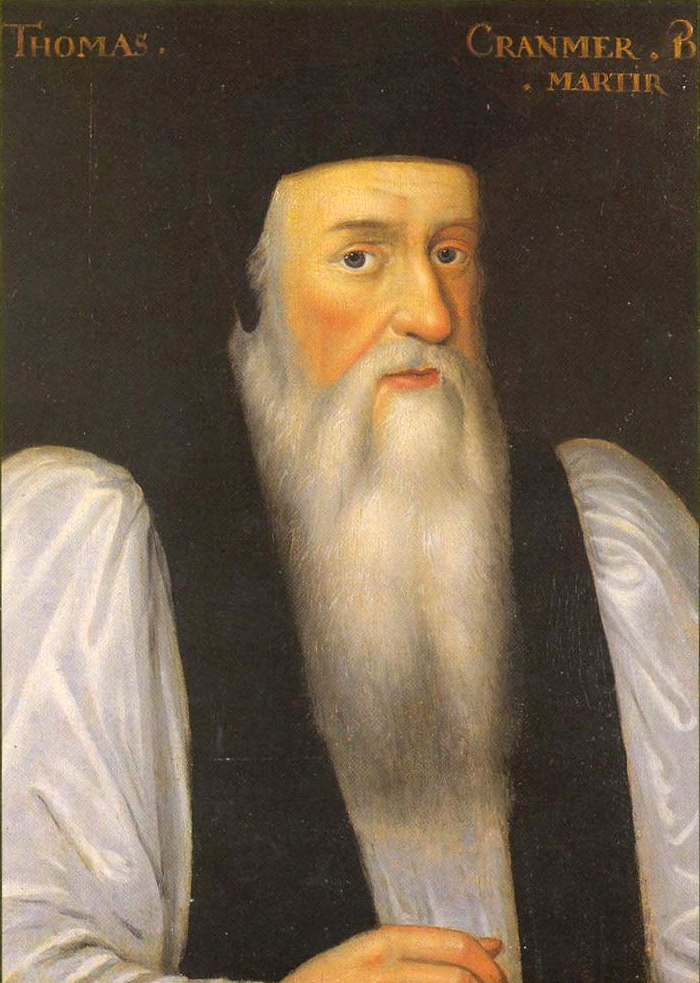
APPEARANCE Thomas Cranmer's appearance can be described based on a portrait painted by Gerlach Flicke in 1545 (see below), which is now housed in the National Portrait Gallery in London This portrait provides us with a detailed visual representation of the Archbishop of Canterbury during a significant period of the English Reformation.

In the portrait, Cranmer is depicted as a middle-aged man with a serious, contemplative expression. He has flowing hair, which was typical for men of his status during that time.

Crnmer by Gerlach Flicke 

FASHION Cranmer adhered to traditional clerical attire, though he embraced simpler garments after England's shift to Protestantism.

CHARACTER Cranmer was diplomatic, thoughtful, and reserved, known for both his intellect and capacity for compromise. He was a devout Christian, a gentle and compassionate man. 

SENSE OF HUMOUR Though primarily serious, his correspondence hints at a subtle wit and self-awareness.

RELATIONSHIPS Cranmer's first marriage occurred in 1515 or 1516, while he was still a young man and before he had taken holy orders. He married a woman named Joan, whose surname remains unknown. The marriage took place in Cambridge, where Cranmer was pursuing his studies. Unfortunately, Joan died in childbirth, leaving Cranmer a widower. This marriage forced him to relinquish his fellowship at Jesus College, Cambridge, but he was able to regain it after his wife's passing.

Cranmer's second marriage, to Margaret Osiander,  the niece of German reformer Andreas Osiander, was far more significant and controversial. It took place in Nuremberg, Germany, in July 1532, while Cranmer was serving as an ambassador to Holy Roman Emperor Charles V. This marriage was particularly notable because it occurred after Cranmer had already become a priest, a clear violation of Catholic doctrine. To protect himself and his wife, Cranmer kept this marriage a secret for many years.

Despite the secrecy and the potential risks, there are indications that Cranmer's second marriage was a loving and committed relationship. He risked his career and reputation by marrying Margaret, suggesting a deep affection for her. Additionally, his decision to keep their marriage hidden for years demonstrates a desire to protect her from potential harm. When clerical marriage was eventually legalized in England, Cranmer openly acknowledged his wife, further solidifying their bond.

Together, Cranmer and Margaret had at least two children: a daughter named Margaret and a son named Thomas. Both children survived into adulthood.

MONEY AND FAME Born into a family of minor gentry in Nottinghamshire, Cranmer's early years were marked by modest circumstances. His father, a village squire, had the means to provide for his eldest son, John, but Thomas, as a younger son, was destined for a career in the church.

However, Cranmer's life took a dramatic turn as he rose through the ranks of the Church of England and became increasingly involved in royal affairs. His involvement in the complex negotiations surrounding Henry VIII's divorce brought him to the attention of the king and set him on a path to greater prominence. In 1530, he was appointed ambassador to the court of Holy Roman Emperor Charles V, a position that further elevated his status.

Cranmer's crowning achievement came in 1533 when he was appointed Archbishop of Canterbury. This prestigious position brought with it considerable wealth and influence. As Archbishop, he had access to extensive landholdings and multiple residences, including Lambeth Palace. His role as a key advisor to the king further solidified his power and prestige.

Cranmer's fame and legacy extended beyond his lifetime. He became one of the most influential figures of the English Reformation, and his work on the Book of Common Prayer continues to shape Anglican worship to this day.

FOOD AND DRINK There is little documentation of Cranmer’s preferences, though as a clergyman, he likely adhered to simple fare.

MUSIC AND ARTS Cranmer valued liturgical music and contributed to its reformation in the English Church.

LITERATURE Cranmer collected medieval scholastic books throughout his life, preserving them carefully

He had a keen interest in biblical scholarship and humanist writings and was well-read in theology and classical works, utilizing these in his doctrinal reforms.

Thomas Cranmer's wrote and compiled the first two editions of the Book of Common Prayer, a complete liturgy for the English Church. Cranmer's decision to use English instead of Latin made church services more accessible to the general population, allowing laypeople to participate more fully in worship.

First Edition (1549): The original Book of Common Prayer was introduced on Pentecost Sunday, 1549. It aimed to unify the various liturgical practices across England by providing a single, comprehensive text in English, replacing the Latin volumes used in the Roman Catholic Church. This book included services for daily prayers, the Eucharist, and other sacraments, all articulated in accessible language. The use of the new prayer book was made compulsory on June 9, 1549.

The title page of the 1549 Book of Common Prayer

Revised Edition (1552): A second edition was published in 1552, which reflected further Protestant reforms. This version rejected the Catholic doctrine of transubstantiation, emphasizing a spiritual presence of Christ in the Eucharist rather than a physical transformation of the bread and wine.

In addition to the Book of Common Prayer, Cranmer authored several important works:

The Litany (1544): This was one of his earlier contributions that laid the groundwork for the Book of Common Prayer. It was an English-language liturgical text that included prayers and supplications.

The Homilies (1547): Cranmer was instrumental in creating a collection of sermons intended to instruct clergy and laity alike on key theological issues. These homilies were used in church services to promote Protestant doctrine.

Prologue to the Great Bible (1539): Cranmer wrote a prologue for this translation of the Bible into English, advocating for its use in churches. He emphasized the importance of Scripture for understanding faith and practice.

Various Treatises: Throughout his career, Cranmer wrote numerous theological treatises defending Protestant positions and addressing issues such as clerical celibacy and the role of images in worship.

NATURE Cranmer appreciated the serene English countryside but was primarily focused on his clerical duties.

HOBBIES AND SPORTS In his youth, Cranmer's father ensured he learned several outdoor skills: Shooting with a longbow, hunting and hawking and riding rough horses.

Cranmer enjoyed engaging in theological debates and discussions. He was part of a group of scholars known as "Little Germany" who met regularly to discuss theological problems raised by Martin Luther's ideas

SCIENCE AND MATHS Cranmer valued academic rigor and evidence-based approaches, such as his appeal to universities over the Pope.

ARCHBISHOP OF CANTERBURY Thomas Cranmer’s appointment as Archbishop of Canterbury on March 30, 1533 was a bit like giving a librarian control of a battleship. He was scholarly, thoughtful, and not particularly power-hungry, but Henry VIII had a problem—namely, that he very much wanted to stop being married to Catherine of Aragon and start being married to Anne Boleyn. Cranmer, ever the obliging cleric, made it all official, even though it meant severing ties with the Pope. 

Image by Perplexity

Thus, he found himself thrust into the turbulent waters of the English Reformation, a position that required a level of theological agility best compared to a man attempting to juggle firecrackers.

Despite being an enthusiastic supporter of Protestant reforms, Cranmer spent most of Henry’s reign peering over his shoulder for angry traditionalists. It wasn’t until the reign of young Edward VI—who, being a child, was refreshingly uninterested in complicating ecclesiastical matters—that Cranmer was truly able to get to work. He produced the Book of Common Prayer, which not only standardized worship but also made church services slightly less incomprehensible. He also helped draft the Forty-Two Articles, which eventually became the Thirty-Nine Articles—presumably because even theology benefits from a little editing.

Alas, Edward VI didn’t last long, and when Mary I arrived, she was very much in the mood to undo everything Cranmer had achieved. He was imprisoned, bullied, and eventually convinced to sign a few recantations. Unfortunately, recanting one’s Protestant faith in order to avoid being burned alive only works if one is then not burned alive. Realizing the flames were coming for him regardless, Cranmer dramatically withdrew his recantation at the last minute, thrust his offending right hand into the fire first, and thus secured his place in history as both a Protestant martyr and a man with a flair for theatrical exits.

Despite his rather grim demise, Cranmer’s legacy endured. The Book of Common Prayer became a cornerstone of Anglican worship, his doctrines shaped the Church of England, and his life remains an enduring lesson in the perils of working for Tudor monarchs. One can only imagine that if he had it all to do over again, he might have chosen a nice, quiet career—perhaps as a librarian after all.

Portrait of Cranmer painted by an unknown artist after Henry VIII's death

PHILOSOPHY & THEOLOGY Thomas Cranmer's theological and philosophical ideas played a crucial role in shaping the English Reformation and the subsequent development of the Anglican Church. His thought was a synthesis of various influences, including Lutheranism, Renaissance humanism, the writings of the Church Fathers, and the works of contemporary reformers such as John Calvin and Martin Bucer.

At the heart of Cranmer's theology was a deep reverence for Scripture. He affirmed the Bible as the sole authority for Christian belief and practice, emphasizing the importance of reading Scripture for its central message of redemption and spiritual formation. Cranmer also embraced the Protestant doctrine of justification by faith alone, a belief that was incorporated into the liturgical forms of the Book of Common Prayer.

Cranmer's views on sacramental theology were distinctive. While he rejected the Catholic doctrine of transubstantiation, he also distanced himself from some of the more radical Protestant views on the Eucharist. He emphasized a spiritual presence of Christ in the Eucharist and the importance of spiritual feeding on Christ through faith during communion.

Cranmer's theological approach was characterized by a desire to balance Protestant reforms with traditional elements of Christian worship and practice. He sought to unite a divided church through a focus on core theological truths and the use of liturgy and homilies to teach doctrine. He also rejected the authority of the Pope and the Roman Catholic magisterium, emphasizing the sufficiency of Christ's atonement.

Cranmer's legacy continues to shape Anglican doctrine and practice. His theological insights are enshrined in the Book of Common Prayer, the Thirty-Nine Articles, and the Book of Homilies. These works remain influential in defining the distinctive identity of the Anglican Church.

POLITICS Cranmer’s career was intrinsically tied to Tudor politics, navigating the complex relationship between church and state under Henry VIII and Edward VI. 

SCANDAL  Cranmer's involvement in Henry VIII's divorce from Catherine of Aragon was contentious, and his role in religious reforms made him a divisive figure. Under Mary I, he recanted his Protestant beliefs but ultimately repudiated these recantations before his execution.

HEALTH AND PHYSICAL FITNESS Details on his health are sparse, though he endured the physical and emotional toll of imprisonment before his execution.

HOMES Cranmer's early years were spent in his birthplace of Aslockton, Nottinghamshire. He remained there until the age of 14, attending the Church of St. John of Beverley in nearby Whatton.

At the age of 14, Cranmer embarked on his academic journey at Jesus College, Cambridge. After completing his studies, he briefly resided in Essex before his life took a significant turn.

Upon his appointment as Archbishop of Canterbury, Cranmer's primary residence became Lambeth Palace, the official London residence of the Archbishop. This historic building served as the center of his religious and political activities.

TRAVEL As Cranmer's involvement in royal affairs deepened, he found himself frequently on the move. His role as an ambassador and royal advisor required him to travel extensively. He followed Holy Roman Emperor Charles V to his residence in Regensburg and also spent time in Nuremberg, where he met and married his second wife.

DEATH In the autumn of 1553, Queen Mary I ordered Cranmer's  arrest on charges of treason and heresy. Imprisoned for over two years, Cranmer endured immense pressure from both state and Church authorities.

Under this duress, Cranmer, in a moment of weakness, made several recantations, publicly reconciling himself with the Catholic Church. However, even these acts of submission were insufficient for Mary I, who remained determined to see him executed.

On March 21, 1556, Cranmer was led to the stake in Oxford. In a dramatic reversal, he publicly withdrew his previous recantations, declaring the Pope "Christ's enemy, and the Antichrist." As the flames began to consume him, he thrust his right hand into the fire first, famously calling it his "unworthy right hand" for having signed the recantations.

Cranmer's martyrdom on that fateful day cemented his legacy as a Protestant martyr. His death was seen as a "glorious martyrdom" by his supporters, and his story was immortalized by John Foxe in his influential Book of Martyrs.

APPEARANCES IN MEDIA Cranmer has appeared in numerous historical dramas and adaptations, often in contexts surrounding his relationship with Henry VIII and the English Reformation. Notable portrayals include:

Lumsden Hare in Young Bess (1953).

Cyril Luckham in A Man for All Seasons (1966).

Bernard Hepton, who portrayed Cranmer in multiple productions, including The Six Wives of Henry VIII (1970), Elizabeth R (1971), and Henry VIII and His Six Wives (1972).

David Waller in the film Lady Jane (1986), focusing on Lady Jane Grey's short reign.

Hans Matheson in The Tudors (2008), a TV series known for its dramatic portrayal of the Tudor court​

Geoffrey Lumb in the BBC adaptation of Wolf Hall (2015 and 2024) The series, based on Hilary Mantel's novels, focuses on the political and personal life of Thomas Cromwell 

ACHIEVEMENTS Authored the Book of Common Prayer, standardizing Anglican worship.

Shaped the theological foundations of the Church of England through the Thirty-Nine Articles.

Played a pivotal role in England’s separation from the Catholic Church.

Just Posted

Here's my most recently posted Trivial Biographies: Kim Jong Un Nicole Kidman David Garrick Nikita Khrushchev Johannes Kepler John F. Ke...