Sunday, 19 May 2013

Gottlieb Daimler

NAME Gottlieb Wilhelm Daimler

WHAT FAMOUS FOR Gottlieb Daimler was a German engineer and industrialist who is credited with the invention of the high-speed internal combustion engine. He is also known for founding the Mercedes-Benz car manufacturer.

BIRTH Gottlieb Daimler was born on March 17, 1834, in Schorndorf, Kingdom of Württemberg (now Germany).

FAMILY BACKGROUND Daimler was born into a modest family. His father, Johannes Daimler, was a master baker and a local town councilor, while his mother, Frederika Daimler, managed the household. The family had deep roots in the area, as the Daimler family had been living in Schorndorf for about two centurie

CHILDHOOD  Young Gottlieb showed an early aptitude for mechanical pursuits, often disassembling and reassembling mechanical devices around his home. This curiosity shaped his future pursuits.

EDUCATION Gottlieb Daimler's fascination with engineering began early in his life. By 13, he had completed six years of primary studies at a Latin school (Lateinschule) while concurrently attending technical drawing classes on Sundays. This early exposure to technical subjects foreshadowed his future career path.

At 14, in 1848, he embarked on a gunsmith apprenticeship in Schorndorf. This experience equipped him with a strong foundation in precision mechanics, a valuable skill for his future endeavors.

After completing his apprenticeship and passing the trade exam in 1852, Daimler continued his education at the Industrial Trade School in Stuttgart. In 1857, he enrolled in Stuttgart's School for Advanced Training in the Industrial Arts (Stuttgart Polytechnic), where he studied under the renowned Ferdinand von Steinbeis. Daimler's dedication extended beyond regular classes, as he also participated in optional Sunday morning classes.

Daimler actively sought practical experience to complement his formal education. He worked at Rollé und Schwilque in Grafenstaden, where he eventually rose to the position of foreman. His pursuit of knowledge also led him to France, where he studied Lenoir's innovative gas engine and gained experience in factories manufacturing locomotives and band saws. Furthermore, Daimler traveled to England, visiting engineering works in various towns to gain firsthand insights into the British mechanical engineering industry.

CAREER RECORD Daimler's career began in 1857, when he took a job as a draftsman at a locomotive factory in Reutlingen. 

In 1862, he moved to Deutz Gasmotorenfabrik, where he worked on the development of stationary gas engines.

After meeting Wilhelm Maybach in the 1860s. they revolutionized automotive technology. In 1885, they created a high-speed petrol engine and the Reitwagen, the first internal combustion motorcycle. Their subsequent innovations included the Grandfather Clock engine, motorized stagecoaches, and boats. 

In 1890, Daimler and Maybach co-founded the Daimler-Motoren-Gesellschaft (DMG), marking a turning point in automotive history.

APPEARANCE Daimler was of average height, with a receding hairline and a moustache and beard,. 

Gottlieb Daimler

FASHION Daimler preferred practical and traditional clothing, consistent with the styles of late 19th-century German professionals.

CHARACTER He was known for his meticulous nature, innovative thinking, and determination. Daimler combined a visionary outlook with pragmatic problem-solving skills.

SENSE OF HUMOUR While not known for his humor, Daimler appreciated light-hearted moments among close colleagues and family.

RELATIONSHIPS Gottlieb Daimler was married twice during his lifetime:

Daimler married Emma Pauline Kurz on November 9, 1867, in Maulbronn. Emma was the daughter of Friedrich Kurz, a pharmacist from Maulbronn. Together, they had seven  children. Emma died on July 28, 1889.

After Emma's death, Daimler married for a second time. He wed Lina Hartmann née Schwend on July 8, 1893, in Schwäbisch Hall, a historic town in Baden-Württemberg, Germany.. Lina was 22 years younger than Daimler and was the widow owner of the hotel where Daimler had stayed in Florence while recuperating from heart problems in 1892.

Gottlieb Daimler's wedding to Lina Hartmann in 1893 by Perplexity

The couple went on a honeymoon trip to Chicago, where Daimler also visited the World Exposition. Their marriage lasted nearly seven years until Daimler's death.

Daimler maintained a lifelong professional relationship with Wilhelm Maybach. 

MONEY AND FAME Gottlieb Daimler achieved significant wealth and fame during his lifetime, primarily driven by his pioneering work in engine development and the automotive industry. His financial success grew alongside his engineering achievements. In 1880, upon leaving Deutz AG, he received 112,000 Gold marks in company shares as compensation for his and Maybach's patents. This substantial sum enabled him to establish his own business in 1882. In 1895, Daimler regained shares in his company valued at 200,000 Marks for a payment of 66,666 Marks, further demonstrating his growing wealth. At the time of his death, he bequeathed approximately 25% of the share capital in the Daimler-Motoren-Gesellschaft company to his family.

Daimler's innovations and business acumen garnered widespread recognition. He is widely acknowledged as the inventor of the truck and a pioneering figure in modern freight transport. Daimler's engines achieved international acclaim, notably by securing all 15 finishing positions in the 1894 Paris-Rouen road race. His engines' renowned reliability attracted prestigious clients, including Ferdinand Graf von Zeppelin, who incorporated Daimler engines into his airships. Daimler's international connections made his engines a prominent topic of discussion abroad, sparking interest among English industrialists. He is recognized as one of the founding fathers of the world's oldest automobile manufacturer, now known as Daimler AG. Daimler is often referred to as "the father of the motorcycle." His work, alongside Carl Benz's, profoundly shaped the industrial landscape of the 20th century.

Despite his considerable success, Daimler remained steadfastly focused on innovation rather than personal acclaim. His visionary concept of utilizing his engine as a universal power source for land, water, and air vehicles was successfully realized, solidifying his enduring legacy within the automotive industry.

FOOD AND DRINK He enjoyed traditional German cuisine, often dining simply despite his success.

MUSIC AND ARTS Daimler appreciated classical music and supported local arts initiatives in Cannstatt.

LITERATURE Daimler was well-read, particularly in technical literature and engineering manuals.

NATURE He took inspiration from nature, which influenced some of his engineering designs.

HOBBIES AND SPORTS Daimler enjoyed mechanical tinkering as a pastime and had a keen interest in boating.

A Daimler-powered car won the very first international car race – Paris to Rouen

SCIENCE AND MATHS He excelled in mechanical engineering, thermodynamics, and practical applications of physics.

INVENTIONS Gottlieb Daimler was a tinkerer extraordinaire. By the ripe old age of 10, he was already apprenticing with a gunsmith, whipping up double-barreled pistols like they were going out of style. It was clear young Gottlieb had a thing for machines, a fascination that would propel him, quite literally, into the history books.

After graduating, he embarked on a whirlwind tour of Europe, picking up practical experience in France and Britain. It was during this time that he stumbled upon a fellow gearhead named Wilhelm Maybach, a partnership that would change the course of transportation forever.

In 1882, these two restless minds decided to strike out on their own. Their workshop in Cannstatt wasn't exactly Buckingham Palace, but it was there that the magic happened. Their goal? To cram some serious power into a tiny package – a high-speed engine that could propel all sorts of contraptions. And boy, did they deliver.

First up was a little ditty they called the "high-speed petrol engine" in 1883. Not the catchiest name, but it got the job done. This wasn't your grandpappy's chugging steam engine – this was a firecracker waiting to be lit. Then came the "grandfather clock" engine in 1884, named for its, well, resemblance to a grandfather clock. Not exactly sleek, but a testament to their relentless tinkering. They were granted a German patent for their engine design on April 3, 1885.


The 1885 Grandfather Clock Engine by Morio

But Daimler and Maybach weren't ones to rest on their laurels. In 1885, they plopped their engine on a two-wheeled contraption and – voila! – the world's first motorcycle, the poetically named Petroleum Reitwagen (Riding Car). 

A year later, they weren't done yet. Taking their engine to the next level, they adapted it to a stagecoach, basically creating one of the first four-wheeled automobiles. Talk about a horseless carriage – this was the real deal.

Gottlieb Daimler is credited with building the world's first gasoline-powered taximeter cab in 1897. The vehicle was a Daimler Victoria, a modified version of Daimler’s early motorcar designs. It was equipped with a taximeter—a device that measured distance or time to calculate the fare, giving rise to the word “taxi” from “taximeter cabriolet.” This innovation made it possible to standardize fares for passengers and launched the concept of the modern motorized taxi service. The first of these gasoline-powered taxis began operating in Stuttgart, Germany on June 16, 1897.

Daimler Victoria. Source: mercedes-benz.com

Daimler's impact on the world is undeniable. His engines weren't just for cars – they were powering boats, trolleys, fire trucks, even those wacky dirigibles that looked like oversized cigars. He even played a part in spreading the gospel of the automobile internationally, licensing his engines to manufacturers around the globe. So next time you're stuck in traffic, take a moment to thank Gottlieb Daimler, the gearhead who kickstarted the horseless carriage revolution.

PHILOSOPHY & THEOLOGY Daimler held strong Protestant values and believed in the importance of hard work and perseverance.

POLITICS He avoided direct political involvement, focusing instead on technological innovation.

SCANDAL Daimler faced business challenges, including disputes with investors, but avoided personal scandals.

When Daimler and Wilhelm Maybach were working on their engine designs in 1882, they converted Daimler's summer house in Cannstatt into a secret workshop. They covered the glass walls with cloth and worked day and night under strict secrecy. The strange noises coming from the workshop aroused suspicion in Daimler's gardener, who believed there was a counterfeiting operation taking place. The gardener called the police, who conducted a raid only to find tools and engine parts

MILITARY RECORD Though not a soldier, Daimler's engineering skills contributed to military applications, particularly in vehicle design.

HEALTH AND PHYSICAL FITNESS Daimler’s later years were marked by health issues, including heart disease, which limited his mobility.

HOMES Gottlieb Daimler was born in a historic half-timbered house on Höllgasse in Schorndorf, Germany. This house, dating back to around 1695, was acquired by Daimler's grandfather in two installments between 1787 and 1806. It served as the family home where young Gottlieb grew up as a baker's son. Today, this significant birthplace is a museum and conference center, owned by Daimler AG since 1979, preserving the legacy of the renowned inventor.

In 1882, at the age of 48, Daimler purchased a villa in Bad Cannstatt, near Stuttgart, for the substantial sum of 75,000 Gold marks. Located on Taubenheimstrasse, at the edge of picturesque spa gardens, this property offered a serene environment. Daimler, who suffered from cardiac issues, was drawn to the villa's proximity to spa facilities, hoping for potential health benefits. The property also boasted a spacious garden complete with a greenhouse.

This greenhouse, however, would soon play a pivotal role in automotive history. Daimler and his collaborator Wilhelm Maybach transformed the greenhouse into a workshop and testing station, a secret haven for their groundbreaking research. It was within these walls that they conducted their initial tests on the small, high-speed internal combustion engine, culminating in its successful development in 1885. This remarkable achievement earned the greenhouse the distinction of being recognized as the birthplace of both the motorcycle and the motorboat.

The secrecy surrounding their work within this workshop inevitably led to some amusing episodes. Suspicions of counterfeiting even resulted in a police raid, highlighting the clandestine nature of their innovative pursuits.

Today, the garden house workshop is meticulously preserved as the Gottlieb Daimler Memorial. This captivating museum showcases the ambiance of those pioneering years through a fascinating array of exhibits, including tools, drawings, documents, photographs, and models. It serves as a poignant reminder of the ingenuity and dedication that fueled Daimler's revolutionary contributions to the automotive world.

Daimler's summer house (Cannstatt) Wikipedia

TRAVEL Gottlieb Daimler was a seasoned traveler, his journeys proving instrumental in both his professional development and personal life.

Daimler's early career saw him embark on a series of educational and professional travels. In the early 1850s, he gained valuable practical experience in mechanical engineering while working in France.

From autumn 1861 to summer 1863, Daimler ventured to England, then considered the "motherland of technology." This period proved highly enriching, as he visited several renowned engineering firms, including Beyer, Peacock & Company in Manchester, engineering works in Oldham and Leeds, locomotive manufacturers in Manchester, and a machine tool factory in Coventry. While in England, he also attended the prestigious 1862 International Exhibition in London, broadening his horizons further.

Before returning to Germany, Daimler also gained valuable experience working in Belgium.

Daimler's travels extended beyond personal and educational pursuits. In late 1881, he embarked on a business trip to Russia on behalf of the gas engine factory. This journey aimed to explore potential business opportunities and gain insights into the state of Russian industry.

In 1893, Daimler and his second wife, Lina, embarked on a memorable honeymoon to North America. They attended the prestigious World Exposition in Chicago, experiencing the cutting-edge technology and industrial advancements of the time.

In the spring of 1893, Daimler traveled to Florence, Italy, seeking medical treatment for his heart condition.

Daimler's legacy lives on in every car that zooms down the road today. The company he co-founded eventually merged with another car pioneer, Carl Benz, to form Daimler-Benz, which later became the Mercedes-Benz we all know and love. 

DEATH Gottlieb Daimler died on March 6, 1900, at the age of 65 in Cannstatt, near Stuttgart, Germany. His death came after years of suffering from a heart condition that had affected him since the late 1880s..

Daimler's funeral and burial took place shortly after his death. He was laid to rest in the Uff-Kirchhof cemetery in Stuttgart-Bad Cannstatt. This cemetery, located in the area where Daimler had lived and worked for many years, became his final resting place.

The death of Gottlieb Daimler marked the end of an era in automotive history. He had just enough time to see the fruits of his labor and innovations in the automotive industry before his passing. Daimler's death came only seven years after his return to the Daimler-Motoren-Gesellschaft (DMG) in 1895, during which time the company experienced a significant upturn in business

APPEARANCES IN MEDIA Daimler’s life and contributions have been highlighted in documentaries and exhibitions about the history of the automobile. 

They include:

The Birth of the Automobile – This documentary explores the contributions of Daimler and Wilhelm Maybach to automotive engineering, highlighting their innovations like the Reitwagen and the Grandfather Clock engine.

The Innovators: Daimler and Maybach – A detailed look at their partnership and the challenges they overcame to revolutionize transportation.

Mercedes-Benz Museum (Stuttgart, Germany) – Daimler’s life and inventions are central features of this museum. Interactive exhibits showcase his Grandfather Clock engine and the Reitwagen.

Deutsches Museum (Munich, Germany) – Includes exhibits on Daimler’s contributions to engineering and his collaboration with Maybach.

ACHIEVEMENTS Development of the high-speed petrol engine (1885)

Creation of the Reitwagen, the first internal combustion motorcycle (1885)

The Reitwagen (riding car), the first internal combustion motorcycle By Joachim Köhler

Foundation of Daimler-Motoren-Gesellschaft (1890)

Production of the first automobile (1892)

Contribution to the merger forming Daimler-Benz AG (1926)


Tuesday, 14 May 2013

Roald Dahl

NAME Roald Dahl. He was named after Norwegian polar explorer Roald Amundsen.

WHAT FAMOUS FOR Roald Dahl was a renowned and beloved children's author, known for his imaginative and often darkly humorous stories.

BIRTH Roald Dahl was born on September 13, 1916, in Llandaff, Cardiff, Wales.

FAMILY BACKGROUND  Roald Dahl was born to Norwegian parents, Harald and Sofie Magdalene Dahl. His father, a prosperous shipbroker who had emigrated to the UK from Sarpsborg, Norway, also had two older children, Louis and Ellen, from a previous marriage. Roald had four sisters: Astri, Alfhild, Else, and Asta.

Tragedy struck the Dahl family early on. When Roald was just three years old, his older sister Astri succumbed to appendicitis. This devastating loss was compounded by the sudden death of his father from pneumonia a few weeks later, leaving Sofie to raise her children alone in Wales, fulfilling her husband's wish for them to receive an English education.

Roald age 10 with his sisters Alfhild, Else and Asta. Cardiff, 1927.

CHILDHOOD Despite his early losses, Dahl's childhood had its joys. His mother, a gifted storyteller with a remarkable memory, captivated young Roald with tales of Norwegian folklore, including trolls and other mythical creatures. This undoubtedly influenced his own imaginative storytelling later in life.

Dahl's first language was Norwegian, spoken at home. He developed a strong love for reading, particularly the adventure novels of Rudyard Kipling and H. Rider Haggard.

His early sense of humor emerged when, at age eight, he and his friends orchestrated the Great Mouse Plot of 1924, placing a dead mouse in a sweet jar as a prank. 

EDUCATION Roald's formal education began at Llandaff Cathedral School, but he only attended for two years. He then moved to St. Peter's Preparatory School in Weston-super-Mare, where he endured a challenging boarding school experience, finding many teachers to be cruel and facing frequent corporal punishment.

At the age of 13, Dahl transferred to Repton Public School in Derbyshire. While he excelled in sports, especially cricket and swimming, his academic performance was less impressive. His English master even remarked that he lacked the ability to express himself effectively in writing.

Despite these academic struggles, Repton provided a crucial inspiration for his future work. The school's proximity to the Cadbury chocolate factory, where students were occasionally invited to sample new products, undoubtedly played a role in the creation of his beloved novel, Charlie and the Chocolate Factory.

CAREER RECORD Began his career as a Shell-Mex and BP employee in Africa.

Served as a fighter pilot in the Royal Air Force during World War II.

Started writing short stories for magazines like The New Yorker.

Gained fame as a children's author with books like Charlie and the Chocolate Factory, James and the Giant Peach, Matilda, and Fantastic Mr. Fox.

APPEARANCE Roald Dahl was a remarkably tall man, towering at 6 feet 6 inches (1.98 meters). During his service in the Royal Air Force (RAF) during World War II, his exceptional height earned him the nickname "Lofty."

Dahl's appearance was quite distinctive, extending beyond his height. In The BFG, one of his beloved children's books, he provides a vivid description of the giant: "Sophie caught a glimpse of an enormous long pale wrinkly face with the most enormous ears. The nose was as sharp as a knife, and above there were two bright flashing eyes." While this describes a fictional character, some speculate that Dahl drew inspiration from his own unique features, particularly his height. This physical distinctiveness likely contributed to his ability to create larger-than-life characters that captivated the imaginations of children worldwide.

Dahl's height was unusual for his time, especially for a fighter pilot. This unique physical trait undoubtedly set him apart throughout his life, becoming an integral part of his persona, both as a writer and in his personal life.

Dahl in 1954

FASHION He dressed simply, favoring practical and comfortable clothing. Dahl was often seen wearing a tweed jacket and a pipe.

CHARACTER Dahl's character was marked by contradictions. He could be kind and generous, yet also cruel and insensitive. As his biographer Jeremy Treglown observed, "Many people loved him and had reason to be grateful to him; many – some of them the same people – frankly detested him."

His early life experiences, including the loss of his father and sister at a young age and the challenges of boarding school, likely contributed to the complexities of his personality. These experiences also deeply influenced his writing, often resulting in stories with dark undertones and morally ambiguous characters.

In his professional life, Dahl was determined and resourceful, traits that undoubtedly contributed to his success as an author. However, he could also be boastful and egotistical about his achievements.

Despite his flaws, Dahl's enduring legacy rests on his ability to create magical worlds and unforgettable characters that continue to captivate readers worldwide. This enduring appeal serves as a testament to the duality of his nature – a man capable of both charm and controversy, 

SENSE OF HUMOUR Roald Dahl's writing was undeniably shaped by his unique sense of humor, a blend of darkness, wordplay, and absurdity that resonated with both children and adults.

1. Dahl wasn't afraid to delve into the macabre. His stories often featured gruesome details and unsettling imagery, a stark contrast to the more sanitized fare typically found in children's literature. For instance, in The Witches, he provides vivid, grotesque descriptions of the witches' physical appearances, including their bald, red-spotted heads and toe-less feet. This dark humor, however, was cleverly balanced with lighter elements, creating a unique and captivating blend.

2. Dahl was a master of language. He delighted in inventing nonsense words, crafting witty puns, creating humorous character names, and employing alliteration and onomatopoeia with masterful effect. One  example of his linguistic creativity can be found in Charlie and the Chocolate Factory, where he introduces the concept of "Square sweets that look round."

In this scene, Willy Wonka presents the children with a confectionery conundrum:

"'There you are!' cried Mr Wonka. 'Square sweets that look round!'

'They don't look round to me,' said Mike Teavee. 'They look square,' said Veruca Salt. 'They look completely square.'

'But they are square,' said Mr Wonka. 'I never said they weren't.'

'You said they were round!' said Veruca Salt.

'I never said anything of the sort,' said Mr Wonka. 'I said they looked round.'"

This exchange showcases Dahl's clever use of wordplay, exploiting the dual meaning of "round" - both as a shape and as a way of saying "to look around." 

3. Dahl embraced the absurd. He believed that children have an inherent fascination with "disgusting stories," a belief reflected in his creation of scenarios that were both revolting and hilarious. This approach served a dual purpose: it allowed children to vicariously experience the grotesque while simultaneously feeling a sense of superiority over the depicted events.

4. Dahl's writing was often laced with sarcasm and irony. He frequently employed a sly, knowing tone, inviting the reader to share in his amusement at the expense of certain characters or situations. This sophisticated use of humor appealed to adults as well as children, contributing significantly to the enduring popularity of his works.

RELATIONSHIPS Roald Dahl was married twice.

Dahl married American actress Patricia Neal on July 2, 1953, at Trinity Church in New York City. 

They had five children: Olivia Twenty (who tragically died at the age of seven), Tessa, Theo, Ophelia, and Lucy. Tessa is the mother of author and model Sophie Dahl, after whom the character Sophie in The BFG is named.

Their marriage faced significant challenges, particularly following Neal's series of strokes in the mid-1960s. They ultimately divorced in 1983.

Patricia Neal and Roald Dahl in April 1954

Shortly after his divorce from Neal, Dahl married Felicity d'Abreu Crosland on June 2, 1983, at Brixton Town Hall in South London. Felicity, often referred to as "Liccy," was a set designer who became an integral part of Dahl's life. They resided together at Gipsy House, Dahl's home in Great Missenden, Buckinghamshire, until his death in 1990.

Dahl's relationships and family life undoubtedly influenced his writing, particularly his children's books, which often explored themes of family, childhood, and the complexities of human relationships.

MONEY AND FAME Roald Dahl's wealth and fame have grown significantly throughout his life and continue to expand posthumously, solidifying his position as one of the most successful children's authors of all time.

At the time of his death in 1990, Roald Dahl's net worth was estimated to be around $20 million. This wealth was primarily generated through his prolific writing career, spanning decades and encompassing both children's books and adult fiction. His books had already achieved massive global success, with titles like Charlie and the Chocolate Factory and James and the Giant Peach becoming international bestsellers.

Since Dahl's passing, the value of his estate has skyrocketed. By 2018, his books had sold over 300 million copies worldwide. The Roald Dahl Story Company, managed by his widow Felicity and their children, has been highly profitable, generating significant annual revenue. In a landmark deal, Netflix acquired the Roald Dahl Story Company for $1.5 billion over two transactions: $1 billion in 2018 for animation rights and $500 million in 2021 for complete ownership.

Dahl's fame extends far beyond financial success. He is widely considered one of the greatest British authors of the 20th century. In 2008, The Times ranked him 16th on its list of "The 50 Greatest British Writers Since 1945." Forbes even ranked him as the top-earning dead celebrity in 2021. His books continue to captivate readers worldwide and inspire numerous film and stage adaptations, ensuring his enduring fame with new generations.

FOOD AND DRINK Roald Dahl had a passionate relationship with food and drink, which was evident in both his personal life and his literary works.

Dahl was a self-proclaimed chocoholic, preferring his chocolate "straight" in candy bar form. He also enjoyed fresh fish, particularly Norwegian prawns, and was a fan of homegrown vegetables, especially young broad beans. Caviar was reportedly his ultimate indulgence. He was known for his culinary flair, often hosting elaborate dinners for friends and family at his home, Gipsy House.

Dahl's fascination with food often appeared in his stories, like the chocolate factory in Charlie and the Chocolate Factory.

Dahl was an avid wine collector, boasting a cellar of approximately 4000 bottles at Gipsy House. He enjoyed a glass of wine every evening without fail. He also shared his love for unique beverages with his children, creating "Witches' Potions" by blending milk with canned peaches and food coloring.

Dahl's culinary habits were as unique as his personality. He had a dedicated bacon slicer to create paper-thin slices and occasionally surprised his children with bacon and marmalade sandwiches for tea. And, in a touch of whimsical eccentricity, he was known to add cake decorating sprinkles to Jell-O® for a unique textural experience.

MUSIC AND ARTS  Roald Dahl had a deep appreciation for music and the arts, particularly classical music. While he did not frequently attend concerts due to his tall stature making it uncomfortable to sit in theater seats, he thoroughly enjoyed listening to music at home.

Dahl had a particular fondness for classical composers, with his widow Felicity noting that "he adored listening to Mozart, to Brahms and especially to Beethoven - his great passion". He would often relax in an armchair at home while enjoying these composers' works.

He collected works of art and antiques.

Dahl wrote screenplays for Ian Fleming’s You Only Live Twice and Chitty Chitty Bang Bang and contributed to other media, including his TV anthology shows Way Out and Tales of the Unexpected.

LITERATURE Roald Dahl authored nearly 50 books, blending dark humor, fantastical elements, and memorable characters. 

After an eventful stint in the Royal Air Force Dahl began writing short stories for adults. These early efforts, often dark and unsettling, were like a literary version of a Hitchcock film – deliciously morbid, you know?

But then, as fate would have it, he stumbled upon a new audience: children. James and the Giant Peach, inspired by bedtime stories he concocted for his own offspring, proved to be a turning point. Suddenly, Dahl was a children's author, and the world, it seemed, couldn't get enough of his peculiar brand of storytelling.

Charlie and the Chocolate Factory, The BFG, Matilda – these weren't your typical children's books. Oh no. Dahl injected them with a healthy dose of the grotesque, a touch of the sinister, and a healthy disrespect for authority. He knew, you see, that children possess a rather morbid sense of humor. They enjoy the deliciously disgusting, the delightfully wicked. Dahl gave them exactly what they craved.

Of course, he wasn't entirely immune to the lure of Hollywood. He dabbled in screenwriting, but his true passion, it seems, lay in conjuring up fantastical worlds and inventing characters that were both charming and utterly bizarre.

Dahl, alas, left us in 1990, but his legacy continues to thrive. His books have sold millions upon millions of copies, been translated into every conceivable language, and have been adapted into countless films and stage productions. He may have been a bit of a rogue, a bit of a grump, but there's no denying his genius. Roald Dahl, the man who brought us giants and witches, chocolate rivers and talking vegetables, remains one of the most beloved and influential children's authors of all time.


Dahl had a lifelong love for literature and reading.

NATURE Roald Dahl had a deep and lifelong love for nature, which profoundly influenced both his writing and his personal life.

Dahl's appreciation for nature began early. His father believed that exposing a pregnant woman to natural beauty would instill a love for beauty in the unborn child. Growing up, Dahl enjoyed the Welsh countryside and idyllic summers in Norway, where he experienced the magic of the natural world firsthand. He developed a keen interest in birds, collecting their eggs (before it became illegal) with great care and respect.

Dahl's writing often reflected his love for nature. Many of his stories explored the complex relationship between humans and the wilderness, emphasizing the importance of respecting and living in harmony with nature. In books like Fantastic Mr. Fox and Danny, the Champion of the World, he criticized those who exploited or destroyed nature out of greed or indifference. His final book, Billy and the Minpins, encouraged readers to discover the wonder and magic of nature, reminding them to look for "the greatest secrets" in the most unexpected places.

Dahl was an avid gardener. He cultivated an orchid house where he experimented with over 400 breeds of phalaenopsis orchids. This unique space also housed a massive cactus, inherited from his mother, which grew so large that the roof of the orchid house had to be periodically raised to accommodate its impressive size.

He enjoyed foraging for wild mushrooms.

PETS Dahl bred budgerigars (budgies) and dogs as hobbies.

HOBBIES AND SPORTS Dahl often carried a camera with him and enjoyed taking photographs.

He enjoyed sports like squash and fives and played golf.

He had an interest in greyhound racing.

Dahl enjoyed playing snooker in his leisure time.

SCIENCE AND MATHS Dahl engaged in precision engineering when designing the WDT valve to aid children with hydrocephalus. His invention of the WDT valve showcased his ability to merge creativity with engineering solutions.

PHILOSOPHY & THEOLOGY While his works often had moral undertones, Dahl did not explicitly align with any particular philosophical or theological framework.

POLITICS Dahl used his charm to advance British interests in the U.S. during World War II, even taking on roles that involved influencing powerful women.

SCANDAL Dahl was criticized for his controversial views later in life, including making anti-Semitic remarks that caused significant backlash. His controversial remarks tarnished his legacy for some.

MILITARY RECORD In November 1939, at the age of 23, Roald Dahl enlisted in the Royal Air Force (RAF) in Nairobi, Kenya. He initially accepted a commission in the British Army, specifically the Royal African Rifles, but transferred to the RAF after just one month of service. He began his flight training in Nairobi, flying Tiger Moth aircraft.

Dahl was assigned to 80 Squadron, where he initially flew the obsolete Gloster Gladiator biplane. On September 19, 1940, while delivering a new aircraft, he crash-landed in the Libyan desert, sustaining a fractured skull and experiencing temporary blindness. After recovering, he transitioned to flying the more modern Hawker Hurricane in combat missions.

Dahl's first aerial combat encounter occurred on April 15, 1941, over Chalcis, Greece, where he successfully shot down a Junkers Ju 88 bomber. He achieved a total of five confirmed aerial victories, earning him the distinction of a "flying ace." He participated in the fierce Battle of Athens on April 20, 1941, where his squadron faced overwhelming odds against the German Luftwaffe. He also engaged in operations over Greece, Crete, and Syria, including attacks on Vichy French forces.

Dahl's military record includes shooting down multiple enemy aircraft, including Ju 88s and a Vichy French Potez 63. He participated in daring raids, such as the attack on Rayak airfield in Syria. He survived numerous dangerous missions, particularly the challenging Battle of Athens.

Persistent headaches, a consequence of his earlier crash injuries, ultimately forced Dahl to end his RAF service. He was invalided out of the RAF in August 1946 with the rank of Squadron Leader.

Post-war research has confirmed his record of five aerial victories, with the possibility of more unconfirmed kills.

HEALTH AND PHYSICAL FITNESS At age 21, while working at Shell Oil, Dahl decided to have all his teeth extracted by a highly regarded dentist in London, believing they were "more trouble than they were worth." He then had an artificial set created to replace them.

This decision wasn't entirely unusual for British people at the time, but Dahl took it a step further by becoming an advocate for tooth removal. He tried to convince his mother and siblings to follow his example, though only his mother agreed.

Five years after the initial extraction, Dahl treated himself to a fancier set of artificial teeth using the proceeds from his first paid piece of writing, Shot Down in Libya.

In 1960, tragedy struck the Dahl family when their young son, Theo, suffered a severe head injury after being hit by a car. The standard medical treatments at the time proved ineffective in relieving the pressure that had built up in Theo's brain. Determined to help his son, Dahl, in collaboration with his friend Stanley Wade, an expert in precision hydraulic engineering, and paediatric neurosurgeon Kenneth Till, designed a revolutionary medical device.

They developed the Wade-Dahl-Till (WDT) valve, a groundbreaking invention that aimed to safely drain excess fluid from the brain. While Theo fortunately recovered to the point where the valve was no longer necessary, the WDT valve has since gone on to save the lives of over 3000 children worldwide. This remarkable invention stands as a testament to Dahl's ingenuity and his unwavering dedication to his son.

HOMES Dahl's early years were spent in Cardiff, Wales. He was born in Villa Marie (later renamed Ty Gwyn) on Fairwater Road in 1916. The family later moved to Ty Mynydd, a country estate in Radyr, and subsequently to Cumberland Lodge, which is now part of Howell's School nursery.

Dahl's most famous residence was Gipsy House in Great Missenden, Buckinghamshire. Purchased in 1954 for £4,500 with his first wife, Patricia Neal, it was originally named Little Whitefield and later renamed Gipsy House in 1960. Set on six acres of land with an orchard and gardens, the house underwent extensive renovations and expansions over the years.

A writing hut nestled within the gardens served as Dahl's creative sanctuary, where he penned many of his most beloved works. While Gipsy House is no longer open to the public, Dahl's writing hut is now on display at the Roald Dahl Museum and Story Centre in Great Missenden.

Dahl also lived in a London mews apartment in Clapham Common. Additionally, he cherished The Cabin in Tenby, Pembrokeshire, a holiday home where he spent Easter holidays for 16 years as a child. The first-floor apartment in The Cabin is now available for holiday rentals.

Dahl's homes, particularly Gipsy House, played a crucial role in shaping his writing career and family life. The gardens and surroundings often inspired elements of his stories, such as the gypsy caravan featured in Danny, the Champion of the World.

TRAVEL Dahl traveled extensively for Shell Petroleum and during his military service.

DEATH Roald Dahl died on November 23, 1990, at the age of 74 in Oxford, England. He passed away due to a rare blood cancer called myelodysplastic syndrome. Dahl had been admitted to John Radcliffe Hospital in Oxford on November 12 with an undisclosed infection.

His granddaughter arranged a special Viking-style funeral to honor Dahl's Norwegian roots. This unconventional approach reflected the author's imaginative spirit and his family's desire to celebrate his life in a meaningful way.

Dahl was laid to rest in the churchyard of St. Peter and St. Paul's Church in Great Missenden, Buckinghamshire. The church is situated on a hill overlooking the village, providing a picturesque final resting place for the beloved author.

Dahl's grave is marked by a simple black slab, contrary to what some might expect for such a famous author. The gravestone bears his name and the dates of his birth and death.

In keeping with the Viking funeral theme and to honor Dahl's personal interests, he was buried with several of his favorite possessions: Burgundy wine, chocolates, HB pencils, snooker cues, and a power saw

Dahl's grave has become a place of pilgrimage for fans. Visitors often leave small tokens, including candy bars, as a tribute to the author of Charlie and the Chocolate Factory and other beloved children's classics

APPEARANCES IN MEDIA Many of Dahl’s stories were adapted into films, including Charlie and the Chocolate Factory, The BFG, and Matilda

He appeared in interviews and documentaries, often sharing anecdotes about his life and career. 

Dahl hosted and narrated episodes of his television series Way Out (1961) and introduced adaptations of his stories in Tales of the Unexpected (1979–1988). 

His works have also inspired numerous stage productions, such as the musicals Matilda and Charlie and the Chocolate Factory. His persona and writings have been referenced in pop culture, cementing his status as a literary icon.

ACHIEVEMENTS Dahl’s contributions to literature earned him global acclaim, and his birthday, September 13, is celebrated as "Roald Dahl Day". His philanthropic efforts, like the WDT valve, have saved countless lives.

Source The Independent

Saturday, 11 May 2013

Louis Daguerre

NAME Louis Jacques Mandé Daguerre

WHAT FAMOUS FOR Louis Daguerre is famous for inventing the daguerreotype, the first practical photographic process.

BIRTH Born on November 18, 1787, in Cormeilles-en-Parisis, a small town near Paris, France.

FAMILY BACKGROUND Louis Jacques Daguerre was born to Louis Jacques Daguerre and Anne Antoinette Hauterre. Raised in a middle-class household, his family relocated to Orléans during his childhood. His father, a known royalist, even named one of Daguerre's sisters after Queen Marie Antoinette during the turbulent French Revolution.

CHILDHOOD Daguerre's interest in art and design became apparent at a young age.

EDUCATION Daguerre's formal education was somewhat limited due to the political upheaval of the time. However, he displayed a natural talent for drawing from a young age. At thirteen, he began an apprenticeship with a local architect. Recognizing his son's artistic potential, his father encouraged further study, arranging for Daguerre to apprentice with Pierre Prévost, the pioneer of panoramic painting, in Paris at the age of sixteen.

CAREER RECORD Daguerre began his career as a stage designer for the Paris Opera, known for his innovative and spectacular scenery. Daguerre worked there on theatrical illusions and dioramas. 

In 1829, he partnered with inventor Joseph Nicéphore Niépce to develop a photographic process. After Niépce’s death, Daguerre continued their work, culminating in the invention of the daguerreotype in 1837.

Daguerre spent his final years in Bry-sur-Marne, having retired there in 1840. He continued to be active in his profession even in retirement, painting diorama tableaux for local churches

APPEARANCE Daguerre possessed a distinctive appearance. He had a head of curly hair and bright, "shiny" eyes. 

In his self-portrait daguerreotype, he is seen wearing a vest with visible creases, and his hands appear sinewy. He sported a carefully manicured beard and accessorized with a wide-brimmed hat and stylish foulards.

Interestingly, some accounts describe Daguerre's later-life appearance as "subversively defiant" and "disarmingly modern," with his style even being compared to that of a contemporary hipster by some observers.

Portrait of Louis Daguerre 

FASHION He adhered to the fashionable styles of the mid-19th century, often seen in tailored suits.

Daguerre wore a wide-brimmed hat and also wore debonair foulards (a type of necktie or scarf). 

CHARACTER Daguerre is described as a meticulous and dedicated scientist, driven to perfect his photographic process. He was also known for his artistic talent and innovative spirit.

SENSE OF HUMOUR  Daguerre’s contemporaries noted his charm and wit during social gatherings.

RELATIONSHIPS DeGuerre married Louise Georgina Smith in 1810. At the time of his marriage, Daguerre was still developing his career as an artist and theatrical designer. Their relationship supported his creative pursuits, though they lived a relatively private life.

MONEY AND FAME Following the announcement of the daguerreotype on January 7, 1839 to the French Academy of Sciences, Daguerre achieved widespread fame and financial security. The French government awarded him an annuity of 6,000 francs annually.

Louis Daguerre announcing the daguerreotype to the French Academy of Sciences

MUSIC AND ARTS Daguerre began his professional career at the Opéra de Paris as a set designer, mentored by I. E. M. Degotti. He also showcased his dancing skills by working as a stage extra.  

His talents extended beyond set design, as he became a renowned lighting director for several Parisian theaters. 

Daguerre gained a significant reputation for his innovative stagecraft, particularly his ability to create breathtaking theatrical scenery, especially atmospheric landscapes and captivating night effects.

LITERATURE He inspired the first photography magazine, the Daguerreian Journal, published in New York in 1856

NATURE His dioramas often featured natural scenes, showcasing his appreciation for landscapes and light effects.

HOBBIES AND SPORTS Daguerre enjoyed painting and designing theatrical sets, which were both his profession and hobby.

SCIENCE AND MATHS Daguerre’s invention of the daguerreotype required a deep understanding of chemistry and optics.

Daguerre viewed photography as a harmonious fusion of science and art. He firmly believed that the most valuable scientific instruments were those that simultaneously inspired artistic endeavors. This philosophy underpinned his development of the daguerreotype, which he saw as both a scientific breakthrough and a powerful artistic medium.

INVENTIONS Now, Louis Daguerre – that was a fellow who really knew how to capture the moment. You see, before Daguerre came along, if you wanted a picture of yourself, you were pretty much stuck with a grumpy-looking portrait painted by some guy who probably smelled of linseed oil. But Daguerre changed all that. He invented this thing called the daguerreotype, and let me tell you, it was a sensation.

Imagine, if you will, a perfectly polished silver plate – like a tiny mirror. Daguerre figured out how to make this plate sensitive to light, then popped it in a box with a hole in it (they called it a camera, fancy that!). After a bit of fiddling around with some nasty-smelling chemicals – iodine, bromine, mercury fumes, the lot – you'd end up with a picture. A real, honest-to-goodness picture!

It was revolutionary, absolutely revolutionary. Before the daguerreotype, pictures were rare, precious things. But now, suddenly, anyone could have their likeness captured for posterity. And the detail! You could see every wrinkle, every freckle, every stray hair. It was incredible.

Of course, Daguerre wasn't just a one-trick pony. He also dabbled in these things called dioramas – basically, giant, immersive paintings with clever lighting that made them seem to come alive. And he was a bit of a tinkerer with cameras too, always trying to improve them, make them smaller, make them see further.

So, the next time you snap a selfie with your phone, spare a thought for Louis Daguerre. He's the reason you can even do that. The man was a true visionary, a pioneer, a… well, a bit of a whiz with a camera, if you ask me."

View of the Boulevard du Temple, taken by Daguerre in 1838 in Paris

PHILOSOPHY & THEOLOGY Daguerre's exploration of light in photography carried a distinct spiritual undertone. His famous exclamation, "I have seized the light – I have arrested its flight!" suggests a quasi-divine power in capturing the ephemeral nature of light. Moreover, his use of putti (cherub-like figures) in his still-life compositions symbolically linked his work to Phaëthon, the Greek god of light.

Christian themes also subtly emerged in Daguerre's later work. In 1842, he created his final diorama for the Church of St. Gervais-St. Protais at Bry. Furthermore, he had plans to paint another religious diorama, depicting a cavalry, for the church at Perreux shortly before his death in 1851.

Daguerre's work and the broader cultural context of 19th-century France reveal a worldview that seamlessly integrated scientific innovation, artistic expression, and elements of Christian tradition.

POLITICS Daguerre was not politically active but benefitted from the French government’s patronage.

SCANDAL No major scandals are associated with Daguerre’s life.

HEALTH AND PHYSICAL FITNESS The process of creating daguerreotypes involved working with chemicals such as mercury vapor, which could have had potential health risks. However, he lived to the age of 63, which was notable for his time.

HOMES Daguerre resided in Paris, where he conducted much of his work, including experiments with photography.

In 1840, Daguerre retired to Bry-sur-Marne, a small town about 7 miles outside of Paris He purchased a large property across the street from the church of Saint-Gervais-Saint Protais de Bry.

TRAVEL Daguerre traveled within France, particularly between Paris and Châlon-sur-Saône, where Niépce was based.

DEATH Louis Daguerre died suddenly of a heart attack at his country estate in Bry-sur-Marne, approximately 12 kilometers from Paris, on July 10, 1851. He was 63. 

Daguerre's funeral took place in Bry-sur-Marne, where he had spent his final years. He was interred in the local cemetery, and a monument now stands at his gravesite, commemorating his significant contributions to the world of photography and the arts

Daguerre's name is one of the 72 names inscribed on the Eiffel Tower, recognizing his significant contributions to French culture and science. 

APPEARANCES IN MEDIA The documentary The Birth of Photography explores the early history of photography, highlighting Daguerre’s invention of the daguerreotype and its impact on the world.

BBC's The Genius of Photography, a series about photography's history and its pioneers, including a segment on Daguerre.

 Daguerre’s daguerreotypes are often included in museum collections, such as the Metropolitan Museum of Art and the Musée d'Orsay.

ACHIEVEMENTS Invented the daguerreotype. His invention was gifted “free to the world” by the French government on August 19, 1839. 

Daguerre's work laid the foundation for modern photography.

Monday, 6 May 2013

Cyrus the Great

NAME Cyrus the Great (c. 600–530 BC)

WHAT FAMOUS FOR Cyrus the Great is celebrated as the founder of the Achaemenid Empire, the largest empire of its time, and for his enlightened policies of governance. He respected the cultures of those he conquered, abolished slavery, and allowed freedom of religion.

BIRTH Cyrus was born around 600 BC (some accounts suggest 576 BC) in the region of Anshan, Persia (modern day Iran).

FAMILY BACKGROUND Cyrus the Great hailed from a prominent Persian royal family. His father was Cambyses I, King of Anshan, and his mother was Mandane, daughter of Astyages, the last king of the Median Empire. This royal lineage placed him in a position of power and privilege. 

CHILDHOOD The details of Cyrus's early life are shrouded in a mix of historical accounts and legendary tales. Herodotus, the Greek historian, recounts a dramatic story of Cyrus being abandoned as a baby due to a prophecy but was raised by a herdsman. He later returned to claim his rightful place as a leader.. Ctesias, another ancient source, offers a different narrative, claiming Cyrus had humble origins. These conflicting accounts highlight the challenges in separating historical fact from myth in ancient sources.

EDUCATION Despite the uncertainty surrounding his childhood, it is clear that Cyrus received a comprehensive education befitting a future ruler. He was likely trained in Persian traditions, including horsemanship, archery, and the values of truthfulness and justice. 

Military training was crucial, preparing him for the challenges of warfare. He may have also learned valuable leadership principles from his father, such as the importance of understanding and caring for one's subordinates. Furthermore, his time at the Median court provided him with insights into Median customs and governance. Given the multicultural nature of his upbringing, Cyrus may have been exposed to various languages and cultures, a valuable asset for a future leader of a vast and diverse empire.

CAREER RECORD Cyrus founded the Achaemenid Empire in 550 BC, uniting the Medes and Persians. His reign saw the conquest of Babylon in 539 BC, where he freed the Jews and allowed them to return to Jerusalem.

APPEARANCE Cyrus the Great's physical appearance remains largely unknown, as no contemporary portraits exist. However, based on historical context and limited evidence, we can make some educated guesses:

As a Persian ruler, Cyrus likely possessed physical characteristics typical of ancient Iranians. His skin tone was probably similar to that of modern Iranians, which often ranges from olive to light brown. Contrary to some popular misconceptions, there's no evidence to suggest that ancient Iranians, including Cyrus, predominantly had blonde hair or blue/green eyes.

A depiction of Cyrus the Great Playground

While direct portraits are lacking, some artistic depictions offer clues. Reliefs at Pasargadae, Cyrus's capital city, depict figures believed to represent him, although these are stylized and not realistic likenesses. Additionally, a cylinder seal impression, thought to portray Cyrus, shows him wearing Elamite dress, suggesting his adoption of local customs.

FASHION Cyrus's attire reflected Persian royal customs, including elaborately embroidered robes and a distinctive headdress. 

Cyrus may have adopted some Median styles of dress and ornamentation4.

Historical accounts suggest Cyrus wore Elamite clothing, showing his willingness to embrace local customs.

CHARACTER Cyrus was described as a charismatic, just, and merciful ruler. He was known for his diplomacy and ability to win the loyalty of conquered peoples.

SENSE OF HUMOUR While not much is known about his humor, his diplomacy suggests a charismatic and approachable personality.

RELATIONSHIPS Cyrus married Cassandane, a Persian noblewoman, in the mid-6th century BC, possibly around 555 BC. This union served multiple purposes: it solidified political alliances within the Achaemenid dynasty, strengthening the foundation of the Persian Empire. Moreover, it appears to have been a deeply affectionate union, with Cassandane reportedly stating that leaving Cyrus was more bitter than death itself.

Together, Cyrus and Cassandane had several children, including Cambyses II, who succeeded Cyrus as king, and Bardiya. Their daughters, particularly Atossa, played crucial roles in the royal family. Atossa's marriage to Darius I further strengthened the dynasty's continuity.

Cassandane's death in 538 BC deeply affected Cyrus. He declared a period of public mourning throughout his empire between March 21-26 538 BC, reflecting her importance as queen and the profound impact of their personal loss.

Cassandane and Cyrus Playground

While some sources suggest Cyrus may have had other marriages for political reasons, his marriage to Cassandane remains central to his legacy. It highlights not only his political acumen but also his capacity for deep personal devotion.

MONEY AND FAME Cyrus the Great's wealth and fame were legendary, a testament to his military conquests and benevolent rule. He amassed immense riches through victories over powerful kingdoms like Babylon and Lydia. The conquest of Babylon granted him access to the city's vast treasures, while the defeat of Lydia brought him the spoils of a kingdom renowned for its wealth. The Persian Empire itself was rich in natural resources, further contributing to Cyrus's wealth.

Cyrus's fame, however, extended beyond his material wealth. He was renowned for his humane treatment of conquered peoples, allowing them to maintain their customs and religions. His liberation of the Jews from Babylonian captivity and his support for the rebuilding of their temple in Jerusalem further solidified his reputation as a just and benevolent ruler.

Cyrus and his successors implemented several economic and administrative reforms that contributed to the empire's prosperity. These included the introduction of a standardized coinage system, the development of a comprehensive road and postal network, and the adoption of Aramaic as the official language, streamlining administration and trade across the vast empire.

Cyrus's legacy as a wealthy and benevolent ruler has endured for millennia. His name became synonymous with wealth and power, influencing political thought and serving as a model for leadership long after his time.

FOOD AND DRINK Cyrus the Great's diet reflected the opulence and sophistication of the Achaemenid Empire. As the ruler of a vast and diverse empire, his meals incorporated culinary influences from Persia and the conquered territories. The imperial kitchens, a symbol of his power and wealth, were highly organized and staffed to prepare elaborate feasts.

Cyrus's diet likely included a variety of meats, including lamb, goat, poultry, and game. Grains like wheat and barley formed the foundation of his meals, often served as fine white bread, a symbol of elite status. Fruits, vegetables, and dairy products complemented these staples. Seasonings like cumin, dill, and saffron added flavor to his dishes. Wine, often served in luxurious vessels, was an important part of royal dining.

The imperial kitchens were centers of culinary activity, processing raw ingredients through labor-intensive methods. Cyrus dined alone, emphasizing his unique position within society. The organization of palace provisions ensured not only the sustenance of the royal household but also the provision of rations for bodyguards, bureaucrats, and artisans.

MUSIC AND ARTS Music played a significant role in ancient Persian society. It was integral to rituals, celebrations, and royal events, with instruments like lutes, harps, and drums frequently used. Music would have accompanied significant events during Cyrus's reign, such as triumphant entries into conquered cities and religious observances.

Cyrus's reign witnessed a blending of artistic styles from across his empire, incorporating Median, Babylonian, and Elamite influences. This cultural synthesis resulted in a distinctive Achaemenid artistic style that celebrated both local traditions and imperial unity.

Cyrus's appreciation for the arts is evident in his patronage of architecture. He founded Pasargadae, his capital, which featured impressive gardens and palatial architecture, reflecting an appreciation for aesthetics and design that would influence subsequent Persian architectural styles.

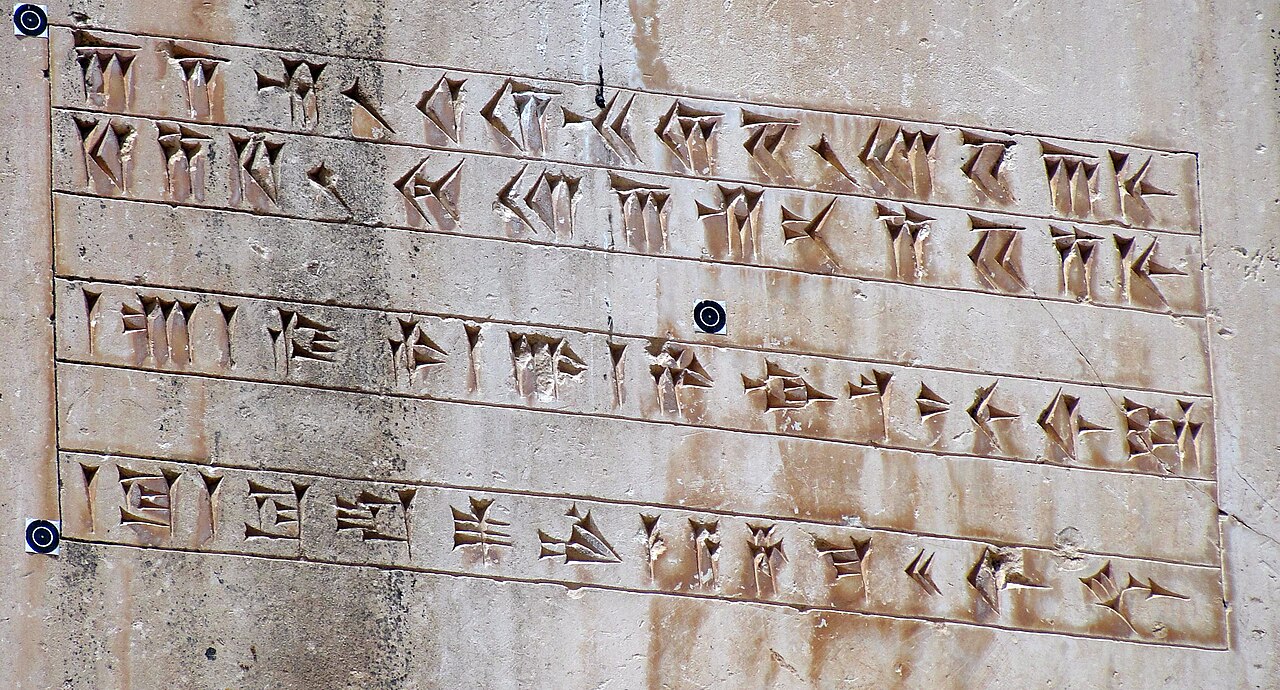
LITERATURE While we cannot say with absolute certainty that Cyrus could read and write, the evidence strongly suggests that as the ruler of a sophisticated empire with a developed bureaucracy, he was likely literate. His education, position, and the demands of ruling a vast empire all point to Cyrus possessing reading and writing skills.

Below is carved in a column in Pasargadae: "I am Cyrus the king, an Achaemenid." in Old Persian, Elamite and Akkadian languages. 

By Truth Seeker (fawiki) 

Cyrus is a prominent figure in ancient Persian and Greek literature. The Greek historian Herodotus's Histories, chronicled Cyrus's life and conquests, presenting a mix of historical facts and legendary tales. Xenophon’s Cyropaedia isa semi-fictional biography that portrays Cyrus as an ideal ruler and military strategist. This work significantly influenced political philosophy and leaders like Thomas Jefferson.

In the Bible, Cyrus is celebrated as a liberator for allowing the Jews to return to Jerusalem and rebuild the Temple. He is specifically mentioned in the Books of Ezra and Isaiah.

NATURE Cyrus valued harmony with nature, as seen in the gardens of Pasargadae, which followed the concept of paradise. These meticulously designed gardens, with their water channels and fountains, showcased the Persian kings' ability to create lush landscapes in arid regions.

PETS Cyrus had a deep connection with horses, which were central to Persian culture and military strategy. He was described as an excellent horseman, skilled in riding and managing horses

HOBBIES AND SPORTS Hunting was one of Cyrus's favorite activities. He enjoyed pursuing wild animals, such as deer and lions, both for sport and as a way to demonstrate courage and skill. 

Hunting was not only a pastime but also a royal tradition in Persian culture, symbolizing strength and leadership.

Cyrus Hunting Wild Boar by Claude Audran the Younger, Palace of Versailles Wikipedia

SCIENCE AND MATHS Cyrus supported advancements in engineering, evidenced by the canal system used to conquer Babylon.

PHILOSOPHY & THEOLOGY Cyrus the Great's philosophy and theology were characterized by a remarkable degree of tolerance and respect for diverse cultures, setting him apart from many other ancient rulers.

Cyrus demonstrated a remarkable degree of religious tolerance. He allowed people within his empire to freely practice their own religions, visiting and contributing to the upkeep of temples of various faiths. While likely a follower of Zoroastrianism, he did not impose his religion on his subjects, demonstrating a pragmatic approach to governance that recognized the importance of religious diversity.

Cyrus appears prominently in the Bible, where he is referred to as God's "shepherd" and "anointed one." Ezra 1:1-4 and 2 Chronicles 36:22-23 record Cyrus's decree allowing Jews to return to Jerusalem and rebuild the Temple. It portrays him as an instrument of God's will, despite not being a follower of Yahweh. His actions in freeing the Jews from Babylonian captivity are seen as fulfilling biblical prophecy. 

Cyrus the Great liberated the Jews from the Babylonian captivity

POLITICS Cyrus championed a philosophy of governance that emphasized tolerance, respect, infrastructure development, fair taxation. and the well-being of his subjects. He allowed conquered peoples to maintain their customs and religions, rejecting the common practice of enslaving or killing defeated populations. He advocated for a government that benefited its subjects, implementing one of the first known constitutions and judicial systems. Furthermore, Cyrus actively sought to combine the strengths, customs, and values of conquered territories with Persian culture, fostering a sense of cultural synthesis.

Cyrus establishment of satrapies (provinces) and efficient systems of communication suggest that he took great interest in the practicalities of ruling.

The Cyrus Cylinder, often regarded as an early declaration of human rights, demonstrates a sophisticated understanding of governance and cultural integration. This suggests an appreciation for art as a medium for conveying political messages and promoting cultural unity.

SCANDAL No significant scandals are associated with Cyrus, reflecting his reputation as a just ruler.

MILITARY RECORD Cyrus the Great was a brilliant military strategist whose campaigns established the Achaemenid Empire as the largest the world had seen up to that time. His military record is marked by innovative tactics, strategic alliances, and a combination of diplomacy and force.

Conquest of Media (553–550 BC): Cyrus's revolt against his Median overlord, Astyages, marked the beginning of his rise to power. With the defection of a key Median general, Harpagus, Cyrus successfully seized the Median capital, Ecbatana, uniting the Medes and Persians under his rule. This victory laid the foundation for the Achaemenid Empire.

Conquest of Lydia (547–546 BC): Facing Croesus, the wealthy king of Lydia, Cyrus employed an innovative tactic by using camels to disrupt the Lydian cavalry. This, coupled with a decisive victory at the Battle of Thymbra, led to the swift fall of Sardis, the Lydian capital. The conquest of Lydia significantly expanded Cyrus's empire and brought him access to immense wealth. Below is Here is an artistic depiction of the Battle of Thymbra, capturing the intensity and strategic brilliance of Cyrus the Great's forces against the Lydian army led by Croesus.

Battle of Thymbra

Conquest of Babylon (539 BC):  On October 12, 539 BC, Cyrus's troops entered Babylon without resistance. Cyrus himself made a triumphant entry into Babylon on October 29, 539 BC, detaining Nabonidus, the last king of the Neo-Babylonian Empire. This remarkable feat was achieved through a clever military maneuver. Utilizing a basin previously dug by Queen Nitokris to defend Babylon against Median attacks, the Persian army diverted the Euphrates River into a canal. This significantly lowered the water level in the riverbed, enabling the Persian forces to march directly through the river and enter Babylon at night.

This victory, achieved with minimal bloodshed, further solidified his empire and earned him a reputation for respect for local customs and religions.

Eastern Campaigns (545–540 BC): Cyrus's campaigns extended Persian control into Central Asia, conquering Bactria, Arachosia, Sogdia, and parts of western India, establishing vassal states in these regions.

Final Campaign and Death (530 BC): Cyrus's final campaign against the Massagetae, a nomadic tribe, proved to be his last. Although initially successful, he was ultimately defeated and killed in battle.

Cyrus was renowned for his innovative military tactics, such as the use of camels against cavalry and the ingenious diversion of the Euphrates River. He effectively combined military force with diplomacy, forging alliances and respecting the customs of conquered peoples. His armies were diverse, reflecting the multicultural nature of his expanding empire.

HEALTH AND PHYSICAL FITNESS As a warrior and ruler, Cyrus likely maintained good physical fitness to lead his armies.

HOMES Cyrus the Great established several significant residences during his reign, with Pasargadae serving as the most notable. This city, founded shortly after his victory over the Median king, Astyages, became the first capital of the Achaemenid Empire and stands as a testament to Cyrus's architectural vision and urban planning.

Located in the fertile Murghab plain of present-day Iran, Pasargadae featured the main residence of Cyrus, known as Palace P. This impressive structure showcased a blend of Persian and Median architectural styles, featuring a central hall surrounded by porticoes and offering views of beautifully designed gardens.

In addition to Pasargadae, Cyrus had access to other residences. Ecbatana, the summer capital of the Medes, offered palatial structures reflecting Median architectural styles. Furthermore, Cyrus was born in Anshan, which served as an important early residence before his expansion of territory.

TRAVEL Cyrus traveled extensively during his military campaigns, covering vast territories from the Indus Valley to the Balkans.

DEATH The death and burial of Cyrus the Great remain subjects of historical debate, with various accounts offering differing details.

Cyrus the Great died around 530 BC, likely during a military campaign in the eastern part of his empire. While the exact circumstances surrounding his death remain uncertain, several accounts exist:

According to Herodotus, Cyrus died in battle against the Massagetae, a nomadic tribe led by Queen Tomyris. After Cyrus killed Tomyris's son, she is said to have defeated him and placed his severed head in a bag of blood.

Ctesias suggests that Cyrus was mortally wounded in battle against the Derbices, possibly with the aid of Indian allies. He reportedly survived for three days after the battle, during which he organized his empire before succumbing to his injuries.

Some sources indicate Cyrus died fighting the Dahae or Daai, another Saka tribe similar to the Massagetae. In contrast, Xenophon claimed that Cyrus died peacefully.

The tomb of Cyrus the Great is located in Pasargadae, in present-day Iran. This remarkable structure consists of a six-step stone platform supporting a chamber made of limestone blocks with a gabled roof.

According to ancient accounts, the tomb originally contained a golden sarcophagus, Cyrus's arms, jewelry, and a cloak. However, the tomb was later looted, and its current contents remain unknown. An inscription allegedly found on the tomb read: "O man, whoever you are and wherever you come from, for I know you will come, I am Cyrus who won the Persians their empire. Do not therefore begrudge me this bit of earth that covers my bones."

The tomb of Cyrus the Great is considered one of the oldest examples of base-isolated structures, demonstrating advanced earthquake engineering for its time. It is now a UNESCO World Heritage Site and a place of cultural importance in Iran.

Tomb of Cyrus in Pasargadae by Bernd81 Wikipedia

APPEARANCES IN MEDIA Cyrus is often featured in documentaries about ancient Persia, such as National Geographic's explorations of the Achaemenid Empire or BBC’s historical series.

Cyrus appears as a leader in Sid Meier’s Civilization games, where his traits reflect his historical legacy of diplomacy and conquest.

Cyrus is frequently depicted in museums and historical recreations, highlighting his leadership and grandeur.

ACHIEVEMENTS Cyrus founded the Achaemenid Empire, liberated the Jews, and authored policies of tolerance that have influenced governance for millennia. His tomb inscription at Pasargadae reflects his humility and enduring legacy.

Friday, 3 May 2013

Cyril and Methodius

NAME Cyril (born Constantine) and Methodius

WHAT FAMOUS FOR Known as the "Apostles of the Slavs," Cyril and Methodius were Byzantine missionaries who brought Christianity, literacy, and cultural influence to the Slavic nations. They created the Slavonic alphabet, a precursor to the Cyrillic script, and translated Scripture and liturgy into Old Church Slavonic.

BIRTH Cyril: c. 826-827, Thessalonica, Byzantine Empire

Methodius: c. 815, Thessalonica, Byzantine Empire

FAMILY BACKGROUND They were born into a noble and devout Greek family in Thessalonica, a city with a significant Slavic population. Their father, Leo, was a high-ranking Byzantine military officer and magistrate, while their mother, Maria, was possibly of Slavic descent. The brothers were part of a large family with seven children, with Cyril being the youngest.

CHILDHOOD The brothers grew up in a multicultural environment, exposed to both Greek and Slavic cultures, which likely influenced their later work as missionaries to the Slavs.  

EDUCATION Both brothers received a rigorous education. Cyril, in particular, excelled academically and was sent to the prestigious Imperial School of Constantinople at the age of 14. There, he studied theology, grammar, arithmetic, geography, astronomy, music, poetry, rhetoric, and languages such as Latin, Hebrew, and Syriac. His intellectual brilliance earned him the title "the Philosopher" and a position as a librarian at the Church of Hagia Sophia and a professor of philosophy at the University of Magnaura.

Methodius, while also well-educated, pursued a different path. He initially worked as an administrator in Macedonia but later renounced worldly pursuits to become a monk, adopting the name Methodius.

CAREER RECORD 851: Cyril (then Constantine) undertook a diplomatic mission to the Caliph of Baghdad

859-861: Cyril and Methodius led a successful missionary expedition to the Khazars near the Caspian Sea

863: Cyril and Methodius began their work among the Slavs in Moravia

863-867: The brothers created the Glagolitic alphabet and translated religious texts into Old Church Slavonic

869: Pope Adrian II formally authorized the use of the Slavic liturgy

870: Methodius was consecrated as Archbishop of Sirmium by Pope Adrian II

870-873: Methodius was imprisoned by German clergy

873: Methodius was liberated by Pope John VIII's intervention1

880: Methodius was summoned to Rome and received papal approval for using the Slavonic liturgy1

882: Methodius visited Constantinople to strengthen his position in the Eastern church.

APPEARANCE Descriptions of their appearance are sparse, but Cyril is often depicted as scholarly and ascetic, while Methodius is shown as strong and resolute. As Byzantine Greeks from Thessalonica, they likely had Mediterranean features common to that region.

Saints Cyril and Methodius - fresco in Troyan Monastery

FASHION Cyril is often depicted wearing a monastic habit, reflecting his status as a monk. Methodius is usually shown vested as a bishop with an omophorion, indicating his role as an archbishop

CHARACTER Cyril was intellectual and visionary, while Methodius was pragmatic and determined. Together, they complemented each other in their missionary work.

SENSE OF HUMOUR Cyril had a quick wit: When challenged about creating a liturgy in the Slavic language, Cyril responded with a sharp retort, asking if his critics thought God was "so weak that he cannot grant it, or so envious that he does not wish it?"

RELATIONSHIPS Neither Saint Cyril or Saint Methodius ever married. Both brothers dedicated their lives to religious service and missionary work.

The brothers had a strong bond, collaborating closely on their missions. Their relationship with the Byzantine Emperor Michael III and Patriarch Photius was also pivotal.

MONEY AND FAME While they gained significant renown for their missionary work, they lived modestly as monks and dedicated their lives to their faith.

FOOD AND DRINK Their diet would have been typical of Byzantine monks: simple and consisting mainly of bread, vegetables, and water.

MUSIC AND ARTS  Cyril and Methodius were well-educated in music and "enriched the Moravian Church with chant and spiritual songs. " They supported the use of Slavic chant in liturgical practices, integrating local traditions into Christian worship. Their approach of using local language and cultural elements in worship was praised by Pope Adrian II, who authorized the use of the Slavonic liturgy

LITERATURE Cyril and Methodius were deeply committed to translating religious texts into the Slavonic language.  To facilitate their translation efforts, the brothers created the Glagolitic alphabet, a writing system specifically designed for the Old Church Slavonic language. Cyril initiated this monumental task by translating the opening lines of John's Gospel: "In the beginning was the Word..." Subsequently, they collaborated to translate the four Gospels, the epistles of Paul, and the book of Psalms. Methodius later completed the translation of the entire Bible, excluding the apocryphal books of Maccabees. Additionally, they translated liturgical books and prayers into Slavonic.

Their translations were renowned for their precision and natural flow. They coined numerous new words and expressions, significantly expanding the Slavic lexicon. Their work laid the groundwork for the development of Slavic literature and formal education. They even authored the first Slavic Civil Code for use in Great Moravia.

The enduring legacy of their efforts is the development of Church Slavonic, a language still employed in certain Eastern Christian liturgies.

The Baška tablet is an early example of the Glagolitic from Croatia

Early writings about their lives and missions, such as The Life of Cyril and The Life of Methodius, detail their theological and cultural contributions.

Modern biographies like Cyril and Methodius: Founders of Slavic Literacy highlight their impact on language, religion, and education.

HOBBIES AND SPORTS Their lives were devoted to religious and scholarly pursuits, leaving little time for leisure activities.

SCIENCE AND MATHS Cyril’s philosophical education included logic and other disciplines, which would have encompassed basic elements of science and mathematics as understood in Byzantine times.

PHILOSOPHY & THEOLOGY Cyril and Methodius's theological and philosophical framework was deeply rooted in their Byzantine Christian heritage and their unwavering commitment to evangelization. Their approach can be encapsulated in several key aspects:

They believed in adapting Christianity to local cultures, particularly through language. To facilitate this, they created the Glagolitic alphabet to transcribe Old Church Slavonic and translated numerous religious texts, including parts of the Bible, into Slavonic.

Cyril and Methodius were strong advocates for the use of local languages in worship, opposing the "Heresy of the Three Languages" which restricted liturgy to Hebrew, Greek, and Latin. Their efforts led to papal approval for Slavonic liturgy, although this was later contested.

Cyril, renowned as "the Philosopher," excelled in teaching theology and philosophy. They emphasized the importance of educating both clergy and laity in their native tongue.

They maintained strong connections to Byzantine theology and spirituality, introducing Byzantine liturgical practices to Slavic regions.

Cyril and Methodius worked to bridge Eastern and Western Christian traditions, seeking approval for their mission from both Constantinople and Rome.

Their missionary strategy centered on encountering and understanding local cultures before evangelizing. They believed in the universality of the Christian message, applicable to all peoples and languages.

They composed works on Christian dogmas in Slavonic. Cyril, in particular, engaged in theological debates, including discussions on the Trinity with the Abbasid Caliph.

Cyril and Methodius' philosophical and theological approach prioritized making Christianity accessible and relevant to new cultures while preserving doctrinal integrity. This philosophy of inculturation and vernacular worship had a lasting impact on Slavic Christianity and culture.

POLITICS They were deeply involved in the politics of their time, navigating tensions between the Byzantine Empire and Rome while advancing their mission.

SCANDAL Their work faced resistance from some Latin-speaking clergy, who opposed the use of Slavonic in liturgy, but the brothers were eventually vindicated by papal support.

MILITARY RECORD They had no direct military involvement but operated within the context of the Byzantine Empire’s strategic interests in the Balkans.

HEALTH AND PHYSICAL FITNESS Cyril’s health was reportedly fragile, leading to his death at a relatively young age. Methodius lived longer, despite the hardships of missionary life.

HOMES They spent much of their lives traveling for their missions, residing in monasteries and mission outposts.

TRAVEL Cyril and Methodius embarked on extensive missionary journeys across Eastern and Central Europe. Their primary goal was to spread Christianity and develop Slavic culture and literacy.

Between 860 and 861, Cyril led a mission to the Khazars near the Caspian Sea. In 863, both brothers initiated their mission to Great Moravia. Later, from 867 to 868, they journeyed to Rome to seek papal approval for their work.

Their travels took them through various routes. They journeyed from Constantinople to Moravia, traversing Pannonia. They also explored Slavic territories in present-day Czech Republic and Slovakia. Their southeast route led them through Hungary, Bulgaria, Serbia, Romania, North Macedonia, and other Balkan countries. Additionally, they took a southwest route to Rome, passing through Austria, Bavaria, Slovenia, and Italy. It's also possible that they visited Lesser Poland and Eastern Silesia.

Given the historical context, they likely traveled on foot for shorter distances, by horseback or horse-drawn carts for longer overland journeys, and by boat when crossing rivers or seas. Their journeys were undoubtedly challenging, involving long distances across diverse terrains and climates, often in regions with limited infrastructure.

Beyond the geographical aspect, Cyril and Methodius' travels facilitated cultural and spiritual exchange. They brought relics of Saint Clement to Rome, disseminated the Glagolitic alphabet and Slavonic liturgy, and forged connections between Byzantine, Slavic, and Roman Christian traditions.

Today, the Cyril and Methodius Route, certified as a Cultural Route of the Council of Europe, invites modern travelers to follow in the footsteps of these influential missionaries, exploring the rich cultural heritage they left behind across numerous European countries.

DEATH Cyril died on February 14, 869, in Rome at the age of 42. Shortly before his death, he became a monk, taking the name Cyril. He was initially buried in St. Peter's Basilica in Rome but was later transferred to the Basilica of San Clemente. His remains were kept there until the late 18th century when they were removed during the French establishment of the Roman Republic. A small relic of St. Cyril was discovered in the 1960s and is now housed in the Basilica of San Clemente.

Methodius died on April 6, 885, in Velehrad, now part of the Czech Republic. He passed away after completing the translation of almost the entire Bible into Slavonic. He was buried in the main cathedral church of Great Moravia, but the exact location of his burial remains unknown due to uncertainty about the location of the main cathedral at that time.

While their physical presence ended, the legacy of Cyril and Methodius continued to shape Slavic Christianity and culture for centuries to come.

APPEARANCES IN MEDIA Cyril and Methodius are celebrated in Eastern Orthodox and Roman Catholic traditions, often depicted in religious art. 

Cyril and Methodius, painting by Jan Matejko, 1885

They are commemorated in films, books, and educational materials highlighting their contributions to Slavic culture and Christianity.

FEAST DAYS Saints Cyril and Methodius have feast days that are celebrated in various Christian traditions:

May 11 (Julian Calendar): This is their primary feast day in the Eastern Orthodox Church, commemorating their work as missionaries and their creation of the Old Church Slavonic language and alphabet.

Roman Catholic Church February 14: Celebrated as their feast day in the Roman Catholic Church, recognizing their contributions as co-patrons of Europe (a title given to them by Pope John Paul II in 1980).

July 5: In the Czech Republic and Slovakia, their feast day is observed as a national holiday, honoring their role as the "Apostles to the Slavs" and their impact on Slavic culture and Christianity.

May 24: Known as Saints Cyril and Methodius Day, this date is widely celebrated in Bulgaria, North Macedonia, and other Slavic countries as a tribute to their contributions to literacy and education through the creation of the Cyrillic script.

ACHIEVEMENTS Creation of the Glagolitic alphabet

Translation of religious texts into Slavic languages

Development of a Slavic liturgical tradition

Spread of Christianity among Slavic peoples

Laying the foundation for the cultural and literary development of Slavic nations

Source Carpatho