Saturday, 2 February 2013

Nicolaus Copernicus

NAME Nicolaus Copernicus

WHAT FAMOUS FOR Copernicus is best known for his heliocentric theory, which proposed that the Earth and other planets revolve around the Sun, a revolutionary idea that challenged centuries of established belief.

BIRTH Nicolaus Copernicus was born on February 19, 1473, in Toruń, a city in the Kingdom of Poland.

FAMILY BACKGROUND His father, a prosperous merchant named Nicolaus Copernicus, moved to Toruń from Kraków in 1460. When Copernicus was just ten years old, his father passed away, leaving him and his siblings orphaned. His mother, Barbara Watzenrode, came from a wealthy, upper-class family of merchants in Toruń.

Fortunately, Copernicus had a powerful guardian in his maternal uncle, Lucas Watzenrode. A church canon and later the Prince-Bishop of Warmia, Watzenrode took on the responsibility of raising young Nicolaus and his siblings. 

Copernicus's brother, Andrew, followed in his uncle's footsteps and became a canon in Frombork. His sister, Barbara, chose a religious life, becoming a Benedictine nun. The youngest sister, Katharina, married Barthel Gertner, a successful businessman and city councillor.

CHILDHOOD Copernicus grew up in a prosperous household in Toruń. He lost his father at a young age, and his uncle, Lucas Watzenrode, a powerful bishop, became his guardian. His uncle became a key figure in his upbringing, fostering his intellectual development.

EDUCATION Copernicus's academic journey was marked by a thirst for knowledge and a keen interest in the cosmos. He began his studies at the University of Kraków in 1491, where he was introduced to the wonders of astronomy under the guidance of Professor Albert Brudzewski. This early exposure ignited a lifelong passion for the celestial sciences.

After a brief return to Poland, Copernicus embarked on a series of studies in Italy. In 1497, he enrolled at the University of Bologna, where he delved deeper into astronomy under the tutelage of Domenico Maria Novara da Ferrara. This renowned astronomer's influence further solidified Copernicus's fascination with the heavens.

Subsequently, Copernicus pursued medical studies at the prestigious University of Padua. However, his academic pursuits extended beyond medicine. On May 31, 1503, having passed the obligatory examinations, he was granted the degree of Doctor of Canon Law from the University of Ferrara, a qualification that would prove useful in his future role as a church official.

Image by Perplexity

Through his extensive studies and diverse range of interests, Copernicus laid the foundation for his groundbreaking work in astronomy. His intellectual curiosity and dedication to scholarly pursuits would ultimately lead him to challenge the prevailing geocentric model of the universe and propose a revolutionary heliocentric theory.

CAREER RECORD 1503-1510: Copernicus returned to Poland from the University of Ferrara and worked at the Episcopal palace, assisting his uncle as his secretary and physician, while exploring astronomy.

1510: He began working as a canon in the bishopric of Frombork.

1514-1532: Gathered information from sky observations and developed his heliocentric theory.

1532: Completed his book De revolutionibus orbium coelestium (On the Revolutions of the Celestial Spheres) but did not publish it immediately.

1543: De revolutionibus orbium coelestium was published shortly before his death

APPEARANCE Copernicus  had dark, natural hair, a prominent broken nose, and a noticeable scar above his left eye. He is often depicted as having a serious and intellectual demeanor, with a contemplative expression.

Nicolaus Copernicus portrait from Town Hall in Toruń - 1580 http://www.frombork.art.pl

FASHION As a Renaissance-era scholar and church canon, Copernicus's attire was a reflection of his status and profession. He typically wore long, ankle-length gowns, a common fashion among scholars, judges, doctors, and other professionals of the time. His wardrobe likely included a dark coat with a fur collar, a white shirt, and a black velvet partlet, a garment covering the chest and neck, often lined in white.

As a church official, Copernicus may have worn additional garments associated with his ecclesiastical role, such as robes and a clerical collar. For formal occasions or portraits, he might have donned more elaborate attire, including a hat or cap befitting his station and possibly a chain or other symbols of office.

CHARACTER Copernicus was thoughtful, reserved, and methodical. He was cautious, particularly about publishing his revolutionary ideas, fearing backlash.

SENSE OF HUMOUR His meticulous nature suggests Copernicus was more serious than jovial.

RELATIONSHIPS Copernicus never married and appears to have been deeply focused on his studies and clerical duties.

MONEY AND FAME In 1500, Copernicus was already a renowned scholar, lecturing on astronomy to large audiences. His intellectual pursuits extended beyond the cosmos. He delved into the realm of economics, pioneering the concept that debased currency drives sound money out of circulation. His work on monetary reform, particularly during his tenure as a governor of Warmia, involved administering taxes and dispensing justice.

Copernicus's most significant contribution to science, On the Revolutions of the Heavenly Spheres, was a groundbreaking work that challenged the prevailing geocentric model of the universe. Despite its initial lack of recognition, Copernicus's heliocentric theory laid the foundation for future astronomical discoveries. It wasn't until Galileo Galilei, a century later, provided empirical evidence to support this theory that it gained widespread acceptance. Today, Copernicus's name is synonymous with scientific revolution and is recognized globally.

FOOD AND DRINK Little is known about his culinary preferences, but as a canon, he likely enjoyed simple, modest meals typical of clergy.

MUSIC AND ARTS Copernicus studied painting during his time at the University of Krakow and later learned from Italian painter Franciszek Rabolini in Bologna

LITERATURE  Copernicus was a multifaceted scholar, contributing to various fields of knowledge. He authored treatises on trigonometry, showcasing his mathematical prowess. Additionally, he translated the works of the Byzantine historian Theophylus Simocatta into Latin, expanding access to valuable historical texts.

Copernicus authored several books on astronomy, including his famous work On the Revolutions of Heavenly Bodies, which marked a pivotal point in the history of astronomy. On the Revolutions of the Heavenly Spheres challenged the long-held geocentric model of the universe. This revolutionary theory proposed that the Sun, rather than the Earth, was at the center of the solar system.

Although he completed the manuscript in 1530, Copernicus hesitated to publish it, fearing the potential backlash from both the scientific community and the Church.  However, Copernicus was actively championed by some of the highest-ranking figures in the Catholic Church. Cardinal Nikolaus von Schönberg, a key advisor to the Pope, wrote to Copernicus in 1536 formally requesting that he share his "new theory of the universe" with the scholarly world. Closer to home, Tiedemann Giese, the Prince-Bishop of Kulm and Copernicus’s lifelong friend, acted as a persistent advocate and "boots-on-the-ground" protector who spent years urging the astronomer to finalize his calculations. This high-level ecclesiastical support provided Copernicus with significant political cover, eventually leading him to dedicate the finished De revolutionibus to Pope Paul III.

In  May 1539, Georg Rheticus, a 25-year-old professor from the University of Wittenberg  arrived in Frombork to meet Copernicus. Whhat was originally intended to be a short visit turned into a two-year intensive collaboration. During this period, Rheticus became Copernicus's first and only real pupil, providing the youthful energy and mathematical support necessary to move the project toward completion. By 1541, Rheticus left with a copy of the manuscript to personally oversee its publication in Nuremberg.

The book was delivered to Copernicus on his deathbed, allowing him to see the printed version just before he died

Despite its groundbreaking nature, the book was initially met with skepticism and hostility, as it contradicted the prevailing worldview. The high price and limited distribution further hindered its commercial success.

Copernicus's daring hypothesis, though initially met with resistance, laid the foundation for modern astronomy and marked a pivotal moment in the history of scientific thought.

Title page of 2nd edition, Basel, 1566

As a student, Copernicus was part of a literary society called "Sodalicja Nadwislanska," where he participated in meetings, trips, and discussions.

Copernicus is a central figure in scientific biographies, such as Dava Sobel’s A More Perfect Heaven, which dramatizes the creation of his heliocentric theory.

NATURE Copernicus had a deep interest in observing the heavens, spending many nights studying the stars and planets from his home.

HOBBIES AND SPORTS Copernicus enjoyed astronomy as both a professional and personal pursuit, dedicating much of his free time to it.

SCIENCE AND MATHS Copernicus was a man of diverse talents. In addition to his groundbreaking astronomical theories, he was also a skilled engineer. He designed and built a hydraulic machine to supply water from a nearby stream to the houses of the canons in Frauenburg, demonstrating his practical ingenuity.

His first recorded astronomical observation was on March 9, 1497, when he observed an occultation of Aldebaran, the brightest star in the Taurus constellation, by the Moon, marking the beginning of Copernicus' lifelong fascination with the celestial bodies. As he delved deeper into the subject, he gained recognition for his insightful observations and innovative thinking. Inspired by the work of Domenico Novara, Copernicus began to question the fundamental principles of Ptolemaic astronomy, a system that had dominated astronomical thought for centuries.

Copernicus's revolutionary book, On the Revolutions of the Heavenly Spheres, challenged the long-held belief that the Earth was the center of the universe. By proposing a heliocentric model, where the Sun occupies the central position, he fundamentally altered our understanding of the cosmos. This groundbreaking theory had far-reaching implications, including refuting the notion that gravity was solely a result of the Earth's central position.

To explain the apparent retrograde motion of planets like Mars, Jupiter, and Saturn, Copernicus proposed that these celestial bodies orbit the Sun at varying distances. As the Earth overtakes these planets in its orbit, they appear to move backward against the backdrop of distant stars. This elegant explanation provided a more accurate and comprehensive understanding of planetary motion.

Copernicus's work was heavily influenced by the ideas of the ancient Greek astronomer Aristarchus of Samos, who had earlier suggested a heliocentric model. However, Copernicus's mathematical rigor and detailed observations provided strong evidence to support this revolutionary concept. While his theory was a significant step forward, it was not without its limitations. Copernicus mistakenly assumed that celestial orbits were perfectly circular, a misconception that would later be corrected by Johannes Kepler.


Copernicus studied mathematics at the University of Krakow and maintained a lifelong interest in the subject. He was influenced by Neoplatonic ideas, which emphasized the inherent harmony and mathematical order of the universe. He believed that mathematics was the key to unlocking the secrets of the cosmos. This belief, coupled with a rationalist approach, led him to question the prevailing geocentric model and seek a more elegant and accurate explanation.

PHILOSOPHY & THEOLOGY Although his heliocentric theory clashed with theological views, Copernicus was deeply religious and served the Church as a canon throughout his life.

Copernicus viewed his scientific work as a way to better understand God's creation. He believed that the universe, governed by mathematical laws and celestial harmonies, was a testament to divine design. Rather than seeing a conflict between science and faith, he saw them as complementary. He interpreted Scripture in a way that allowed for scientific inquiry, recognizing the limitations of literal interpretations when they contradicted empirical evidence.

Despite his revolutionary ideas, Copernicus was a cautious and humble scholar. He emphasized the importance of empirical observation, but also recognized the limitations of human knowledge. He was aware of the potential controversy surrounding his heliocentric theory and delayed its publication until the end of his life.

As a canon in the Catholic Church, Copernicus navigated the delicate balance between his scientific pursuits and his religious obligations. While he dedicated his major work to Pope Paul III, he was mindful of the potential backlash from both the Church and the broader scientific community.

Copernicus's legacy extends far beyond his groundbreaking astronomical discoveries. His philosophical and theological framework, which sought to reconcile faith and reason, continues to inspire and challenge us today.

POLITICS Copernicus worked with the Prussian diet on monetary reform, publishing studies on the value of money, demonstrating his expertise in economics.

SCANDAL In the 16th century, the prevailing cosmological model, known as the geocentric model, placed Earth at the center of the universe, with all celestial bodies orbiting around it. This view was widely accepted and supported by both philosophical and religious authorities. However, Copernicus's heliocentric model, suggesting that the Earth revolved around the Sun, threatened the prevailing worldview and the Church's teachings.

The implications of Copernicus's theory were profound. It dethroned humanity from its privileged position as the universe's focal point, humbling our place in the cosmos. The Church, fearing the potential impact on religious doctrine, responded by banning Copernicus's book.

Martin Luther, a prominent religious figure, was among the many who vehemently opposed Copernicus's theory. He condemned it as "anti-Biblical and intolerable," citing the biblical passage where Joshua commands the Sun to stand still. Luther's criticism, along with the Church's ban, highlights the significant cultural and religious implications of Copernicus's work.

On March 5, 1616, the Roman Catholic Church officially placed De revolutionibus orbium coelestium (On the Revolutions of the Heavenly Spheres) on the Index Librorum Prohibitorum (Index of Forbidden Books). This move was largely a reactionary measure triggered by Galileo Galilei’s vocal and theological defense of the heliocentric model, which the Church viewed as a challenge to Scriptural interpretation.

However, the book was not subject to an absolute ban; it was suspended "until corrected" (donec corrigatur). The Church's primary demand was that heliocentrism be presented strictly as a mathematical hypothesis for astronomical calculation rather than a physical, literal truth. In 1620, the Congregation of the Index released a formal list of corrections—involving the modification or deletion of only about nine sentences—designed to soften the book’s claims about the Earth's motion.

While the Church’s stance began to soften in the 18th century, the legal timeline of the "ban" has two distinct markers:

The 1758 Reform: Under Pope Benedict XIV, the general prohibition against books teaching that the Earth moves was removed from the Index.

The 1835 Finality: Despite the 1758 shift, the specific titles by Copernicus, Galileo, and Kepler were not formally struck from the list until the 1835 edition of the Index.

By 1835, the scientific evidence for a sun-centered system was undeniable, and the Church officially concluded the centuries-long legal restriction on these foundational works of modern science.

MILITARY RECORD Copernicus' uncle's position as Prince-Bishop likely exposed him to the political and military tensions of the time.

Nicolaus Copernicus played a crucial role in several diplomatic missions between Poland and the Teutonic Knights of Prussia. In 1519-1520, Copernicus was part of a Polish delegation sent to the Grand Master of the Teutonic Knights. The mission's primary objective was to negotiate the return of the town of Braniewo, which had been captured by the Teutonic Knights.

During the Polish-Teutonic War of 1519-1521, Copernicus took on a more active role in the defense of his homeland. He organized and oversaw the defense of Olsztyn Castle against the invading Teutonic Knights, demonstrating his military prowess and strategic thinking.

In 1521, Copernicus was appointed Commissioner for Warmia, a position that required him to negotiate with the Teutonic Knights for the return of Warmian territories that had been seized. His diplomatic skills and knowledge of the region proved invaluable in these negotiations.

Throughout his career, Copernicus served the Prince-Bishop of Warmia in various diplomatic capacities. He frequently engaged in negotiations with the Teutonic Order, demonstrating his commitment to both his scientific pursuits and his civic duties.

HEALTH AND PHYSICAL FITNESS  Copernicus studied medicine at the University of Padua and obtained the right to practice. He practiced medicine throughout his life, diagnosing patients and preparing prescribed drugs.

Copernicus suffered from apoplexy and paralysis in his later years, which contributed to his death.

HOMES Nicolaus Copernicus's life was marked by several significant residences, each contributing to his intellectual and personal development.

Bologna (1497-1501): During this period, Copernicus resided in Bologna, Italy, where he lodged with a renowned mathematics professor, Domenico Maria de Novara. This experience exposed him to the latest scientific thought and fostered his interest in astronomy.

Lidzbark Warmiński (1503-1510): Upon returning to Poland, Copernicus lived in his uncle's bishopric palace in Lidzbark Warmiński. This period provided him with a stable environment to further his studies and contemplate the mysteries of the cosmos.

Frombork (Frauenburg) (1514 onwards): Copernicus spent the latter part of his life in Frombork, where he lived in a canon's house. It is said that he made observations of the celestial bodies through small holes in the walls of his apartment, a testament to his dedication to astronomical study.

TRAVEL Copernicus traveled extensively for his education, studying in Kraków and Italy, and also for Church-related duties.

DEATH Nicolaus Copernicus passed away on May 24, 1543, at the age of 70. In the twilight of his life, he suffered a stroke that left him paralyzed. It is said that on the day of his death, he was presented with an advance copy of his groundbreaking work, De revolutionibus orbium coelestium. A poignant moment, he is believed to have smiled upon seeing his life's work before passing away.
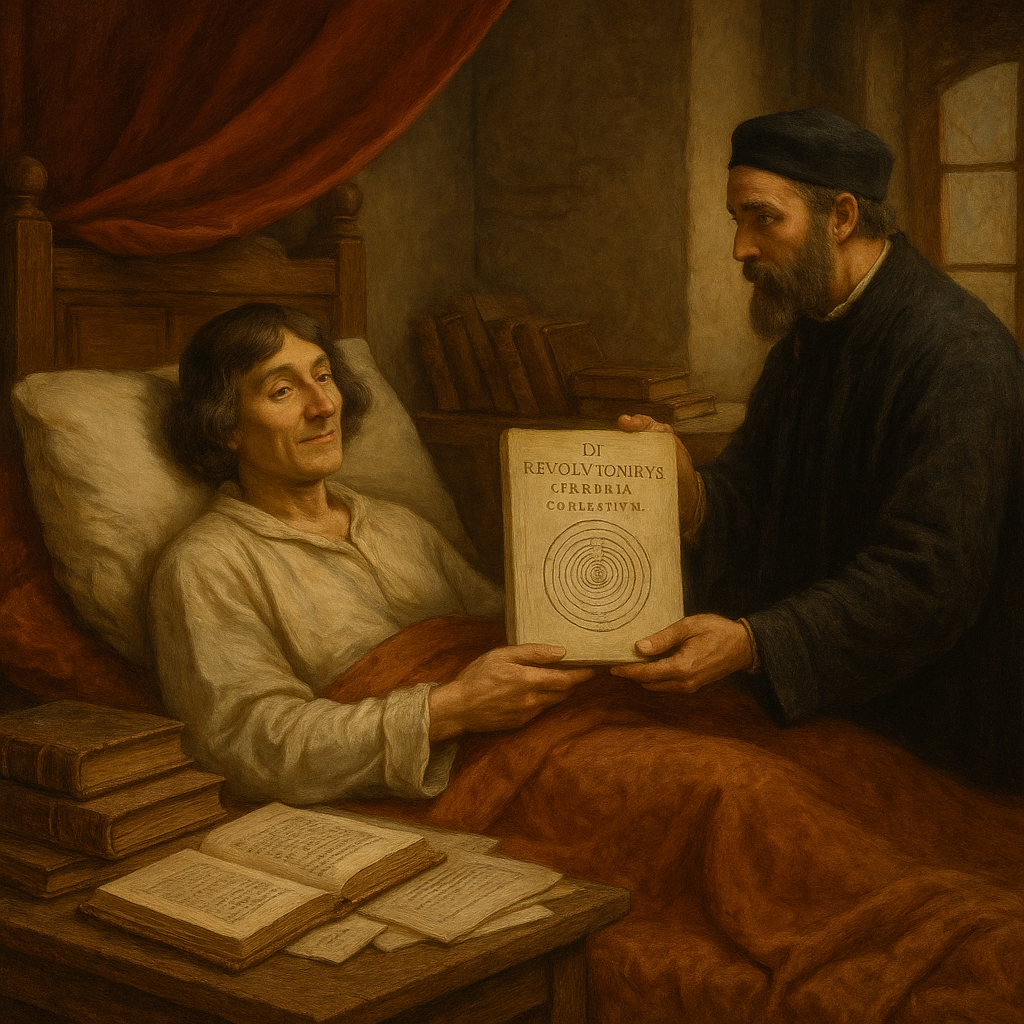
Image by Perplexity

Copernicus was initially laid to rest in an unmarked grave beneath the floor of Frombork Cathedral in northern Poland. His burial was simple, without any special marker or monument.

In 2005, archaeologists made a significant discovery when they located Copernicus's probable grave in the cathedral. Through DNA analysis, comparing genetic material from the skull with that from hairs found in one of his books, his remains were positively identified. Forensic experts even reconstructed his face based on the skull, which closely resembled known portraits of the astronomer.

On May 22, 2010, 467 years after his initial burial, Copernicus was given a second funeral and reburied with full honors. His remains were placed in a tomb in Frombork Cathedral, marked with a black granite headstone that recognizes him as the founder of the heliocentric theory and a church canon. The reburial ceremony, conducted with Catholic honors, symbolized a reconciliation between the Church and science.

This symbolic gesture acknowledged Copernicus's immense contributions to science and marked a significant shift from the historical treatment of his ideas, which were once condemned by the Church as heretical.

APPEARANCES IN MEDIA Copernicus has been featured in numerous historical documentaries, books, and educational programs. His life and work are celebrated as pivotal moments in the Scientific Revolution.

Nicolaus Copernicus has been featured and referenced extensively in various forms of media, underscoring his monumental contributions to science and his role in the history of the Scientific Revolution. Here are notable examples:

1. DOCUMENTARIES AND EDUCATIONAL PROGRAMS

The Universe (History Channel): Copernicus’s heliocentric model is frequently highlighted in episodes focusing on the history of astronomy and revolutionary scientific ideas.

PBS’s Nova series: Copernicus has been featured in episodes exploring astronomy and the Scientific Revolution.

BBC’s The Great Scientists: This series profiles Copernicus as one of the pivotal figures in changing humanity's understanding of the universe.

2. FILMS

Copernicus (1973): This Polish film directed by Ewa Petelska and Czesław Petelski dramatizes his life and the challenges he faced in promoting his heliocentric model.

"Cosmos: A Spacetime Odyssey" (2014): Hosted by Neil deGrasse Tyson, the series recounts Copernicus’s groundbreaking theory and the resistance it faced.

3. TELEVISION SHOWS

Cosmos: A Personal Voyage (1980): Carl Sagan narrates the story of Copernicus’s revolutionary ideas and their impact on science and philosophy.

Cosmos: A Spacetime Odyssey (2014): Hosted by Neil deGrasse Tyson, the series recounts Copernicus’s groundbreaking theory and the resistance it faced.

Animated history programs: Copernicus has been represented in educational animated series like Horrible Histories and CrashCourse in their episodes on scientific revolutions.

4. MUSEUMS AND EXHIBITIONS

Planetariums and science museums worldwide: Copernicus is frequently featured in exhibits about astronomy and the history of science, particularly in Toruń, Poland, where the Copernicus Science Centre honors his legacy.

The "Copernicus and His Legacy" exhibit has toured internationally, showcasing his work and its impact on science.

5.ART

He has been depicted in numerous historical paintings, including Jan Matejko’s famous painting Astronomer Copernicus: Conversation with God (see below)

6. NAMESAKES AND SYMBOLS

Astronomical features: The lunar crater Copernicus and the asteroid 1322 Coppernicus are named in his honor.

Cultural institutions: His name graces countless schools, universities, and scientific organizations worldwide, especially in Poland.

ACHIEVEMENTS  Developed the heliocentric theory, placing the Sun at the center of the universe.

Authored On the Revolutions of Heavenly Bodies, introducing the term "revolution" in an astronomical context.

Contributed to economic theory through studies on monetary reform.

Invented a hydraulic water system for the Frauenberg Cathedral.

His work inspired later astronomers, including Galileo and Kepler, cementing his legacy in the history of science.

Sunday, 27 January 2013

Gary Cooper

NAME Gary Cooper (born Frank James Cooper). As other actors were using the name "Frank Cooper", he adopted the performing name of "Gary" after his agent's hometown of Gary, Indiana.

WHAT FAMOUS FOR A legendary American film actor known for his stoic, understated performances and ruggedly handsome appearance.

BIRTH Born May 7, 1901, at 730 Eleventh Avenue, Helena, Montana.

FAMILY BACKGROUND Gary Cooper, born Frank James Cooper on May 7, 1901, in Helena, Montana, hailed from an English immigrant family. His father, Charles Henry Cooper, a prominent lawyer and Montana Supreme Court justice, and his mother, Alice Louise Brazier Cooper, both had English roots.

CHILDHOOD Cooper spent his early years in Montana, enjoying outdoor activities like horseback riding and hunting. He was a shy and reserved child, often preferring solitude to social interaction.

Cooper aged 3

EDUCATION His formal education took him to England, where he attended Dunstable Grammar School from 1910 to 1913. Upon returning to the U.S., he continued his studies at Helena High School and briefly attended Gallatin County High School and Montana Agricultural College. 

His English teacher at Gallatin County High School, Ida Davis, encouraged him to focus on academics and participate in debating and dramatics,

In 1921, he enrolled at Grinnell College in Iowa, but he left without graduating.

CAREER RECORD Initially worked as a Yellowstone Park guide and then as a Hollywood extra. Cooper's first credited role was in The Winning of Barbara Worth (1926). Over 36 years, he starred in numerous classics and won two Academy Awards for Best Actor. ome of his most famous roles include: High Noon, Mr. Deeds Goes to Town, Sergeant York and A Farewell to Arms.

APPEARANCE Gary Cooper was renowned for his striking appearance and commanding presence. Towering at 6'3" (1.91 m), he possessed a lean, lanky frame complemented by broad shoulders. 

His piercing blue eyes and rugged good looks were iconic, and his distinctive bow-legged gait, a result of a teenage hip injury, added to his unique allure. 

Cooper's strong, silent screen persona and rugged handsomeness made him the quintessential Western and adventure film hero.

Cooper in The Winning of Barbara Worth, 1926

FASHION While known for his Western roles, Cooper was also comfortable in sharp tailoring off-screen. He was a client of the prestigious tailoring house Anderson & Sheppard.

CHARACTER Reserved, introspective, and deeply moral. He was often described as a gentle giant. Cooper exuded authenticity on and off the screen.

SENSE OF HUMOUR Noted for a dry wit, often understated but charming in delivery.

RELATIONSHIPS Gary Cooper married Veronica "Rocky" Balfe, a New York socialite, on December 15, 1933. Their marriage, which lasted nearly 28 years until Cooper's death in 1961, produced one daughter, Maria Cooper. 

While the couple faced challenges, primarily due to Cooper's infidelities, they remained married. Rocky's unwavering support during Cooper's final illness underscores the enduring nature of their bond.

Gary Cooper and future wife Veronica Balfe in November 1933

MONEY AND FAME Cooper was one of the highest-paid actors of his time. In the late 1930s, he earned around $4,000 per week, an impressive figure during the Great Depression. By the 1950s, his earnings increased due to his sustained popularity and his ability to negotiate lucrative contracts with major studios.

From 1936 to 1957, Cooper consistently ranked among the top ten box office attractions, a feat achieved 18 times—a record during his lifetime. His movies grossed millions, contributing to his status as a top earner in Hollywood.

Cooper was savvy with his finances, investing in properties and maintaining a ranch in Montana, reflecting his attachment to his Western roots.

Cooper’s popularity transcended the screen. His naturalistic acting style and relatable characters made him beloved by audiences worldwide. The name "Gary" gained widespread popularity as a baby name in the United States, directly attributed to Cooper's fame. His rugged charm and cowboy persona shaped Hollywood’s portrayal of the American West.

FOOD AND DRINK Gary Cooper was known for his hearty appetite and love for good food. His culinary preferences were diverse, ranging from classic American fare to more exotic dishes. Grilled steaks, particularly those enjoyed on Sunday afternoons in his Los Angeles garden, were a favorite. He also had a penchant for cheese soufflé, spareribs and sauerkraut with green applesauce, and buttermilk griddle cakes made using his mother's recipe.

Cooper's prodigious appetite was well-documented. In his early Hollywood days, he famously consumed a "starvation diet" consisting of a dozen eggs, loaves of bread, bacon, and pork chops. Even on hunting trips, his meals were hearty, often featuring wild duck with bacon, eggs, and steak. He could easily consume a cherry pie and a quart of milk for lunch.

While buttermilk was a staple ingredient in his cooking, particularly for his beloved griddle cakes, he also enjoyed drinking milk, often consuming a quart with his meals.

In his later years, Cooper's hearty appetite began to take a toll on his health, leading to a weight gain of about 15 pounds. Despite this, his passion for food remained undiminished, as evidenced by his contributions to cookbooks.

MUSIC AND ARTS Gary Cooper was a kind of cinematic titan, a man who seemed to embody the very essence of American manhood. With his quiet strength, his piercing blue eyes, and his easygoing charm, he was the perfect leading man, a hero for the ages. He wasn't just a movie star; he was an institution, a cultural touchstone.

He wasn't a showy actor, but his understated performances were all the more powerful for it. He had a knack for slipping into a role and making it seem effortless, as if he was just being himself. Whether he was playing a rugged cowboy, a war hero, or a troubled soul, he always brought a sense of authenticity to the screen.

Cooper wasn't just a great actor; he was also a fascinating character. He was a bit of a loner, a man who preferred the quiet solitude of his ranch to the glitz and glamour of Hollywood. He was also a bit of a philosopher, always pondering the meaning of life and the nature of existence.

In the end, Gary Cooper was more than just a movie star. He was a symbol of a bygone era, a reminder of a time when heroes were real and dreams were within reach.

While primarily a film star, Cooper appreciated the arts, particularly painting and drawing, and his later interest in art collecting, which led to a formidable collection featuring works by renowned artists like Renoir, Gauguin, O'Keeffe, and Picasso. He also had a musical side, playing the harmonica and guitar.

LITERATURE Cooper enjoyed reading about Western history and novels that connected to his frontier roots.

NATURE Cooper was passionate about horseback riding and the outdoors, with a strong connection to his Montana ranching heritage.

He found solace in the tranquility of gardening on his Encino ranch, cultivating corn and avocados.

PETS A dog lover, Cooper owned Boxers, Dobermans, Great Danes, and Sealyhams throughout his life.

HOBBIES AND SPORTS Gary Cooper, beyond his illustrious acting career, possessed a diverse range of hobbies and interests. He was an avid outdoorsman, enjoying hunting, fishing, skiing, scuba diving, hiking, and horseback riding. Cooper also pursued various sports, including tennis, golf, archery, boxing, and swimming.

Cooper also enjoyed board games like backgammon and bridge. 

PHILOSOPHY & THEOLOGY Gary Cooper's philosophy and theology underwent a profound evolution throughout his life, ultimately culminating in his conversion to Catholicism. This journey reflected his innate spirituality, moral introspection, and deepening faith.

Raised in the Episcopal Church, Cooper’s daughter, Maria, described him as having a “very real spirituality” that seemed inherent to him. Growing up in the American West, he developed a strong connection to nature and an appreciation for Native American spirituality, which fostered his sense of the divine in the natural world.

As Cooper achieved fame and wealth, he began to feel the emptiness of his life, particularly due to moral conflicts stemming from his extramarital affairs. He acknowledged a sense of obligation for his good fortune, believing he owed “somebody something” for the blessings he had received.

Cooper began attending church more frequently with his family, moving beyond occasional visits on Christmas and Easter. His interest in faith deepened through exposure to the teachings of Father Harold Ford, whose sermons resonated with Cooper’s growing need for spiritual grounding.

Cooper’s journey toward Catholicism culminated in a significant moment during an audience with Pope Pius XII in 1953, which left a lasting impression. On April 9, 1959, he was baptized as a Roman Catholic at the Church of the Good Shepherd in Beverly Hills, calling the decision “the best thing I ever did.”

Cooper openly acknowledged his imperfections, stating, “I’ll never be anything like a saint. I know. I just haven’t got that kind of fortitude.”

He emphasized the importance of effort, remarking, “The only thing I can say for me is that I’m trying to be a little better. Maybe I’ll succeed.”

As Cooper faced terminal cancer, his faith gave him strength and peace. He accepted his condition with grace, saying, “I know that what is happening is God’s will. I am not afraid of the future.”

POLITICS Cooper generally avoided political affiliations, focusing on his career and private life.

SCANDAL He was criticized for extramarital affairs, but these did not significantly overshadow his professional achievements.

MILITARY RECORD While not a veteran, Cooper portrayed soldiers with great conviction in films like Sergeant York.

HEALTH AND PHYSICAL FITNESS At age 15, Cooper injured his hip in a car accident, which led to his characteristic stiff, off-balanced walk. After the accident, he spent time recuperating at the family ranch, developing his horseback riding skills

Struggled with health issues later in life, including prostate cancer, which led to his death.

HOMES After Cooper embarked on his Hollywood career, he resided in various homes in the Los Angeles area, including a period of cohabitation with the fiery actress Lupe Vélez. Eventually, he and his wife, Rocky, settled into their primary residence in Brentwood, a sprawling estate that served as a haven for their family.

In his later years, Cooper and his family moved to a modern home in Holmby Hills, a sophisticated neighborhood known for its celebrity residents. This house became the center of their lives, a place where they entertained friends, raised their daughter, and ultimately, said their final goodbyes.

Beyond his primary residences, Cooper also owned a cozy cabin in the serene mountain town of Sun Valley, Idaho, a perfect retreat for relaxation and outdoor activities. Additionally, he had a ranch in Encino, California, where he indulged his passion for gardening and the simple pleasures of rural life.

TRAVEL Traveled extensively for films and personal leisure, maintaining ties to Europe and Montana.

Cooper was an avid car enthusiast, owning a collection of high-performance vehicles

DEATH Gary Cooper passed away on May 13, 1961, at the age of 60. The cause of death was cancer, a battle he had privately fought for some time. His final moments were spent at his home in Holmby Hills, Los Angeles, surrounded by his loved ones: his wife Veronica, daughter Maria, a family doctor, a priest, and two nurses. To ease his suffering in his final days, Cooper was heavily sedated.

On May 12, the day before his passing, Cooper received the last rites of the Catholic Church, a faith he had embraced in 1959. A requiem mass was held on May 18, 1961, at the Church of the Good Shepherd in Beverly Hills, drawing a host of Hollywood luminaries, including James Stewart, John Wayne, Frank Sinatra, Bob Hope, and Marlene Dietrich.

Image by Perplexity

Initially, Cooper was laid to rest in the 'Grotto' Section of Holy Cross Cemetery in Culver City, California. However, in 1974, following his family's relocation to New York, his remains were exhumed and reinterred at Sacred Hearts Cemetery in Southampton, New York. His new grave is marked by a bronze plaque and a three-ton rose-colored boulder, a poignant nod to the Californian landscapes that served as the backdrop for many of his iconic Western films.

APPEARANCES IN MEDIA Numerous films and documentaries have featured Cooper's life and career.

His fame extended into pop culture, with mentions in songs like Irving Berlin’s “Puttin’ on the Ritz” (1929), showcasing his prominence even outside film.

ACHIEVEMENTS Cooper is recognized as one of the greatest actors in Hollywood history.

He received five Academy Award nominations with two wins for Sergeant York (1941) and High Noon (1952).  He received a lifetime achievement Oscar just weeks before his death, which was accepted on his behalf by James Stewart. 

Friday, 25 January 2013

Bradley Cooper

NAME Bradley Charles Cooper

WHAT FAMOUS FOR Bradley Cooper is known as an American actor and filmmaker, celebrated for his versatile roles in both comedic and dramatic films, as well as for his talent in directing and producing films like A Star Is Born.

BIRTH Born on January 5, 1975, in Philadelphia, Pennsylvania, USA.

FAMILY BACKGROUND Cooper’s father, Charles Cooper was a stockbroker at Merrill Lynch and his mother, Gloria Campano, worked for the local NBC affiliate. He has Italian ancestry on his mother’s side and Irish roots from his father. Cooper has an older sister named Holly.

CHILDHOOD Growing up in Jenkintown and Rydal in Pennsylvania, Cooper faced health challenges early on. He had cholesteatoma in his ear and punctured his eardrum while diving. 

As a child, his long hair often led people to mistake him for a girl. Despite this, he excelled at basketball and enjoyed cooking, frequently preparing meals for friends after kindergarten. 

His father's influence, introducing him to films like The Elephant Man, sparked his interest in acting.

EDUCATION Cooper attended Germantown Academy before transferring from Villanova University to Georgetown University. He graduated with honors from Georgetown in 1997 with a Bachelor of Arts degree in English. During his time at Georgetown, he was a member of the rowing team and acted with Nomadic Theatre. A six-month exchange program in Aix-en-Provence, France, made him fluent in French. 

In 2000, he earned a Master of Fine Arts degree in acting from the Actors Studio Drama School at The New School in New York

Cooper speaks French fluently and has even conducted interviews in French

CAREER RECORD Cooper started with a guest role in Sex and the City in the late 1990s before his film debut in Wet Hot American Summer (2001). He gained wider recognition for his roles in films like Wedding Crashers, Silver Linings Playbook, American Hustle, and A Star Is Born.

APPEARANCE Bradley Cooper stands at 6'1" (185 cm) tall, with striking blue eyes and light brown hair. His often rugged yet clean-cut style makes him a distinctive presence on screen. While he has undergone significant physical transformations for specific roles, his natural build is lean.

One of his distinctive features is a series of scars on his forehead, including one that extends from his left eyebrow to his scalp. These subtle scars are often noted as adding to his charm. 

Cooper maintains a youthful appearance, prompting speculation about potential cosmetic procedures. However, these claims remain unverified.

Interestingly, Cooper's natural, hairy chest was showcased and celebrated in A Star is Born, contrasting with the prevalent trend of male body hair removal in Hollywood. His versatility in appearance is evident in his ability to adapt his look for different roles, ranging from a clean-cut image to a more rugged style with longer hair and facial scruff.

 His allure has earned him the title of People's Sexiest Man Alive in 2011.

Cooper at the premiere of The Hangover in 2009 by Ian Smith from London, England

FASHION He frequently appears in well-tailored, classic suits at premieres and awards shows, favoring looks that are refined yet approachable.

CHARACTER Bradley is often described as thoughtful, charismatic, and highly focused, with a reputation for professionalism and dedication to his craft.

SENSE OF HUMOUR Cooper showcases his easygoing personality in interviews with an ability to find humor in various situations, whether it's poking fun at himself, engaging in comedic bits, or simply laughing at life's awkward moments.

Known for his quick wit, Cooper brings a grounded, relatable humor to his roles, often using humor to balance his intense screen presence.

RELATIONSHIPS Bradley Cooper has had several notable relationships throughout his career.

Jennifer Esposito (2006-2007): His first public relationship and marriage, the couple wed on December 30, 2006, but the marriage was short-lived, ending in divorce in April 2007. Cooper later described the relationship with the actress as "just wasn't right."

Jennifer Esposito in 2008 by David of Earth (NY)

Renée Zellweger (2009-2011): The two co-starred in Case 39 and were rumored to be dating in 2009. While they never publicly confirmed their relationship, they reportedly split in March 2011.

Zoe Saldana (2011-2012): Cooper and Saldana met on the set of The Words and had a private relationship for about a year, breaking up in late 2012.

Suki Waterhouse (2013-2015): The couple dated for approximately two years, attending several high-profile events together before splitting in January 2015.

Irina Shayk (2015-2019): Cooper and Russian fashion model Irina Shayk began dating in 2015 and welcomed their daughter, Lea De Seine Shayk Cooper, on March 21, 2017. They separated in June 2019.

Gigi Hadid (2023-present): Cooper and Hadid began dating in late 2023, and their relationship has grown more serious in 2024. Hadid has described Cooper as "supportive," and he is reportedly "eager to date again and be in a relationship."

Throughout his relationships, Cooper has generally preferred to keep his personal life private. His post-split relationship with Irina Shayk remains amicable, with both focusing on co-parenting their daughter. Cooper has openly acknowledged the profound impact fatherhood has had on his life, even suggesting it may have saved him.

Irina Shayk 2019 By Conde Nast Russia -

MONEY AND FAME As one of Hollywood’s top-paid actors, Cooper’s fame has brought him significant wealth, but he maintains a low-key, unpretentious lifestyle.

FOOD AND DRINK Cooper enjoys Italian cuisine, reflecting his heritage, and often opts for a balanced diet to maintain his health and energy levels.

To achieve his physically demanding role in American Sniper, Bradley Cooper underwent a rigorous transformation. He followed a strict diet that involved consuming around 8,000 calories per day, eating every 55 minutes to fuel his body and gain over 40 pounds of muscle.

Cooper's commitment to a healthy lifestyle extends beyond specific roles. He adheres to a strict no-sugar diet to maintain his physique, particularly his well-defined abs. 

Cooper is passionate about cooking and enjoys preparing meals for friends. His specialty is reportedly lasagna, and he developed his culinary skills growing up in an Italian family

Cooper starred in the movie Burnt, where he played a chef. While the film's portrayal of cooking techniques was criticized for inaccuracies, it suggests Cooper has some familiarity with high-end culinary practices.

Bradley Cooper gave up alcohol aged 29, after what he describes as "rock bottom" during a dinner party. He considers himself "very lucky" to have achieved sobriety at a relatively young age, before reaching peak fame. His sobriety journey has not only improved his personal life but also positively impacted his acting career, allowing him to portray characters like Jackson Maine in A Star Is Born with more depth and authenticity

MUSIC Cooper has a keen interest in both rock and classic American folk music. Some of his favorite artists include Radiohead, Philip Glass, Johnny Cash, Odd Future, and Metallica

His passion for music was evident in A Star Is Born, where he performed many songs himself. Bradley Cooper's transformation into Jackson Maine in A Star is Born was nothing short of extraordinary. The actor underwent a rigorous 18-month vocal training regimen to achieve the character's distinctive gravelly voice, even lowering his speaking voice by an octave.

To complement his vocal performance, Cooper dedicated six months to mastering the guitar and piano. His commitment to authenticity was unwavering, as all of his singing in the film was performed live, without the aid of lip-synching or pre-recorded tracks. While he had some prior musical experience, playing the upright bass as a child, his dedication to the role required intensive daily practice, including two hours each of guitar and piano.

To further immerse himself in the role, Cooper performed live at major music events like Glastonbury Festival in 2017. His musical talent extended to songwriting, as he co-wrote several songs for the film's soundtrack. However, even with his dedication, professional musicians were necessary for the more complex guitar work. Lukas Nelson, a seasoned musician, dubbed some of Cooper's guitar lines, assessing his playing skill at a "five or six" out of ten.

THE ARTS Bradley Cooper – a name that's become synonymous with Hollywood stardom. It's hard to believe that this guy, with his chiseled jaw and piercing blue eyes, once had doubts about his career. He started out, like so many others, with small roles on television and in films. But it was his role in The Hangover that truly catapulted him to fame.

From there, it was a whirlwind of success. He’s been in everything from gritty dramas to romantic comedies. He’s even tried his hand at directing, producing, and songwriting. And let's not forget his incredible transformation for American Sniper, where he bulked up and completely disappeared into the role.

But what's most impressive about Cooper is his versatility. He can go from playing a troubled musician in A Star is Born to a tormented detective in Silver Linings Playbook. And he does it all with a certain effortless charm.

So, next time you're watching one of his movies, take a moment to appreciate the journey this guy has taken. From small-screen actor to A-list Hollywood star, Bradley Cooper has proven that with talent, hard work, and a bit of luck, anything is possible.

Cooper has a passion for film, with some of his favorite movies being The Celebration, The Conversation, and The Diving Bell and the Butterfly.

Cooper has spent time working with the Learning through the Expanded Arts Program (LEAP), a non-profit organization that teaches inner-city school children about acting

LITERATURE Cooper enjoys reading in his spare time. Some of his favorite books are Adventures of Huckleberry Finn, Lolita, and The Giving Tree.

He’s an avid reader and has expressed interest in classic literature, finding inspiration in stories of transformation and resilience.

NATURE Cooper appreciates nature and often spends time outdoors for relaxation and fitness, although his urban lifestyle doesn’t always allow for it.

PETS Bradley Cooper's love for dogs runs deep. Over the years, he's welcomed several furry companions into his life.

His first notable dog, Samson, was a rescue dog saved from euthanasia. This loyal companion lived to be a ripe old age of 13. Cooper honored Samson's memory with a large portrait in his living room, a testament to their strong bond.

Later, Cooper adopted Charlotte from a shelter in Santa Monica. While specific details about her breed and lifespan are scarce, it's clear she held a special place in his heart.

Currently, Cooper shares his life with Charlie, a lovable Labradoodle. Named after his late father, who passed away from lung cancer in 2011, Charlie has even made a cameo appearance in the movie A Star Is Born. The dog's heartwarming performance in the film earned him PETA's Compassion in Film Award.

Cooper's dedication to his dogs is evident. He's often described as pouring as much love and care into his pets as he does into his acting career. It's said that any potential romantic partner must also be a dog lover to win his heart.

HOBBIES AND SPORTS An avid sports fan, Cooper supports the Philadelphia Eagles and frequently participates in physical activities, including running and weight training.

Cooper was an athlete in college, competing on the Men's Heavyweight Crew team at Georgetown University. He also enjoys playing football and golf

PHILOSOPHY & THEOLOGY Bradley Cooper was raised a Roman Catholic and baptized as a child. He holds fond memories of the grandeur and ritualistic aspects of Catholic mass. His faith was significantly shaped by his father, Charlie Cooper, whom he admired for his prayerful nature. Cooper aspired to emulate his father's spiritual practices, fostering his own belief in God.

While Cooper doesn't delve into the specifics of his current religious beliefs, he openly identifies as a spiritual person. He views spirituality as an integral part of life, akin to breathing. 

Cooper has referenced Buddhist philosophy as influential in his life, finding value in mindfulness practices and focusing on the present.

POLITICS While Cooper maintains a relatively private political stance, he supports causes related to mental health and veterans, reflecting his respect for service and wellbeing.

SCANDAL Despite his celebrity status, Cooper has largely avoided major scandals, maintaining a respected and relatively private personal life.

MILITARY RECORD Cooper's portrayal of Navy SEAL Chris Kyle in American Sniper earned him praise for his empathetic and realistic approach to the role.

HEALTH AND PHYSICAL FITNESS Cooper's father, Charles Cooper, passed away from lung cancer in 2011. He has since supported organizations that help fight cancer.

Cooper has been open about his struggles with addiction and mental health.

Known for his disciplined approach, Cooper stays physically fit with regular exercise, including workouts tailored for various film roles, such as intensive weightlifting for American Sniper.

HOMES On December 1, 2023, Bradley Cooper purchased a sprawling 33-acre farm estate in New Hope, Bucks County, Pennsylvania for a cool $6.5 million. This historic property, dating back to 1704, boasts 7 bedrooms, 6 bathrooms, and spans over 6,323 square feet. The estate offers a plethora of amenities, including a 20-acre private lake, a guest house, an in-ground pool, and a charming stone bank barn. Inside, the home features elegant French oak hardwood floors, inviting walk-in fireplaces, and exposed stone and beam ceilings.

The strategic location of this property, just an 8-minute drive from Gigi Hadid's mother, Yolanda, suggests that Cooper's purchase is linked to his relationship with Hadid. 

While this New Hope estate is Cooper's latest acquisition, he's no stranger to luxury real estate. He has previously owned properties in Pacific Palisades, California, and New York City. Additionally, he once owned a cozy bungalow in Venice Beach.

The purchase in Pennsylvania marked a return to his home state, where Cooper's roots lie in Abington Township, near Philadelphia.

TRAVEL Frequent travel is part of his work, but Cooper has expressed an affinity for Italy, appreciating its culture and cuisine.

Cooper has a strong interest in motorcycles and owns several bikes, including a Triumph Thruxton, Aprilia Mana 850 GT ABS, and Ducati 1199.

APPEARANCES IN MEDIA Cooper has appeared in various interviews, award shows, and late-night talk shows, where his down-to-earth nature and engaging humor make him a favorite guest.


ACHIEVEMENTS Cooper’s achievements include BAFTA and Grammy Awards for his work in A Star Is Born, as well as multiple Oscar nominations across acting, producing, and directing categories. 

Hew won the Oscar for Best Original Song for his Lady Gaga duet "Shallow." Cooper and Gaga performed it at the ceremony.

Source  Celebrity Inside

Monday, 21 January 2013

Calvin Coolidge

NAME John Calvin Coolidge Jr.

WHAT FAMOUS FOR The 30th President of the United States, known for his quiet demeanor and laissez-faire approach to government.

BIRTH Coolidge was born on July 4, 1872, making him the only U.S. President to be born on Independence Day.

FAMILY BACKGROUND Coolidge’s family was of rural, New England stock, with a tradition of self-sufficiency. His father, John Calvin Coolidge Sr., was a farmer, storekeepe, and local public servant.

His mother Victoria Josephine (Moor) Coolidge died in 1885 when Calvin Coolidge was 13 years old. She was described by Coolidge as "practically an invalid ever after I could remember her," suggesting she had health issues for much of his childhood.

CHILDHOOD Coolidge grew up in Plymouth Notch, Vermont, a small, remote town. His childhood was modest, and he was raised with traditional Yankee values of thrift, hard work, and independence.

The loss of his mother, followed by the death of his younger sister, Abigail Grace, at the age of fifteen, cast a long shadow over his youth. These experiences likely contributed to his reserved and somewhat fatalistic demeanor.

EDUCATION Despite these hardships, Coolidge pursued his education diligently. He attended Black River Academy in Ludlow, Vermont, and briefly studied at St. Johnsbury Academy before enrolling at Amherst College in 1891. At Amherst, he excelled academically, winning prizes for public speaking and essay writing. He graduated cum laude in 1895.

Coolidge as an Amherst College undergraduate

CAREER RECORD  After college, Coolidge embarked on a legal career, reading law with a firm in Northampton, Massachusetts. He was admitted to the bar in 1897.

Coolidge began his career as a lawyer and moved into local and state politics in Massachusetts. He rose through the ranks, eventually serving as Governor of Massachusetts. 

In 1920, he was elected Vice President under Warren G. Harding and assumed the presidency in 1923 upon Harding’s sudden death.

APPEARANCE Calvin Coolidge possessed a distinctive appearance that mirrored his reserved personality. Standing at approximately 5 feet 9 inches tall with a slender build, he cut a somewhat unassuming figure. His face was characterized by finely chiseled features, a narrow, pointed nose, a cleft chin, small, deeply set blue eyes, and thin, pursed lips.

His hair, initially a vibrant red, gradually transitioned to a sandy hue as he aged. A peculiar habit of slicking down his hair with petroleum jelly added to his distinctive look. Coolidge's high forehead and prominent nose further accentuated his facial features. His distinctive New England nasal twang completed his unique physical presence.

Despite his unassuming appearance, Coolidge's public image was far from ordinary. The British ambassador famously remarked, "I never saw a man who looked less like the son of a farmer." This understated look, coupled with his serious demeanor and numerous eccentricities, contributed to his political appeal.

Calvin Coolidge, Governor of Massachusetts

FASHION Coolidge dressed conservatively, favoring dark, plain suits, which reflected his unassuming nature.

CHARACTER Coolidge was known for his honesty, self-discipline, and practicality. His reserved nature led some to see him as cold, but those close to him described him as thoughtful and compassionate. He was often described as a man of few words.

SENSE OF HUMOUR Despite his reputation as "Silent Cal," Coolidge had a dry, understated sense of humor. He once famously responded to a bet by remaining silent for an entire dinner party. His practical jokes included stepping on his wife’s biscuits to emphasize their toughness.

Coolidge’s witty quotes and personal anecdotes frequently appear in books and articles about presidential humor. Stories like his habit of ringing the White House doorbell and hiding, or his habit of saying as little as possible in conversations, continue to fascinate readers. His brief, humorous interactions are often cited to show his quick wit, like the time he responded to a woman’s bet that she could get him to say more than two words by simply replying, “You lose.”

Another memorable story is his famous decision not to run for re-election, announced with the simple phrase, “I do not choose to run for President in 1928.”

RELATIONSHIPS Calvin Coolidge first met Grace Anna Goodhue in Northampton, Massachusetts, where Grace was a dedicated educator at the Clarke School for the Deaf. Their courtship was brief yet decisive, with Coolidge proposing in a straightforward manner: "I am going to be married to you."

The couple exchanged vows in a simple ceremony held at Grace's parents' home in Burlington, Vermont on October 4, 1905. After a week-long honeymoon in Montreal, they returned to Northampton to begin their life together.

Grace and Calvin were an unlikely pair, with contrasting personalities. While Grace was vivacious, talkative, and sociable, Calvin was reserved, stoic, and serious. Despite these differences, their marriage was a harmonious one. Grace's outgoing nature complemented Calvin's quiet demeanor, making them a well-balanced couple, particularly in social and political settings.

The Coolidges had two sons: John Coolidge, born in 1906, and Calvin Coolidge Jr., born in 1908. While John inherited his father's reserved nature and embarked on a successful career in business, Calvin Jr. was more outgoing and creative, resembling his mother. Tragically, Calvin Jr. died on July 7, 1924 aged 16 as a result of playing tennis. He was wearing shoes without socks and died from a fatal toe infection.

Grace, a hands-on mother, raised her sons without the aid of servants. The family maintained a modest, middle-class lifestyle, even as Calvin's political career soared. The untimely death of Calvin Jr. cast a long shadow over the family, leaving a lasting impact on the President's public persona.

Calvin Coolidge reflected on his marriage in his autobiography, writing, "For almost a quarter of a century she has borne with my infirmities, and I have rejoiced in her graces." 

Their enduring love story lasted until Calvin's death in 1933. Grace continued to be an active figure in various causes until her passing in 1957.

Grace Coolidge in 1924

MONEY AND FAME Coolidge’s restrained approach to life extended to his view on wealth; he lived modestly even after achieving fame. He famously declined to run for a second elected term in 1928, leaving public life with little fanfare.

FOOD AND DRINK Calvin Coolidge, a man of simple tastes, preferred traditional New England fare and home-style cooking. Corned beef with cabbage and beef stew were among his favorite dishes, expertly prepared by White House cook Margaret Carr. When it came to dessert, Coolidge had a particular fondness for apple pie, a preference that aligned with his New England roots and taste for classic American comfort foods.

Pancakes were another breakfast favorite, a preference shared by several American presidents. While Coolidge appreciated the simplicity of these dishes, he was less enthusiastic about his wife Grace's culinary skills, particularly her baking. Grace herself admitted to being "fairly helpless in the kitchen." Coolidge often joked about the heaviness of her biscuits and the toughness of her pie crusts. Despite these playful jabs, the couple shared a good-natured relationship, and Grace often joined in the humor by mimicking Calvin's distinctive New England accent.

As for Coolidge's drinking habits, they are not extensively documented. However, given his reputation for frugality and simple tastes, it is likely that he was a moderate drinker.

MUSIC AND ARTS Calvin Coolidge took little interest in music the arts. However, Grace Coolidge possessed a lifelong love for music. She began receiving private lessons in piano, speech, and singing at a young age. Her passion for music continued at the University of Vermont, where she joined the college glee club.

As First Lady, Grace's love for music and theater flourished. She organized numerous musicales at the White House, inviting up to 300 guests to enjoy performances by renowned musicians such as Sergei Rachmaninoff (who performed at the White House three times) and tenor John McCormack. Grace was also a frequent attendee of operas and plays in Washington, particularly enjoying the works of Gilbert and Sullivan. Her goal, as she stated, was "to gather a company of people who knew and appreciated the best in music.

LITERATURE Coolidge was well-read in classical literature and personally translated Dante's Inferno, which he gifted to his wife. However, he rarely read for pleasure.

Coolidge has been the subject of numerous biographies, including Coolidge by Amity Shlaes, which examines his minimalist approach to government. In the book, Shlaes argues for the relevance of his conservative economic policies and commitment to limited government. 

NATURE Coolidge enjoyed nature and the outdoors. He had a strong connection to his rural roots in Vermont, where he frequently returned for respite.

PETS Coolidge had a passion for animals and had an extensive menagerie, including Rob Roy, his beloved white collie, who was immortalized in a portrait of Grace Coolidge (see below).

On November 25, 1926, a raccoon intended for President Calvin Coolidge's Thanksgiving dinner was spared and named Rebecca. She became a beloved pet of the Coolidge family, even making appearances at the White House Easter Egg Roll. However, her mischievous nature, including a penchant for ripping clothing and upholstery, led to some frustration among White House staff. A second raccoon, Reuben, was added as a companion, but the two were reportedly incompatible. Despite their antics, Rebecca and Reuben left a unique mark on White House history.

Coolidge also a cat named Tiger, and a chow chow named Timmy. 

He also received numerous exotic animal gifts, many of which were donated to the National Zoo. His collection of exotic pets included Billy, a pygmy hippo gifted by Harvey Firestone.

HOBBIES AND SPORTS Calvin Coolidge, unlike many other presidents, had relatively few hobbies and interests. His leisure activities were limited and often unconventional.

One of the few hobbies he took up later in life was fishing. Encouraged by his Secret Service chief, Colonel Starling, Coolidge enjoyed trout fishing in the Adirondack Mountains. However, he preferred to let the Secret Service agents handle the baiting and handling of the fish.

Horseback riding was another activity that Coolidge enjoyed in his youth. As president, security concerns prevented him from riding real horses. To compensate, he had an electric mechanical horse installed in the White House to continue exercising.

Coolidge was also known to enjoy smoking cigars, though the frequency of this habit is unclear.

Coolidge installed an electric horse in the White House for daily exercise.

Coolidge's limited interests were evident in various aspects of his life. He did not participate in sports or athletics, nor did he engage in activities like card games, billiards, chess, stamp or coin collecting, or artistic pursuits. He seldom attended cultural events such as theater, concerts, or movies. His focus was primarily on his work and family, with little time or inclination for leisure activities.

When asked about his hobbies, Coolidge famously quipped, "I run for office." This humorous response highlights his dedication to his political career and his lack of traditional pastimes.

SCIENCE AND MATHS Though not particularly science-focused, Coolidge had an interest in new technologies, including radio. On December 6, 1923, he became the first U.S. president to address the American people directly from the White House using radio. The State of Union broadcast reached an estimated audience of millions, far surpassing the reach of previous presidential addresses. It set a precedent for future presidents to use radio as a means of communicating with the public.

PHILOSOPHY & THEOLOGY Calvin Coolidge’s philosophy was deeply rooted in the principles of personal responsibility, limited government, and fiscal conservatism. 

Coolidge’s theology was grounded in his Congregationalist faith, a Protestant tradition emphasizing individual moral responsibility and a direct relationship with God. He attended church regularly, prayed daily, and saw moral integrity as the foundation of leadership. For Coolidge, faith was not only personal but a guiding principle in governance, where he saw divine law as a cornerstone of ethical public service. His political and personal philosophies thus intertwined, leading him to advocate for what he saw as virtuous living through discipline, humility, and service to others.

POLITICS Coolidge was a Republican whose policies emphasized fiscal conservatism, limited government, and laissez-faire economics. He prioritized reducing government debt and was wary of social programs.

PRESIDENCY Calvin Coolidge, or “Silent Cal” as he was affectionately known, was a man of baffling simplicity. He seemed to possess an almost supernatural ability to say very little, and to say it very slowly. This was a man who, when asked what advice he’d give to young people, replied, “Get married.” That’s it. That was his life advice.

A New Englander to his core, Coolidge was the sort of fellow who’d rather stare at a wall than engage in idle chatter. He was the poster boy for taciturnity, a man who could make a stone gargoyle seem loquacious. Yet, despite his reticence, he somehow managed to become president of the United States.

His presidency was a curious blend of inaction and prosperity. He believed in the power of doing nothing, a philosophy that somehow seemed to work during the Roaring Twenties. He let the economy run its course, and it roared. But beneath the surface of this apparent prosperity, there were cracks beginning to form.

Coolidge was a man of contradictions. A conservative who on June 2, 1924, signed a law granting citizenship to Native Americans. A man who, despite his love of tradition, embraced the new age of technology. He was a paradox wrapped in a riddle, a man who remains one of history’s most enigmatic figures.

SCANDAL Coolidge's administration was notably scandal-free, especially in contrast to the corruption-plagued Harding administration that preceded him.

MILITARY RECORD Coolidge led the country through a period of post-World War I adjustments and a peacetime military build-down.

HEALTH AND PHYSICAL FITNESS Coolidge suffered from asthma and experimented with unconventional treatments, including inhaling chlorine. Despite his health issues, he maintained an active lifestyle.

HOMES Calvin Coolidge resided in several locations throughout his life.

Plymouth Notch, Vermont: This quaint Vermont village served as his childhood home, the Coolidge Homestead, from the age of four (1876) until 1887 when he departed for further education.

The Coolidge Homestead in Plymouth Notch, Vermont by Magicpiano

Northampton, Massachusetts: After college, Northampton became Coolidge's primary residence for much of his adult life. Here, he established his law practice and embarked on his political career. In 1905, he married Grace Coolidge, and they continued to reside in Northampton. In 1906 they moved into a house on Massasoit Street.

Boston, Massachusetts: His political ascent brought him to Boston while serving as Governor of Massachusetts from 1919 to 1921.

Washington, D.C.: The pinnacle of his career saw Coolidge residing in Washington during his terms as Vice President (1921-1923) and President (1923-1929). The White House served as his official residence during these years.

Summer White House: An interesting note is Coolidge's use of rooms in Coolidge Hall, located in his birthplace of Plymouth Notch, Vermont, as a summer retreat in 1924.

Return to Northampton: Following his presidency, Coolidge returned to his beloved Northampton. The Coolidges purchased the house at 16 Hampton Terrace, known as "The Beeches," in 1930. This move was necessitated by the increasing number of tourists visiting their previous residence on Massasoit Street, which was affecting their privacy.

The house on Massasoit Street, where the Coolidges had lived since 1906, had become a popular attraction. It was estimated that in May, an automobile passed by every six seconds, and later in the summer, the street was sometimes blocked with cars. "The Beeches" offered much more privacy than their previous home. It was situated on a large lot at the end of a long driveway, and from the street, the house was almost entirely hidden by trees. Coolidge lived at "The Beeches" for the rest of his life

It's important to highlight the enduring connection Coolidge held with his Vermont roots. He frequently returned to Plymouth Notch to visit family and ultimately chose the Plymouth Notch Cemetery as his final resting place.

TRAVEL Coolidge preferred to stay within the United States and rarely traveled outside of New England or Washington.

DEATH Calvin Coolidge unexpectedly passed away on January 5, 1933, at the age of 60. He died of a coronary thrombosis (heart attack) at his home, "The Beeches," in Northampton, Massachusetts. Mrs. Coolidge discovered her husband's body in the dressing room shortly after she returned from shopping.

Mrs. Coolidge opted for a brief and simple funeral service, eschewing a eulogy. The funeral was held on January 7th at Edwards Congregational Church in Northampton. President Herbert Hoover and other dignitaries attended. The casket lay in state at the church for a short period, allowing the public to pay their respects. The service, conducted by Reverend Albert Penner, was a simple ceremony lasting only 20 minutes, reflecting Mrs. Coolidge's belief that "Everyone knows what Mr. Coolidge has done and who he was."

Following the service, Coolidge's remains were transported to Plymouth Notch, Vermont, for burial in the Hillside Cemetery, where six generations of his family are interred. The burial took place on a cold, rainy day. Six United States marshals carried the casket to the grave as darkness fell. Reverend Penner offered prayers, and taps were sounded at the graveside. Coolidge was laid to rest between his father and his son in the family plot.

His death was mourned across the nation. The New York Times aptly summarized the sentiment: "In a very real sense the nation has lost the leader in whom it most completely trusted." The simplicity and dignity of his funeral mirrored Coolidge's character and public persona.


APPEARANCES IN MEDIA Calvin Coolidge has been portrayed in media as an intriguing figure of quiet leadership and sharp wit, largely due to his reserved personality and the many memorable anecdotes from his life. Here are some of Coolidge's notable media appearances:

Film and Television: Coolidge has occasionally appeared as a character in historical films and television series about U.S. presidents. He was portrayed in the TV mini-series Backstairs at the White House (1979), where he was depicted as quiet, humorous, and sometimes reclusive. His character also briefly appears in documentary series focused on presidential history, often highlighting his unique style.

Documentaries: Coolidge's role in the 1920s "Roaring Twenties" era is often covered in documentaries on American history, such as Ken Burns’ Prohibition, which examines the cultural and political atmosphere of his presidency. He is also frequently featured in programs on the Great Depression, as his presidency and policies are considered key elements leading up to that economic shift.

Popular Culture References: Coolidge’s legendary silence has inspired references in humor and comedy. In the 1993 film Dave, which follows an everyman impersonating the U.S. president, Coolidge’s minimalist communication style is referenced as an example of understated leadership. Comedians and writers sometimes invoke Coolidge’s wit when discussing political restraint or reserved personalities in office.

Miscellaneous  Calvin Coolidge's inauguration on March 4, 1925, was the first presidential inauguration to be nationally broadcast. This marked a significant moment in American history, as it allowed millions of people across the country to experience the event in real-time  via radio, a relatively new technology at the time.

ACHIEVEMENTS Coolidge restored public trust in the presidency after Harding's scandals and led the nation through a period of economic prosperity in the 1920s. He was also the first president to address the nation via radio, marking a new era in communications.

Friday, 18 January 2013

Sam Cooke

NAME Samuel Cook, known professionally as Sam Cooke.

WHAT FAMOUS FOR Sam Cooke was a legendary American singer, songwriter, and record producer. He is often referred to as the "King of Soul" and is credited with bridging the gap between gospel and secular music. His soulful voice and innovative songwriting techniques made him one of the most influential figures in popular music history.

BIRTH Born on January 22, 1931, in Clarksdale, Mississippi, USA.

FAMILY BACKGROUND Cooke was one of eight children in a deeply religious family. His father, Rev. Charles Cook, was a minister in the Church of Christ (Holiness) and instilled in him a strong gospel influence. His mother, Huberta Cook, was a schoolteacher.

CHILDHOOD Cooke moved with his family to Chicago, Illinois, aged two, where he began singing in church with his siblings, nurturing his love for music early on.

EDUCATION Cooke's formative years were spent in Chicago's public schools. He attended Doolittle Elementary School and later graduated from Wendell Phillips High School in 1948, the same school that Nat "King" Cole had attended.

CAREER RECORD Sam Cooke began his career as a gospel singer with the group The Soul Stirrers in the early 1950s, quickly becoming a gospel star. 

He transitioned into secular music in the late 1950s, with hits like "You Send Me," "Wonderful World," and "A Change is Gonna Come," which cemented his influence in pop and soul.

APPEARANCE Cooke possessed a uniquely handsome visage. Described as having "white features" and a Grecian-like bone structure, he sported dark brown eyes, black hair, and a slim, boyish build standing at 5'10" (178 cm). His youthful good looks earned him nicknames like "that pretty child" and cemented his image as a heartthrob for many.

FASHION Cooke's fashion mirrored his career trajectory. Initially, he embraced a clean-cut, gospel-inspired look. Venturing into pop music, he experimented briefly with a trendy "hip cat" style.

However, Cooke's signature style was heavily influenced by Ivy League fashion. He donned V-neck sweaters and pleated, beltless pants for casual settings, transitioning to modestly elegant business suits and Italian suits for formal occasions. Notably, he opted for close-cropped hair, defying the popular straightened hairstyles of the time.

As his career matured, Cooke's style loosened up. Sports jackets, open collars, and casual slacks became more prevalent, showcasing his desire to stay comfortable without sacrificing sophistication. Notably, he often designed his own clothes, ensuring a unique and trend-setting look.

Cooke in Billboard, 1965, released posthumously

CHARACTER He was known to be ambitious, charismatic, and driven by a desire to bridge racial and musical divides, though he struggled with the balance between his religious roots and his pursuit of fame.

SENSE OF HUMOUR Cooke was known to have a warm, engaging sense of humor, often joking with friends and fans, which made him well-loved in the music community.

Sam Cooke incorporated subtle humor into some of his songs:

In "Wonderful World," he playfully showcased teenage naïveté with a humorous twist5. The song's lyrics humorously contrast academic struggles with confidence in matters of love.

"The Cha-Cha-Cha" demonstrates Cooke's attempt at writing a humorous story-song, albeit with mixed results. The song tells a corny tale of a guy teaching a girl to dance, ending with a somewhat forced punchline

RELATIONSHIPS Sam Cooke's personal life was as complex as his musical career. He was married twice and had several other relationships.

Cooke's first marriage was to Dolores Mohawk. They married in 1953 and divorced in 1957. Tragically, Dolores passed away in a car accident in 1959. Despite their divorce, Cooke generously paid for her funeral expenses.

Cooke's second marriage was to Barbara Campbell, a relationship that began when they were both young. They married on October 9, 1959 and the wedding ceremony was performed by Cooke's father in Chicago. Sam and Barbara had three children together: Linda, Tracy, and Vincent. Sadly, their youngest child, Vincent, drowned in a tragic accident in 1964. The marriage lasted until Cooke's untimely death in 1964.

Throughout his marriage to Barbara, Cooke was involved in multiple affairs. He fathered at least three children outside of his marriage, which caused significant strain on his relationship with Barbara.

After Cooke's death, Barbara's life took a surprising turn. Just three months after the funeral, she married Bobby Womack, Cooke's protégé. This marriage was controversial and seen as a betrayal by many. The marriage ended in 1970 when Barbara discovered Womack in bed with her daughter, Linda.

MONEY AND FAME Cooke was more than just a singer; he was a savvy businessman. He founded his own label, SAR Records, and signed promising talent like Bobby Womack and Johnnie Taylor. He also established a music publishing house and management fir

His fame brought both admiration and backlash, especially as he navigated between gospel and pop.

FOOD AND DRINK In "Having a Party," Cooke mentions Cokes and popcorn as refreshments at the party described in the song.

The song "Sugar Dumpling" uses a food-based term of endearment as its title, though the song itself is more about the woman than actual food.

MUSIC AND ARTS Cooke’s music was a revelation, a blend of gospel and secular soul that transcended racial boundaries. His songs, often drawn from his own life and the turbulent times of the Civil Rights Movement, struck a deep chord.

Raised in a devout family, young Sam and his siblings were encouraged to sing. By his teens, he was a fixture in gospel groups, his voice soaring with the Soul Stirrers, one of the most revered gospel acts of the era.

But Cooke yearned for something more. In 1956, he ventured into the secular world with “Lovable,” released under the pseudonym Dale Cooke, a nod to the potential backlash from gospel fans. His distinctive voice, however, was unmistakable. The Soul Stirrers soon dropped him.

Undeterred, Cooke released “You Send Me” in 1957. The song, penned by his brother L.C., topped the charts and established Cooke as a major force in popular music.

Like many Black artists of the time, Cooke toured the Chitlin’ Circuit, a network of segregated venues. He shared stages with legends like Jackie Wilson and LaVern Baker, honing his craft and growing his fanbase.

In 1961, Cooke signed with RCA Records and produced a string of hits, including “Chain Gang,” “Sad Mood,” and “Another Saturday Night.” His crossover appeal was undeniable, breaking down barriers and opening doors for other Black artists. His triumphant performance at New York’s Copa club in 1964 cemented his status as a mainstream star.

His untimely death in 1964 cut short a brilliant career, but his legacy lives on. Sam Cooke’s music continues to inspire and influence. 

LITERATURE Sam Cooke was an avid reader. His reading material was diverse, including newspapers, magazines, history books, and classic works of philosophy. Cooke was so passionate about reading that he installed an airplane swivel light in his car, allowing him to read while traveling

Cooke was highly interested in civil rights and social justice literature, which influenced his songwriting, especially in songs like "A Change is Gonna Come."

HOBBIES AND SPORTS Cooke enjoyed the company of fellow musicians and was known to spend time in clubs and music scenes. His primary hobby was deeply tied to his music career.

Cooke enjoyed amusement park and would take his nieces and nephews to predominantly white amusement parks. He rode roller coasters with them, despite societal disapproval at the time

PHILOSOPHY & THEOLOGY Cooke’s roots were firmly planted in the fertile soil of the American South’s religious fervor. Raised in a devout Christian household, his father, a preacher in the Holiness Movement, instilled in him a deep love for gospel music. This early exposure shaped Cooke’s musical sensibilities, imbuing his performances with a raw, emotional intensity.

He cut his teeth in the gospel circuit, his voice soaring with groups like The Singing Children, The Highway Q.C.’s, and most notably, The Soul Stirrers. His reputation as a gifted storyteller, capable of weaving tales of faith and redemption, grew with each performance.

However, Cooke's ambitions extended beyond the confines of the church. His decision to venture into secular music was met with fierce disapproval from his religious community. Some saw it as a betrayal, a sin akin to apostasy. Yet, Cooke persisted, blending the sacred and the secular in a way that was both innovative and controversial.

While his music evolved, it retained the essence of gospel. His soulful vocals and emotive delivery remained constant, bridging the gap between the church pew and the nightclub stage. Cooke believed in the power of music to uplift and inspire, regardless of genre.

His lyrics, often imbued with social consciousness, reflected the turbulent times of the Civil Rights Movement. “A Change is Gonna Come,” a powerful anthem of hope and resilience, stands as a testament to his commitment to justice and equality.

Beneath the surface of the flamboyant performer and savvy businessman, Cooke wrestled with profound spiritual questions. His lyrics hint at a certain disillusionment and uncertainty, as evidenced by the quote: "It's been too hard living, but I'm afraid to die. 'Cause I don't know what's up there, beyond the sky."

POLITICS Cooke was an advocate for civil rights, using his music to address social issues, particularly with his song "A Change is Gonna Come," which became an anthem for the Civil Rights Movement.

SCANDAL In 1964, Sam Cooke, the once-beloved gospel singer, returned to his roots, joining his former group, The Soul Stirrers. Yet, instead of a hero's welcome, he was met with a chilling silence. The audience, once filled with adoration, now regarded him with disdain. His transition to secular music had alienated his gospel following. The once-reverent figure was now a pariah, a "blues singer" who had forsaken his faith.

HEALTH AND PHYSICAL FITNESS Cooke maintained a relatively healthy lifestyle nd he was known for his vibrant and energetic performances.

HOMES Born in the heart of Mississippi, Sam Cooke's journey to musical stardom began in the bustling streets of Chicago. At the tender age of two, his family relocated to the Windy City, initially settling near 33rd and State Streets.  However, the family soon found a more permanent home in the vibrant Bronzeville neighborhood, a hub of African American culture and music. They resided on the top floor of the Lenox Building at 3527 South Cottage Grove Avenue.

Though his music career eventually took him to Los Angeles, where he resided with his family, Chicago remained a significant part of his life. He purchased a home at 4742 South King Drive, a testament to his enduring connection to the city.

As a tribute to his legacy, a portion of 36th Street in Chicago was renamed "Sam Cooke Way," a fitting honor for a musical icon whose roots ran deep in the city.

TRAVEL Cooke’s career took him across the United States, performing in various venues, but there are few records of extensive international travel.

Cooke released an album called Cooke's Tour in May 1960, which was described as an "adventurous travelogue" exploring various territories around the world.

DEATH On December 11, 1964, Cooke, accompanied by a young woman named Elisha Boyer, checked into a Los Angeles motel. A dispute arose, and Boyer fled the room, taking Cooke's clothes with her. In a desperate attempt to retrieve them, Cooke, half-naked, stormed into the motel manager's office. The confrontation escalated, and the 55-year-old manager, Bertha Franklin, fatally shot Cooke. His last words were reportedly, “Lady, you shot me.” His sudden death shocked the music world.

The first service, held in Chicago, drew an estimated 200,000 mourners who lined up for blocks to pay their respects. The second service, held in Los Angeles, featured a poignant performance by Ray Charles, who stood in for the grief-stricken Bessie Griffin.

Cooke was laid to rest at Forest Lawn Memorial Park Cemetery in Glendale, California. However, the circumstances surrounding his death have been shrouded in controversy. Singer Etta James, who attended the funeral, claimed to have witnessed severe injuries on Cooke's body that were not consistent with the official account. While the autopsy report did not mention these injuries, James's account has raised questions about the true nature of Cooke's demise.

Despite the tragic circumstances of his death, Cooke's musical legacy lives on. In the months following his passing, several posthumous releases further solidified his place in music history.

APPEARANCES IN MEDIA Cooke’s life and music have been featured in numerous documentaries and films, with his influence felt in various biographies and civil rights retrospectives.

ACHIEVEMENTS Cooke’s achievements include hit songs across gospel, R&B, and pop genres, pioneering control over his music rights, and his induction into the Rock and Roll Hall of Fame in 1986. His song “A Change is Gonna Come” remains an enduring anthem for social change.

Wednesday, 16 January 2013

Thomas Cook

NAME Thomas Cook

WHAT FAMOUS FOR Thomas Cook was a pioneering entrepreneur and social reformer who is widely recognized as the father of mass tourism. He founded a travel agency that revolutionized the way people travel, making it accessible to the masses.

BIRTH Born on November 22, 1808, in the village of Melbourne, Derbyshire, England, at 9 Quick Close.

FAMILY BACKGROUND Thomas was the only child of John Cook, a labourer, and Elizabeth Cook. His father died in 1812 when Thomas was just 4 years old. His mother remarried James Smithard after his father's death. Cook was raised in a strict Baptist household

CHILDHOOD Thomas Cook faced hardship early in life. His father's death in 1812, when Thomas was just four, left the family struggling financially. His mother's subsequent marriage to James Smithard did little to alleviate their situation.

Growing up in modest circumstances in Leicestershire, England, young Thomas was forced to work from a tender age. At ten, he began a meager job as a gardener's boy on Lord Melbourne's estate, earning a mere penny a day.

Cook grew up deeply influenced by Baptist teachings, shaping his future work as both a missionary and temperance advocate.

EDUCATION Cook's formal education was curtailed by his family's financial constraints, forcing him to leave school at the age of ten. However, he did attend the local Methodist Sunday School in his early years. At thirteen, his mother encouraged him to embrace Baptist faith.

At fourteen, Cook embarked on an apprenticeship as a wood-turner and cabinet-maker under the tutelage of his uncle, John Pegg.

CAREER RECORD At age 14, Cook started an apprenticeship as a wood-turner and cabinet-maker with his uncle, John Pegg.  He worked for five years as a cabinet maker during his apprenticeship.

Later, he worked for a printing and publishing firm in Loughborough.

Cook became an active Baptist, working as a lay preacher and evangelist in his early adulthood. He organized temperance societies and promoting moral reform.

1841 In 1841, Cook organized his first railway excursion, taking a group of temperance activists on a trip from Leicester to Loughborough. Following its success, he established Thomas Cook, a travel agency that offered affordable and reliable travel services to the public. Cook's agency expanded rapidly, organizing tours to various destinations around the world.

1865 Cook's son, John Mason Cook began working for the company full-time. 

1871, John Mason Cook became a partner, and the name of the company was changed to Thomas Cook & Son.

APPEARANCE Cook sported mutton chops, a popular facial hair style of the time. His portraits often reflect the serious and stern demeanor common in formal Victorian photography, where smiling was less customary.

Thomas Cook

FASHION Thomas Cook, a prominent figure of the Victorian era, would have adhered to the fashion of a respectable businessman. This typically involved a dark suit or frock coat, a waistcoat, a high-collared white shirt, and a cravat or necktie. For outdoor occasions, a top hat was often worn.

CHARACTER Cook was a visionary, a meticulous planner, and a tireless worker. He was also a devout Christian, known for his steadfast moral character, dedication to the temperance movement, and evangelical zeal.

RELATIONSHIPS Thomas Cook married Marianne Mason on March 2, 1833, at the parish church in Barrowden, Rutland. Marianne, born in 1807, was slightly older than Thomas.

Following their marriage, the couple settled in Market Harborough. Together, they had two children: John Mason Cook, born in 1834, and Annie Elizabeth, born in 1845. Annie Elizabeth died in a bath aged 35 after inhaling poisonous fumes from a faulty water heater.

The Cooks were dedicated to their temperance beliefs. They opened their home in Leicester to provide temperance travelers with a quieter and cleaner alternative to the local inns. Additionally, they ran a small temperance hotel above their Fleet Street office in London.

Their marriage, which lasted over 50 years until Marianne's death in 1884, was a partnership that supported Thomas's business ventures and aligned with their shared temperance values. Together, they provided accommodations for like-minded travelers and worked to promote temperance principles. Their son, John Mason Cook, would later become a key figure in the family business, joining Thomas as a partner in the renowned travel agency, Thomas Cook & Son.

MONEY AND FAME At age 20, he abandoned his apprenticeship to become an itinerant village missionary, earning £36 a year.

The 485 temperance advocates, who Cook on his first railway excursion from Leicester to Loughborough paid one shilling each for the return train journey. Commercial tours began in 1845 with 350 people going on a four day rail trip from Leicester to Liverpool.A first-class ticket would set you back 15 shillings, while a more modest second-class fare was 10 shillings. The following year, Cook upped the ante with an 800-mile tour of Scotland for a mere guinea.

Cook’s travel business became financially successful, gaining both local and international recognition. However, he remained dedicated to his temperance values and social causes rather than personal luxury.

FOOD AND DRINK Cook was a committed teetotaler who took the temperance pledge on January 1, 1833, organizing anti-liquor meetings and rallies. The standard temperance "drinks" in London during this period included lemonade, ginger beer and ginger ale. 

MUSIC AND ARTS Cook’s tours often included cultural and social events, such as the Great Exhibition of 1851, demonstrating his appreciation for the educational aspect of travel.

LITERATURE Cook was involved in printing and publishing, producing books aimed at the local market such as the Leicester Almanack and Guide to Leicester.

Cook wrote handbooks for his excursions, which contained historical and geographical information about the destinations. He was particularly fascinated by Egypt and the Middle East, viewing them as Biblical lands he had read and preached about all his life. 

Cooks 1907 Handbook to Norway and Denmark

Numerous books on travel history and biographies of famous business figures feature Cook as a pioneering figure. For example, Thomas Cook: The Holiday-Maker by Jill Hamilton explores his contributions to tourism and the social changes he encouraged. Other books on Victorian entrepreneurship or the history of the British travel industry often dedicate sections to his innovations.

NATURE Cook promoted gardening as a new Victorian pastime. He distributed potato seeds among the working class to encourage them to grow their own food. Cook even started a gardening magazine called The Cottage Gardener.

HOBBIES AND SPORTS Cook enjoyed walking, which allowed him time for contemplation and inspired his original idea for organizing package tours.

SCIENCE AND MATHS Cook embraced the science of railway technology, seeing it as a means to promote social reform and broaden people’s experiences.

PHILOSOPHY & THEOLOGY Thomas Cook, raised in a religious family, became a devout Baptist lay preacher. His commitment to Christ was nurtured in the Sunday School of Melbourne Baptist Church in Derbyshire, where he was baptized as a believer. At the age of 19, he embarked on a career as an evangelist with the General Baptist Missionary Society.

Deeply committed to the temperance movement, Cook believed that alcohol abuse was a significant contributor to social problems in Victorian England. He was a passionate advocate for total abstinence, actively campaigning against the dangers of alcohol and serving as Secretary of the South Midland Temperance Association.

Cook saw travel as a powerful tool for education and social reform. He believed that by making travel accessible to the working and middle classes, he could broaden minds and provide new experiences to those who might otherwise be limited. He also viewed travel as a means to break down prejudices, promote understanding, and offer a healthy alternative to the vices of the time.

Cook's Christian faith was a driving force in his life and business. He was particularly interested in visiting the Biblical lands of Egypt and the Middle East. He also sought opportunities to meet and encourage Christian missionaries during his travels, especially in India.

While Cook was a shrewd businessman, he often prioritized his spiritual, moral, and social ambitions over pure profit. He was known to extend preferential treatment to fellow Baptists, sometimes to the chagrin of his more commercially-minded son. However, his unwavering belief in the transformative power of travel and his dedication to making it accessible to all ensured his enduring legacy.

POLITICS Cook’s stance on temperance linked him to social reform movements, though he was not overtly political beyond his advocacy for moral improvement.

SCANDAL Thomas Cook maintained a reputation for integrity and social activism.

MILITARY RECORD  When the British government organised the relief expedition to rescue General Gordon from Khartoum in 1884, they relied on Thomas Cook & Son to arrange the transport of the British army up the Nile. The travel company provided steamers, boats, and logistical support, facilitating the movement of troops, supplies, and equipment along the Nile River. Their involvement was crucial, and this episode is recorded as one of Thomas Cook & Son’s most famous contributions to Victorian-era British history. (1)

HEALTH AND PHYSICAL FITNESS In his later years, Cook experienced declining health and suffered from blindness before his death.

HOMES Cook moved to Leicester in 1841, where he lived for many years. His specific residences in Leicester included:

1841: No. 1 King Street

1843-1853 26-28 Granby Street ("Cook's Rooms")

1860s Cook moved his business to London, though he maintained connections to Leicester and built a large house called "Thorncroft" in Knighton, Leicester, in his later years.

1878 Retired to Thorncroft after disputes with his son over the business.

Cook lived in various homes in England, including his final residence, Thorncroft, in Knighton, Leicester.

TRAVEL On July 5, 1841, Thomas Cook, a Baptist evangelist with a dab hand at organizing, had a bright idea. He’d round up some of his fellow temperance enthusiasts and take them on a little train trip from Leicester to Loughborough. A novel concept, you might think, but it was actually the world's first. package tour.

In 1845, Thomas Cook took his first big leap into the world of commercial travel. He organized a four-day rail trip from Leicester to Liverpool, attracting a whopping 350 passengers.  Six years later, he turned his attention to the Great Exhibition of 1851, organizing transportation for a staggering 150,000 people from Yorkshire and the Midlands to London's Crystal Palace.

But Cook wasn't content with domestic travel. In 1855, he took his first group of British tourists on a grand tour of Europe, including Belgium, Germany, and France. Their arrival in Paris was met with a fanfare of band music and a cannon salute, a grand welcome for the pioneers of package tourism.

As the 19th century progressed, Cook's ambitions grew. He expanded his operations to North America and Africa, even launching a fleet of steam ships to take tourists up the Nile in Egypt.

In 1872, Cook formed a partnership with his son, John, and officially established Thomas Cook & Son. But, like all good things, it couldn’t last. Father and son, Thomas and John, started squabbling over the business. Eventually, young John got his way, and the old man was shuffled off into retirement. A bit of a shame, really. After all, it was Thomas who had the original vision.

Panels from the Thomas Cook Building,  Leicester, displaying excursions offered by Thomas Cook NotFromUtrecht

DEATH  In his declining years, Cook had been afflicted with blindness. However, on the day of his death, he had been walking about his residence apparently in his usual health.

On the evening of July 18, Cook was suddenly seized with paralysis on one side of his body around 8 o'clock. Despite medical aid being summoned immediately, he never rallied and passed away just before midnight. 

Thomas Cook was buried on July 22, 1892 at Welford Road Cemetery in Leicester.

APPEARANCES IN MEDIA Thomas Cook’s role as the founder of organized tourism is often highlighted in documentaries on the travel industry. The BBC and other networks have aired specials tracing the history of travel, which include segments on Cook’s early package tours and his impact on global tourism.

ACHIEVEMENTS Cook is celebrated as a pioneer of mass tourism, having introduced package tours, promoted international travel, and laid the foundations of modern travel agencies. His company, Thomas Cook & Son, grew into one of the world’s largest travel agencies and endured for over a century, though it ceased trading on September 23, 2019 after experiencing financial difficulties.

Source: (1) AM Digital

Just Posted

Here's my most recently posted Trivial Biographies: Kim Jong Un Nicole Kidman David Garrick Nikita Khrushchev Johannes Kepler John F. Ke...